Timeline
Two peoples, two histories of the same land.
Israeli schools and the pro-Palestinian movement (BDS and the campaigns around it) each tell this history with their own focal points. Neither story is invented, but each dwells on some events and passes over others, and much of the talking past each other starts there. Every event below says what happened, then marks which story puts it at the centre and how each tells it. Extra lenses — the Qur'an and early Islam, end-times beliefs on every side, Iran, the Soviet Union, and the pogroms and massacres suffered by both peoples — have their own filters. Figures marked ⚠ are still being checked.
Antiquity
- c. 1208 BCE
First mention of 'Israel'
Israeli story: central
An Egyptian victory stele of Pharaoh Merneptah names 'Israel' as a people in Canaan — the oldest known reference outside the Bible. Israelites emerge from the wider Canaanite population of the highlands.
- As Israelis are usually taught
- The start of an unbroken Jewish connection to the land, three thousand years before modern Zionism.
- As the pro-Palestinian story tells it
- Often skipped, or used to argue that Palestinians descend from the Canaanites who were there first.
- c. 1000–586 BCE
Kingdoms of Israel and Judah
Israeli story: central
Two Israelite kingdoms: Israel in the north (destroyed by Assyria in 722 BCE) and Judah in the south with Jerusalem as its capital. The name 'Jew' comes from Judah.
- As Israelis are usually taught
- Jerusalem as the historic capital of the Jewish people.
- As the pro-Palestinian story tells it
- Some activists dispute or minimise the archaeology; others accept it and argue it confers no modern claim.
- —
The Qur'an on the Children of Israel and the Holy Land ⚠
The Qur'an retells the story of Moses, David and Solomon, and has Moses say: 'O my people, enter the Holy Land which God has assigned to you' (5:21). Some Muslim scholars and commentators cite this verse for a Jewish connection to the land; others read it as conditional, or as fulfilled in the past. Qur'an 17:104 speaks of the Children of Israel dwelling in the land and being gathered 'when the promise of the Hereafter comes'. Some modern preachers read that as the ingathering in Israel, before an end-times battle.
- 586 BCE
Babylonian exile
Israeli story: central
Babylon destroys Jerusalem and the First Temple and deports much of Judah's elite. 'By the rivers of Babylon' — the first exile, and the first return: in 538 BCE the Persian king Cyrus lets the exiles go home and rebuild the Temple. Jewish tradition honours him for it (the Bible calls him God's 'anointed', Isaiah 45:1), and Iranian and Jewish history have been linked ever since. Classical Muslim commentators read Qur'an 17:4–7 ('twice you will cause corruption on earth') as referring to the two destructions of Jerusalem, this one and 70 CE.
- 167–63 BCE
Maccabean revolt and Hasmonean kingdom
Israeli story: central
A Jewish revolt against the Seleucid Greeks (remembered at Hanukkah) leads to an independent Jewish kingdom, which ends when Rome takes Jerusalem in 63 BCE.
- 66–73 CE
Great Revolt; the Second Temple destroyed
Israeli story: central
A Jewish revolt against Rome ends with the destruction of Jerusalem and the Second Temple in 70 CE and the fall of Masada. Many Jews are killed or enslaved; a large Jewish population remains in the land, especially in Galilee.
- As Israelis are usually taught
- The beginning of the long exile; Masada as a symbol of 'never again'.
- As the pro-Palestinian story tells it
- Used in the 'real descendants' argument: if most Jews stayed, their descendants became today's Palestinians.
- 132–136 CE
Bar Kokhba revolt; Judea renamed 'Syria Palaestina' ⚠
Israeli story: centralPalestinian story: central
After a second failed revolt, Rome devastates Judea, bars Jews from Jerusalem, and renames the province Syria Palaestina, after the ancient Philistines. The name 'Palestine' enters administrative use here; Greek writers had used it for the region before.
- As Israelis are usually taught
- Rome renamed the land to erase the Jewish connection — 'Palestine' began as a punishment.
- As the pro-Palestinian story tells it
- 'Palestine' is an ancient name for the land, used for two thousand years before Zionism.
Late antiquity
- c. 200–600
The Mishnah, the Talmud, and Christian Palestine
The Mishnah (c. 200) and the Jerusalem Talmud (c. 400) are compiled in Galilee. Under Byzantine rule the land becomes largely Christian; Jewish and Samaritan communities remain, with revolts in the 5th–6th centuries.
Islamic rule
- c. 621–624
The Night Journey and the change of qibla
Palestinian story: central
Qur'an 17:1 tells of the Prophet's Night Journey 'from the Sacred Mosque to the Farthest Mosque' (al-Masjid al-Aqsa). Muslim tradition locates the Farthest Mosque in Jerusalem, on the Temple Mount, and this is the root of al-Aqsa's holiness in Islam. The first Muslims prayed towards Jerusalem until the direction of prayer (qibla) was changed to Mecca (2:142–144).
- 627–628
Medina's Jewish tribes: Banu Qurayza and Khaybar ⚠
Israeli story: central
According to the early Muslim sources, the men of the Jewish tribe of Banu Qurayza in Medina were executed after the siege of 627 and the women and children enslaved (alluded to in Qur'an 33:26–27); in 628 the Muslims conquered the Jewish oasis of Khaybar, whose inhabitants became tributaries. Historians debate the numbers and details. The chant 'Khaybar, Khaybar, ya Yahud' ('Khaybar, Khaybar, O Jews, the army of Muhammad will return'), heard at some protests today, refers to this.
- 634–641
The Arab Muslim conquest
Palestinian story: central
Arab armies conquer the Byzantine Levant. Caliph Umar lets Jews live in Jerusalem again. Over the following centuries most of the local population — Christians, Jews, Samaritans — gradually adopt Arabic and, more slowly, Islam, alongside Arab settlement.
- As Israelis are usually taught
- Often framed as the first Arab colonisation of the land — the mirror of the 'settler-colonial' charge.
- As the pro-Palestinian story tells it
- The roots of Arab Palestine: a people descended both from the land's ancient inhabitants and from Arabs who came with Islam.
Only a small share of ancient Jews ever left; Palestinians are the real descendants of the ancient inhabitants, and today's Jews are mostly Europeans.Most Palestinians are descendants of recent Arab immigrants who came for the jobs Zionism created; the real locals were only a few villagers and tribes.Israel is a settler-colonial state.Al-Aqsa is in danger. - 691–705
The Dome of the Rock and the al-Aqsa mosque ⚠
Israeli story: centralPalestinian story: central
Caliph Abd al-Malik builds the Dome of the Rock on the Temple Mount, on the site of the destroyed Jewish Temple, with inscriptions addressed to Christians rejecting the Trinity; the al-Aqsa mosque at the south end of the platform follows under al-Walid. Muslim tradition identifies this place with 'the Farthest Mosque' (al-Masjid al-Aqsa) of Qur'an 17:1, which the Qur'an does not locate and which did not yet exist as a building in the Prophet's lifetime. Some historians (from Ignaz Goldziher onward) argue that the Umayyads promoted Jerusalem's sanctity for political reasons, while a rival caliph held Mecca; others reject this. Jerusalem is never named in the Qur'an, a point often raised in pro-Israel arguments; for Muslims its holiness rests on the tradition that identifies it.
- As Israelis are usually taught
- A shrine built on the Jewish Temple: the conquering religion building over the one before it. Often cited as Arab colonialism, the mirror of the 'settler-colonial' charge.
- As the pro-Palestinian story tells it
- The third holiest site in Islam, the heart of Jerusalem's Muslim identity for 1,300 years.
- —
What genetics says about both peoples ⚠
Genetic studies find that Jewish communities (Ashkenazi, Sephardi, Mizrahi) and Palestinians both carry substantial ancient Levantine ancestry — Jews with admixture from their diaspora host populations, Palestinians with admixture from Arabia and elsewhere. Neither people is 'fake'; both are, in large part, descended from the land's ancient inhabitants.
Only a small share of ancient Jews ever left; Palestinians are the real descendants of the ancient inhabitants, and today's Jews are mostly Europeans.Most Palestinians are descendants of recent Arab immigrants who came for the jobs Zionism created; the real locals were only a few villagers and tribes. - 1099
Crusaders take Jerusalem
Crusaders massacre Muslims and Jews in Jerusalem. Saladin retakes it in 1187 and allows Jews to resettle; the Mamluks rule from 1260. In 1267 Nachmanides finds only a few Jewish families in the city and re-founds its community.
Ottoman
- 1492–1600
Spanish expulsion; Safed flourishes
Israeli story: central
Jews expelled from Spain (1492) and Portugal settle across the Ottoman Empire, which takes the land in 1516. Safed becomes a centre of Jewish law and mysticism (the Shulchan Aruch, Lurianic Kabbalah).
- 16th c. – today
The millet system: religion as community law ⚠
The Ottoman Empire governs its non-Muslim subjects as religious communities (millets), each running its own personal-status law and courts under its religious leaders. The system outlives the empire. The British Mandate keeps it, and so do Israel, Lebanon, Jordan and others, which is why Israel today has rabbinical courts for Jews, Sharia courts for Muslims and church courts for Christians, and no civil marriage.
- 1831–1840
Egyptian rule and the 1834 revolt ⚠
Muhammad Ali's Egypt rules the region, bringing Egyptian soldiers and settlers. In 1834 a peasant revolt against conscription is crushed; some historians see in it an early sign of a local Palestinian identity. Rioters also plunder the Jewish community of Safed.
- 1840
The Damascus blood libel ⚠
Jews in Damascus are accused of murdering a Capuchin monk for his blood; community leaders are arrested and tortured, and several die. The case, pushed by the French consul, brings the European blood libel into the Middle East, and it sparks the first international Jewish protest campaign (Montefiore, Crémieux).
- 1858
Ottoman Land Code
Palestinian story: central
Land must now be registered. Many peasants register it in the names of urban notables to avoid tax and conscription. Decades later, absentee owners sell land to Zionist buyers, and tenant farmers who had worked it for generations lose their livelihood. The Code still underpins land law in the West Bank today, including Israel's 'state land' declarations.
- As Israelis are usually taught
- The land was bought legally, often from absentee landlords at high prices.
- As the pro-Palestinian story tells it
- Legal sales dispossessed the farmers who actually lived on the land.
- 1885
Reform Judaism: 'no longer a nation' ⚠
American Reform rabbis adopt the Pittsburgh Platform: Jews are 'no longer a nation, but a religious community' and expect no return to Palestine. Reform reverses course in 1937 (Columbus Platform) and supports a Jewish homeland.
- 1881–1882
Pogroms in Russia; the First Aliyah ⚠
Israeli story: centralPalestinian story: central
Pogroms in the Russian Empire drive mass Jewish emigration, mostly to America. A small organised wave goes to Ottoman Palestine and joins the existing Jewish community (the Old Yishuv) in Jerusalem, Safed, Tiberias and Hebron. Jerusalem already has a Jewish plurality by then.
- As Israelis are usually taught
- A return home by refugees from persecution.
- As the pro-Palestinian story tells it
- The start of European settler colonisation.
- 1903
The Kishinev pogrom ⚠
Israeli story: central
Over two days at Easter, 49 Jews are killed and hundreds injured in Kishinev, a city nearly half Jewish, while the authorities stand by. The pogrom shocks the world and pushes many young Jews towards self-defence and Zionism; Bialik's poem 'In the City of Slaughter' becomes its lament.
- 1894–1897
The Dreyfus affair and the First Zionist Congress
Israeli story: centralPalestinian story: central
The antisemitic Dreyfus trial in France convinces Theodor Herzl that Jews need their own state. In 1897 he convenes the Congress in Basel, which calls for a publicly secured home for the Jewish people in Palestine. The same year, 1897, Jewish socialists in Vilna found the Bund, which fights for Jewish rights where Jews live and rejects Zionism.
- As Israelis are usually taught
- National liberation, born of the failure of European emancipation.
- As the pro-Palestinian story tells it
- The founding of a colonial project.
- 1897
The Bund: 'here, where we live, is our country'
In Vilna, Jewish socialists found the General Jewish Labour Bund. Against Zionism it preaches doykeit, 'hereness': Jewish workers' rights, Yiddish culture and equality where Jews already live. The Bund organises strikes and armed self-defence against pogroms, and becomes a mass movement across the Russian Empire and later Poland.
- 1911
The newspaper Filastin is founded in Jaffa
Palestinian story: central
An Arabic newspaper named after the region, founded by Christian Arab cousins, voices the concerns of the land's Arabs, including opposition to Zionist land purchase.
- As Israelis are usually taught
- Usually unknown, which makes 'there was never a Palestinian people' feel plausible.
- As the pro-Palestinian story tells it
- Evidence of a Palestinian identity before the Mandate.
Mandate
- 1917-11-02
Balfour Declaration
Israeli story: centralPalestinian story: central
Britain declares support for 'a national home for the Jewish people' in Palestine, adding that nothing should prejudice the civil and religious rights of 'existing non-Jewish communities'. The only Jewish member of the British cabinet, Edwin Montagu, opposed it as 'anti-Semitic', fearing it would brand British Jews as foreigners.
- As Israelis are usually taught
- International recognition of the Jewish right to a national home.
- As the pro-Palestinian story tells it
- An empire promising away a land that wasn't its own — the original sin.
- 1920–1921
Nebi Musa and Jaffa riots
Israeli story: central
Arab rioting against Jews in Jerusalem (April 1920) and Jaffa (May 1921) leaves dozens dead on both sides. The Haganah is founded in 1920 as a Jewish defence force.
- 1922
League of Nations Mandate for Palestine
Israeli story: central
The Mandate writes the Balfour commitment into international law and entrusts it to Britain. Transjordan is exempted from the Jewish national home provisions. Its coins and stamps read 'Palestine' in English and Arabic, and in Hebrew 'Palestina' followed by the initials of Eretz Yisrael — a compromise both sides protested.
- 1929-08
1929 riots and the Hebron massacre ⚠
Israeli story: central
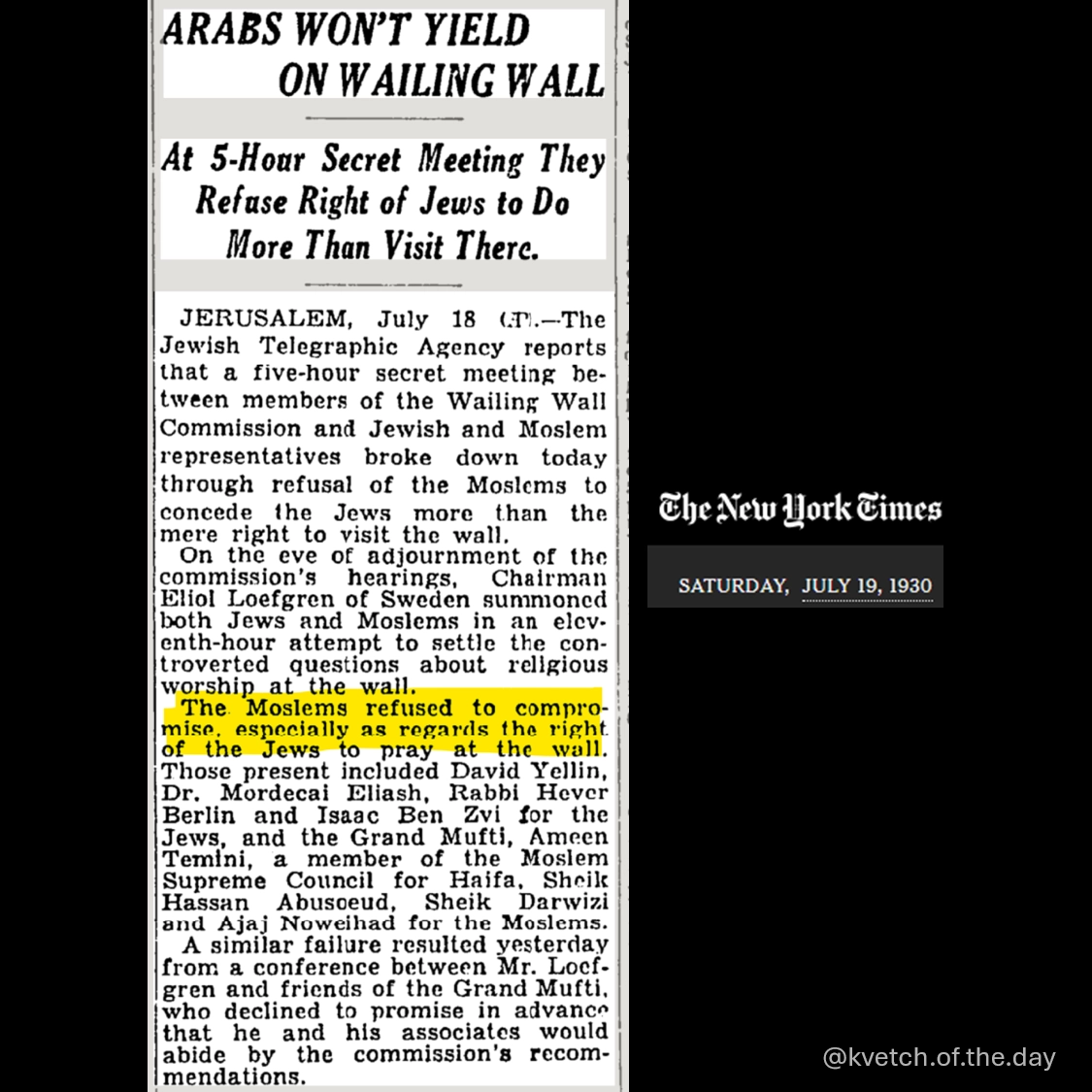
Tensions over the Western Wall, fuelled by rumours that Jews planned to seize al-Aqsa, erupt into riots. In Hebron 67 Jews are killed and in Safed about 18, while Arab families shelter hundreds of others. British forces kill many rioters.
- As Israelis are usually taught
- Proof that the violence predates the occupation and even the state.
- As the pro-Palestinian story tells it
- Rarely mentioned; when it is, it's framed as a reaction to Zionist provocations at the Wall.
- 1936–1939
Arab Revolt
Palestinian story: central
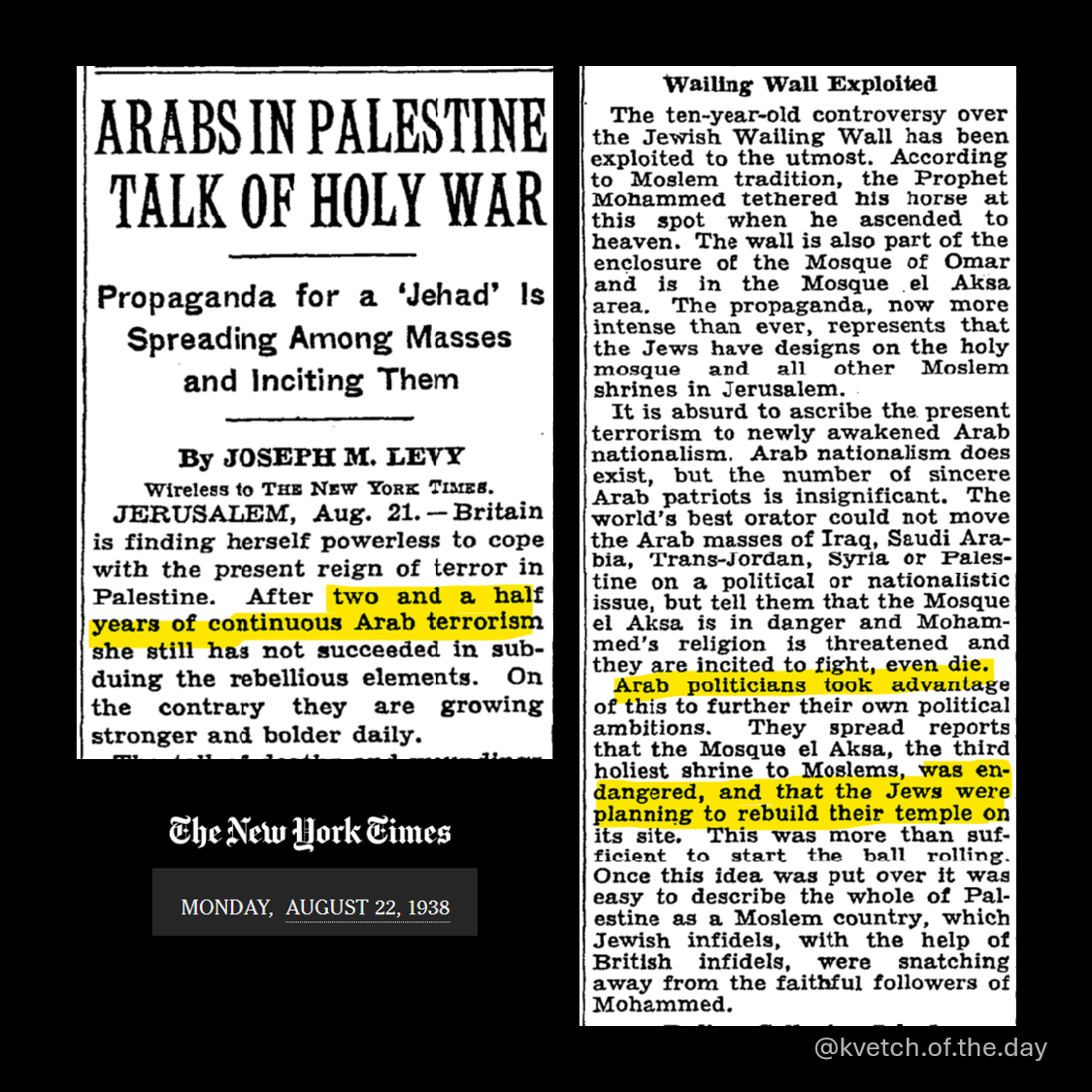
A general strike and armed uprising against British rule and Jewish immigration, led in part by the Mufti's faction. The British suppress it harshly, and internal Arab violence kills many rival Palestinians.
- As Israelis are usually taught
- Arab terror, led by the Mufti.
- As the pro-Palestinian story tells it
- The great revolt against British colonialism.
- 1937
Peel Commission proposes partition
Israeli story: central
A British commission proposes the first partition plan, with population transfer. The Zionist leadership accepts it in principle with reservations; the Arab Higher Committee rejects it.
- As Israelis are usually taught
- The first of many compromises the Arabs rejected.
- As the pro-Palestinian story tells it
- Usually skipped; its transfer clause is cited as proof that expulsion was always the plan.
- 1938-10-02
The Tiberias massacre ⚠
Israeli story: central
During the Arab Revolt, Arab fighters attack the Jewish quarter of Tiberias and kill 19 Jews, 11 of them children.
- 1939
The White Paper
Israeli story: central
Britain caps Jewish immigration at 75,000 over five years and promises an Arab-majority state — as the Holocaust begins. Illegal immigration (Aliyah Bet) grows.
- 1938-12
The Bund at its peak ⚠
In Warsaw's municipal elections, the Bund wins 17 of the 20 city-council seats that go to Jewish parties, and it does well in Łódź and elsewhere. On the eve of the war, 'hereness' is the choice of most Jewish voters in Poland's largest cities.
- 1939–1945
The Holocaust
Israeli story: central
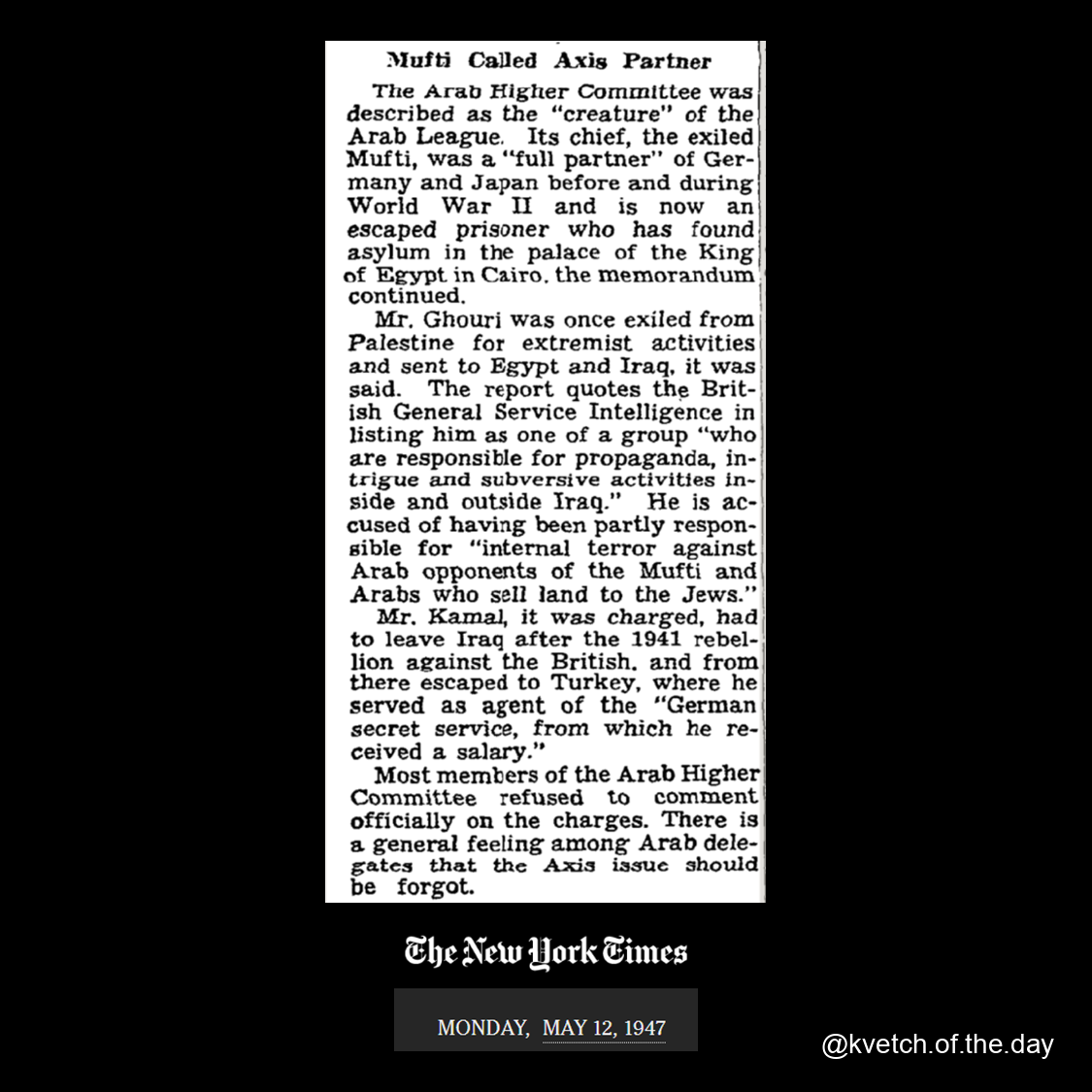
Nazi Germany and its collaborators murder six million Jews. The Mufti of Jerusalem, Haj Amin al-Husseini, spends the war in Berlin, broadcasting Nazi propaganda and lobbying against Jewish emigration to Palestine. After the war, a quarter of a million Jewish survivors are in displaced-persons camps.
- As Israelis are usually taught
- The proof that Jews need a state of their own.
- As the pro-Palestinian story tells it
- 'Why should Palestinians pay for Europe's crime?' The Mufti's role is usually left out.
- 1943
The Warsaw Ghetto Uprising; Zygielbojm's protest ⚠
Israeli story: central
In April 1943 Jewish fighters in the Warsaw Ghetto rise against the Nazis; Bundists fight alongside Zionist youth groups, and the Bundist Marek Edelman is one of the commanders. On 12 May, the Bund's representative in London, Szmul Zygielbojm, takes his own life in protest at the world's indifference to the murder of Poland's Jews. The Bund's world is destroyed; Edelman stays in Poland and remains a non-Zionist until his death in 2009.
- 1941-06
The Farhud in Baghdad ⚠
Israeli story: central
After a pro-Axis coup, a pogrom in Baghdad kills on the order of 180 Jews. The Mufti, in Iraq at the time, had backed the coup; later that year he meets Hitler in Berlin.
- As Israelis are usually taught
- Arab-world antisemitism was not caused by Israel.
- As the pro-Palestinian story tells it
- Largely absent; the story is one of Jews living peacefully in Arab lands until Zionism.
- 1944–1947
The Jewish underground revolt: Irgun and Lehi
Palestinian story: central
The Irgun and Lehi attack British targets; Lehi assassinates Lord Moyne (1944). On 22 July 1946 the Irgun bombs the King David Hotel in Jerusalem, the British administrative headquarters, killing 91 people — British, Arab and Jewish. The mainstream Haganah condemns parts of the campaign. Britain deports Jewish refugees to camps on Cyprus.
- As Israelis are usually taught
- Part of the fight for independence. The King David bombing is contested (a warning call was made) and memorialised by the Irgun's heirs in Likud.
- As the pro-Palestinian story tells it
- Proof that Israel was founded by terrorists — and that the West calls it terror only when Palestinians do it.
Israel was a British colonial project — the Empire planted the Jews in Palestine.Israel is a settler-colonial state.◆ "What about you?"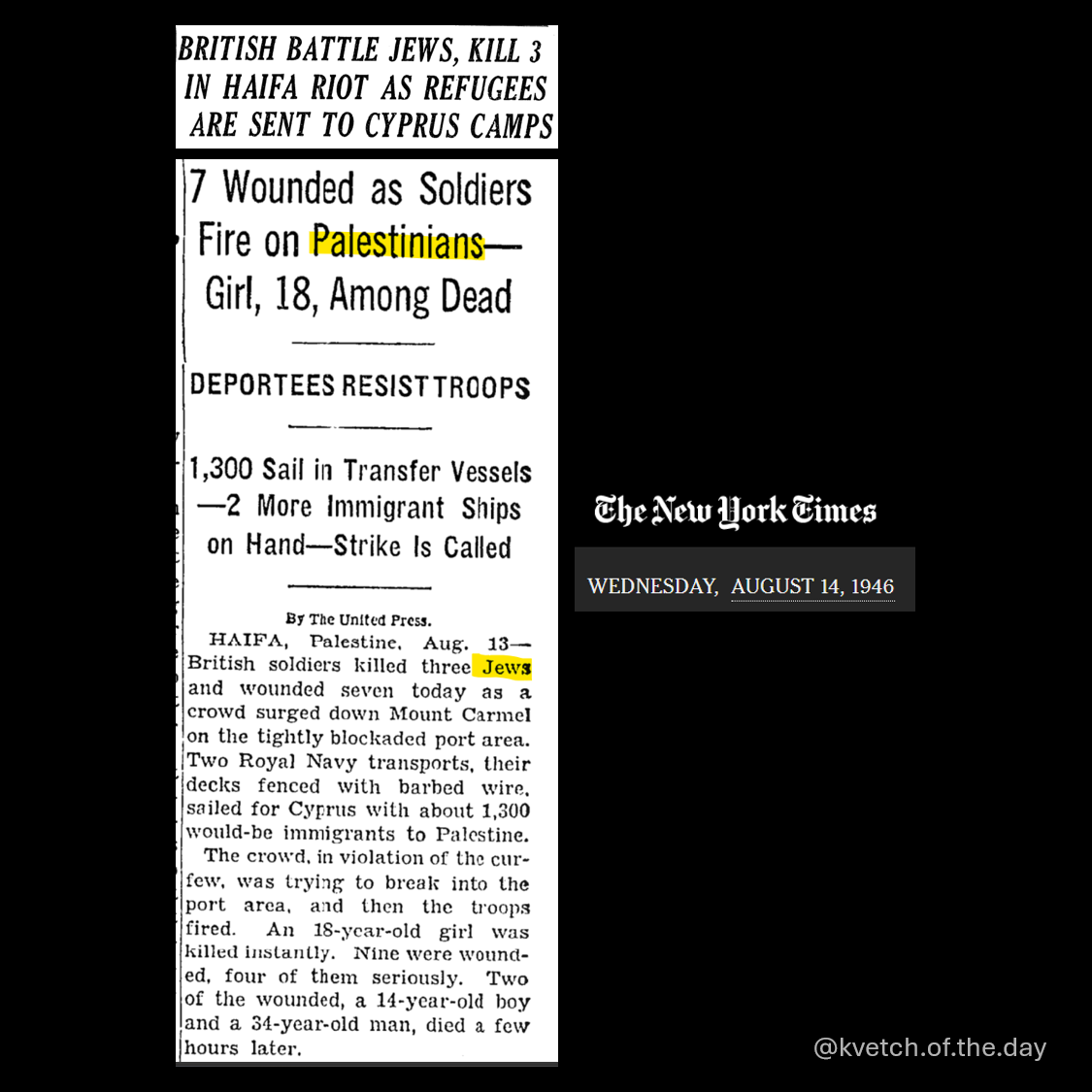 1946-08-14 · The New York Times · ✓British Battle Jews, Kill 3 in Haifa Riot as Refugees are sent to Cyprus Camps
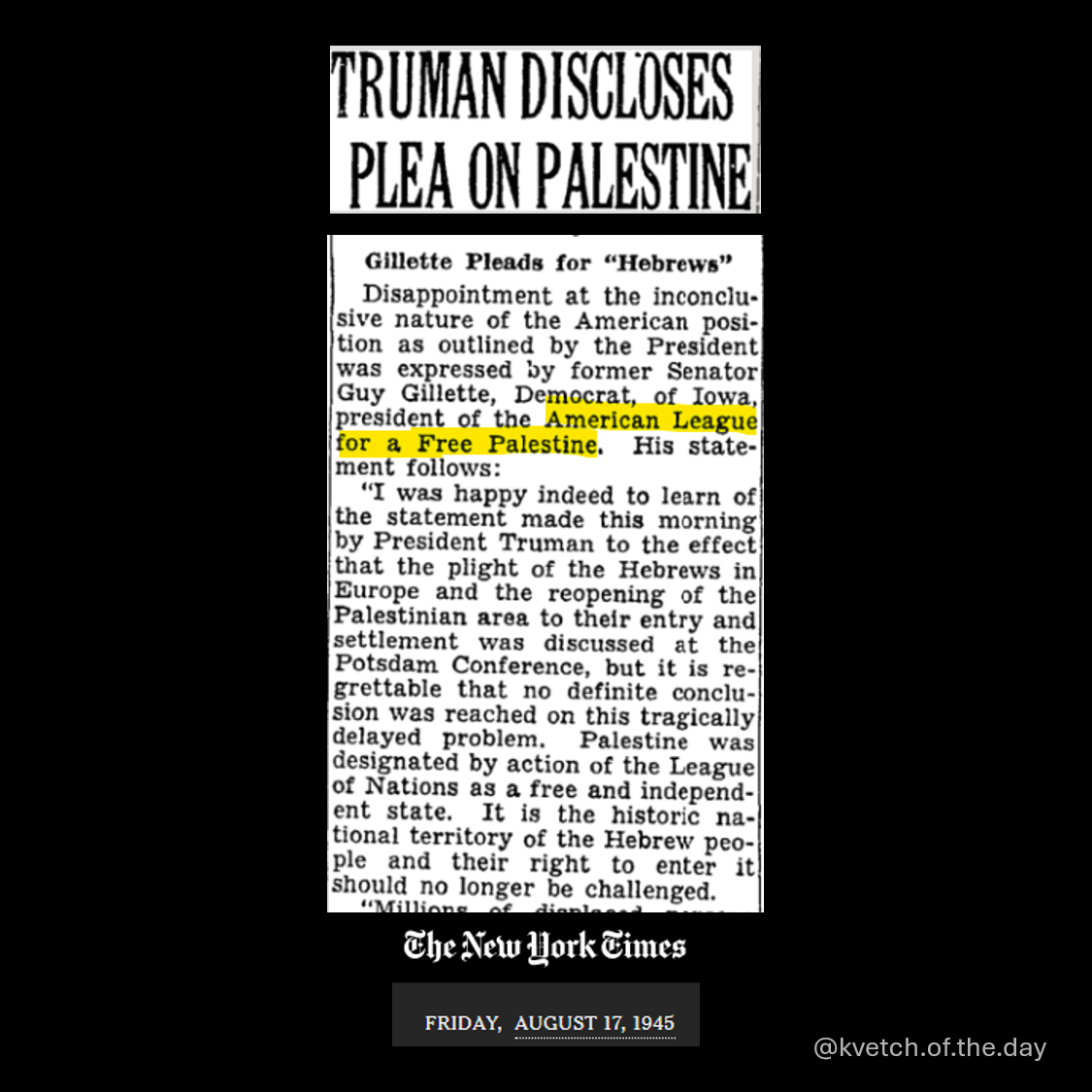 1945-08-17 · The New York Times · ✓Truman Discloses Plea on Palestine
Further reading: Wikipedia: King David Hotel bombing reference
- 1945–1947
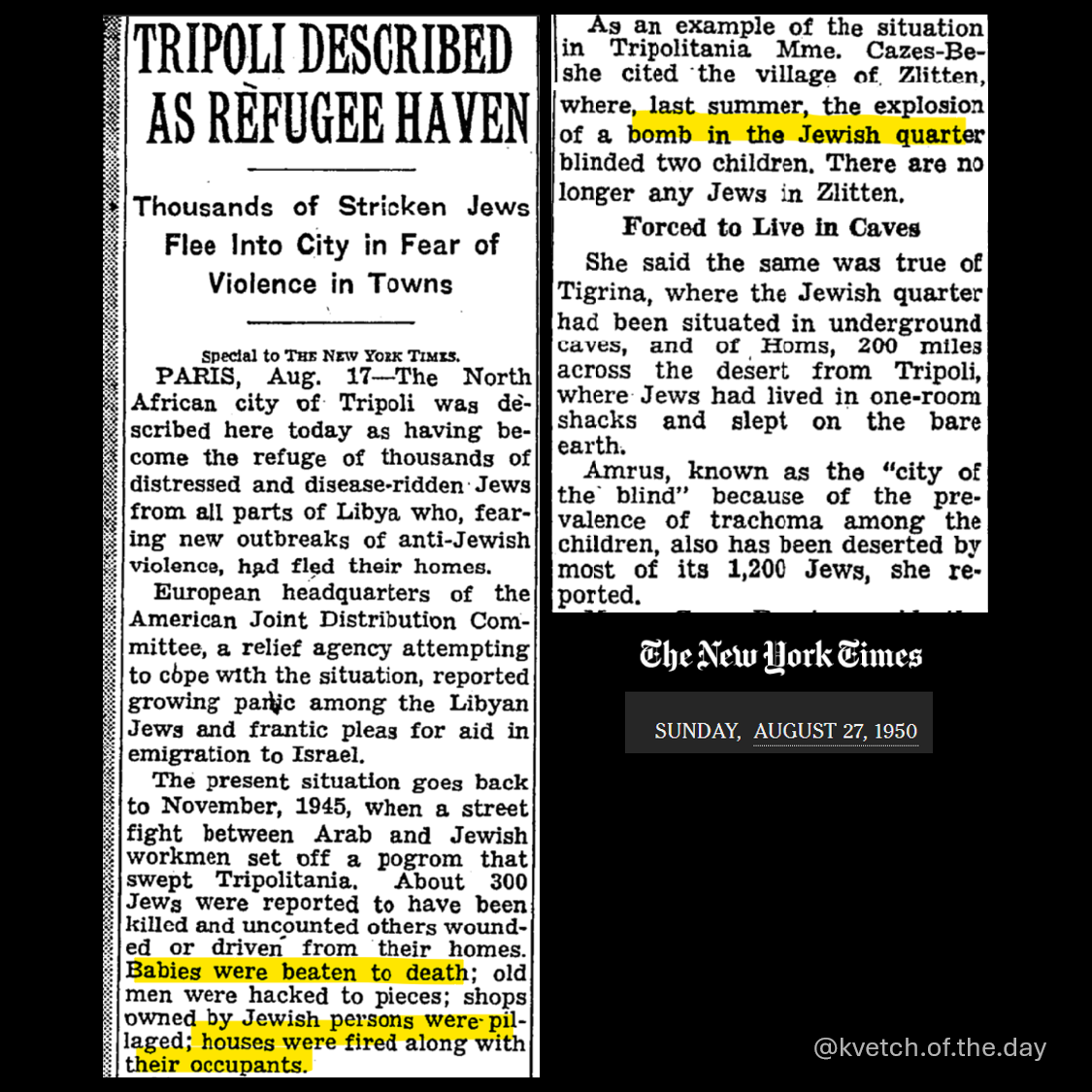
Pogroms after the war: Tripoli, Kielce, Aden, Aleppo ⚠
Israeli story: central
In Tripoli (Libya), November 1945, rioters kill around 130 Jews. In Kielce (Poland), July 1946, 42 Holocaust survivors are murdered, and tens of thousands of Polish Jews flee west. After the UN partition vote in December 1947, riots in Aden kill 82 Jews, and in Aleppo synagogues and homes are burned and much of the ancient community flees.
1948
- 1947-11-29
UN partition plan (Resolution 181)
Israeli story: centralPalestinian story: central
The General Assembly recommends a Jewish state, an Arab state and an international Jerusalem. The Jewish Agency accepts; the Arab Higher Committee and Arab states reject it. Civil war breaks out the next day.
- As Israelis are usually taught
- The Jews said yes; the Arabs said no, and went to war.
- As the pro-Palestinian story tells it
- The UN gave 56% of the land to a third of the population.
- Dec 1947 – Mar 1948
Civil war: bombs on both sides ⚠
Israeli story: centralPalestinian story: central
After the partition vote the land slides into civil war, with attacks on civilians from both sides. The Irgun throws bombs into a crowd of Arab workers at the Haifa oil refinery (30 December 1947), and Arab workers then kill 39 Jewish colleagues inside. Lehi bombs the Jaffa Serail (January 1948), and the Haganah blows up the Semiramis Hotel in Jerusalem, killing some two dozen civilians. Arab forces bomb the Palestine Post and Ben Yehuda Street in Jerusalem (February 1948, about 50 killed) and besiege Jewish Jerusalem.
- As Israelis are usually taught
- A war of survival forced on the Jewish community, with Jerusalem under siege; Irgun and Lehi actions are often treated as the work of 'dissidents'.
- As the pro-Palestinian story tells it
- The start of the Nakba: Zionist militias, including the Irgun and Lehi, terrorise Arab towns and villages.
- 1948-03-10
Plan Dalet
Palestinian story: central
The Haganah adopts Plan D: securing the territory of the planned Jewish state and its borders ahead of the expected Arab invasion, including orders to occupy, and where villages resist, destroy them and expel their populations. Historians disagree on whether it was a master plan for expulsion or a military plan that allowed it.
- As Israelis are usually taught
- A defensive military plan against invading armies.
- As the pro-Palestinian story tells it
- The blueprint for ethnic cleansing.
- 1948-04-09
Deir Yassin ⚠
Palestinian story: central
Irgun and Lehi fighters attack the Arab village of Deir Yassin near Jerusalem, killing around 100–110 villagers, many of them civilians; early reports said 254. The Jewish Agency and Haganah condemn it. News of the massacre spreads fear and speeds up Arab flight elsewhere.
- As Israelis are usually taught
- Acknowledged in school as a stain, blamed on the dissident Irgun and Lehi rather than the Haganah; the death toll and the 'massacre' framing are debated.
- As the pro-Palestinian story tells it
- The emblem of the Nakba: deliberate terror to drive Palestinians out.
The Palestinians left voluntarily in 1948 — their own leaders told them to go.The Nakba was a pre-planned ethnic cleansing — Plan Dalet was the blueprint.Further reading: Nice Jewish Girl in NYC: 'Let's talk about Deir Yassin' pro-Israel
- 1948-04-13
Hadassah convoy massacre ⚠
Israeli story: central
Arab forces attack a medical convoy to Hadassah Hospital on Mount Scopus, killing around 78 Jews, mostly doctors, nurses and patients.
- As Israelis are usually taught
- Remembered as the answer to 'what about Deir Yassin?'
- As the pro-Palestinian story tells it
- Almost never mentioned.
- 1948-04-22
The fall of Haifa
Israeli story: central
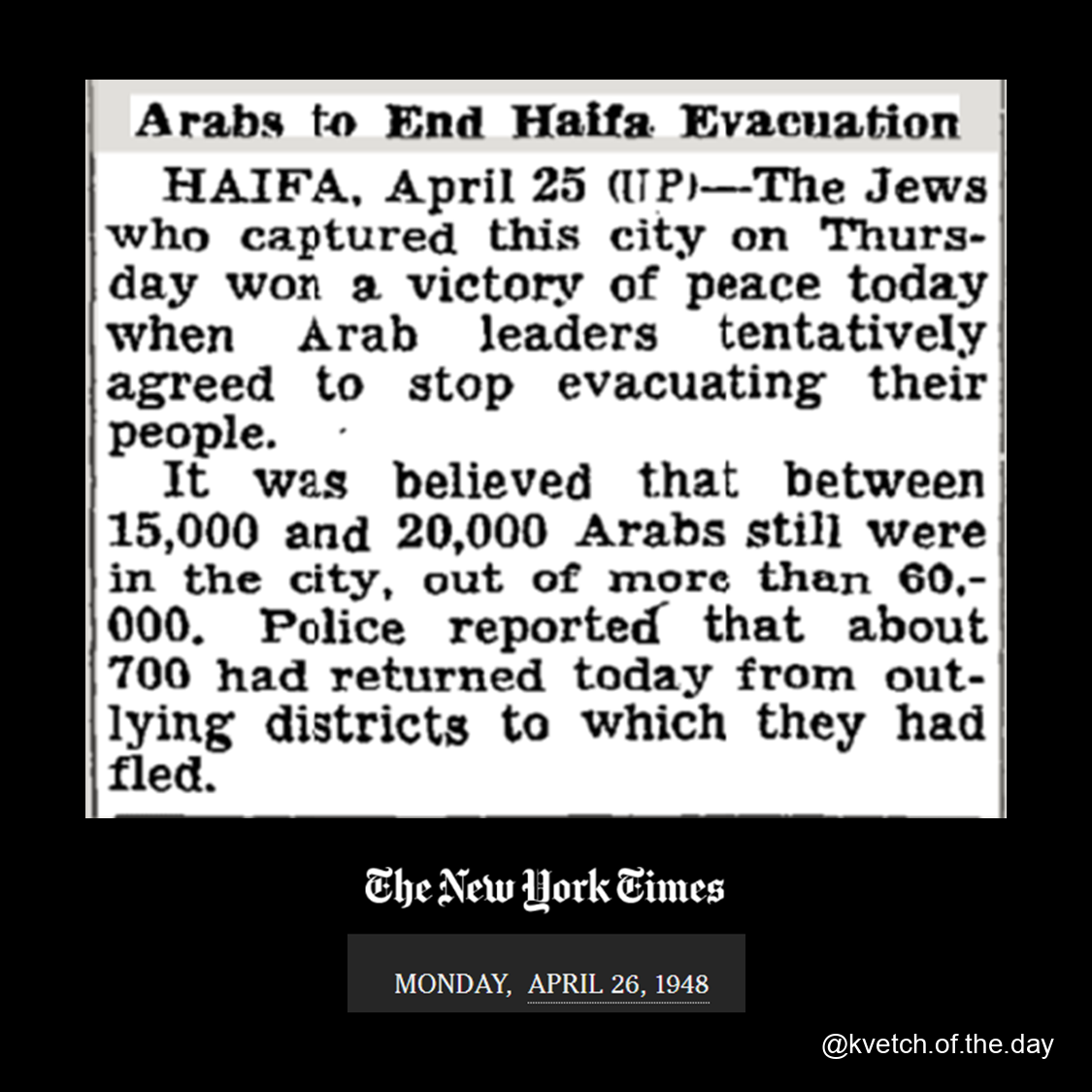
The Haganah takes Haifa. Most of the city's Arabs leave, with their leadership organising the evacuation while some Jewish leaders urge them to stay.
- As Israelis are usually taught
- Proof that Arabs left on their own leaders' orders.
- As the pro-Palestinian story tells it
- The flight followed a military assault and shelling; urging people to stay didn't make it voluntary.
- Apr – May 1948
Jaffa, Tiberias, Safed: the Arab towns empty ⚠
Palestinian story: central
Arab Tiberias falls (18 April), and its Arab population leaves under British escort. The Irgun assaults Jaffa (late April), and most of its roughly 70,000 Arabs flee by sea and land before the city surrenders on 13 May. Safed falls on 10–11 May, and its Arab majority flees. By the time the state is declared, the largest Arab towns in the Jewish state's territory are mostly empty.
- 1948-05-13
Kfar Etzion massacre ⚠
Israeli story: central
After the Etzion bloc surrenders, around 127 Jewish defenders and residents are killed by Arab forces and irregulars.
- 1948-05-14
Israel declares independence; Arab states invade
Israeli story: centralPalestinian story: central
Israel declares independence as the Mandate ends. The next day Egypt, Transjordan, Syria, Iraq and Lebanon send armies into Palestine.
- As Israelis are usually taught
- Independence Day: a new state survives an invasion by five armies.
- As the pro-Palestinian story tells it
- Nakba Day (15 May): the day the catastrophe is remembered.
- 1948
Moscow backs the Jewish state ⚠
Israeli story: central
The Soviet Union votes for partition (1947), recognises Israel de jure on 17 May 1948 (the first state to do so), and through Czechoslovakia supplies the rifles, machine guns and fighter planes that are crucial to Israel in the 1948 war. Soviet support was aimed at pushing Britain out of the Middle East.
- 1948-05-22
Tantura ⚠
Palestinian story: central
After the Alexandroni Brigade takes the coastal village of Tantura, villagers are killed; the numbers and circumstances are fiercely disputed. A 1998 master's thesis alleging a massacre led to a libel case and a retraction by its author, and later testimony by veterans (2022 documentary 'Tantura') revived the claims.
- 1948-06
The Altalena affair ⚠
Israeli story: central
Ben-Gurion orders the new army to fire on the Altalena, an Irgun arms ship, off Tel Aviv; 16 Irgun fighters and 3 soldiers are killed. The Irgun is folded into the IDF: one state, one army. The rift between Ben-Gurion's camp and Begin's lasts decades.
- 1948-07-12
Lydda and Ramle ⚠
Palestinian story: central
Israeli forces take the towns of Lydda and Ramle. After fighting in Lydda, in which many Arab residents are killed (including in and around a mosque), some 50,000–70,000 inhabitants are expelled on orders issued in Yitzhak Rabin's name and march east in the summer heat; some die on the way. It is the largest single expulsion of the war.
- As Israelis are usually taught
- Long left out of school histories; Rabin's own account of the expulsion was censored from his 1979 memoirs.
- As the pro-Palestinian story tells it
- The death march, a core memory of the Nakba.
- 1948-09-17
Lehi assassinates the UN mediator ⚠
Lehi gunmen assassinate Count Folke Bernadotte, the UN mediator, in Jerusalem. His plan had proposed the return of refugees. Israel outlaws Lehi, but no one is ever tried for the killing.
- Oct – Nov 1948
Al-Dawayima and the massacres of the war's last months ⚠
Palestinian story: central
In the final offensives, Israeli soldiers kill civilians in several villages: at al-Dawayima near Hebron (29 October) estimates range from dozens to several hundred, and in Operation Hiram in the Galilee there are killings in villages such as Safsaf, Saliha and Eilaboun. Some were investigated at the time, and few were punished.
- 1948–1949
The Nakba
Israeli story: centralPalestinian story: central
Around 700,000 Palestinian Arabs flee or are expelled from what becomes Israel — through fear, fighting, the collapse of their leadership, and in many places direct expulsion (Lydda and Ramle, July 1948). Hundreds of villages are emptied, and Israel bars return.
- As Israelis are usually taught
- The War of Independence: a war of survival against invading armies. For decades the flight was taught as mostly voluntary or on Arab orders; Israel's 'new historians' of the 1980s challenged this, and the word 'Nakba' remains contested in Israeli schools.
- As the pro-Palestinian story tells it
- The Nakba — deliberate ethnic cleansing and the defining catastrophe. The civil war the Arab side started and the invasion are often left out.
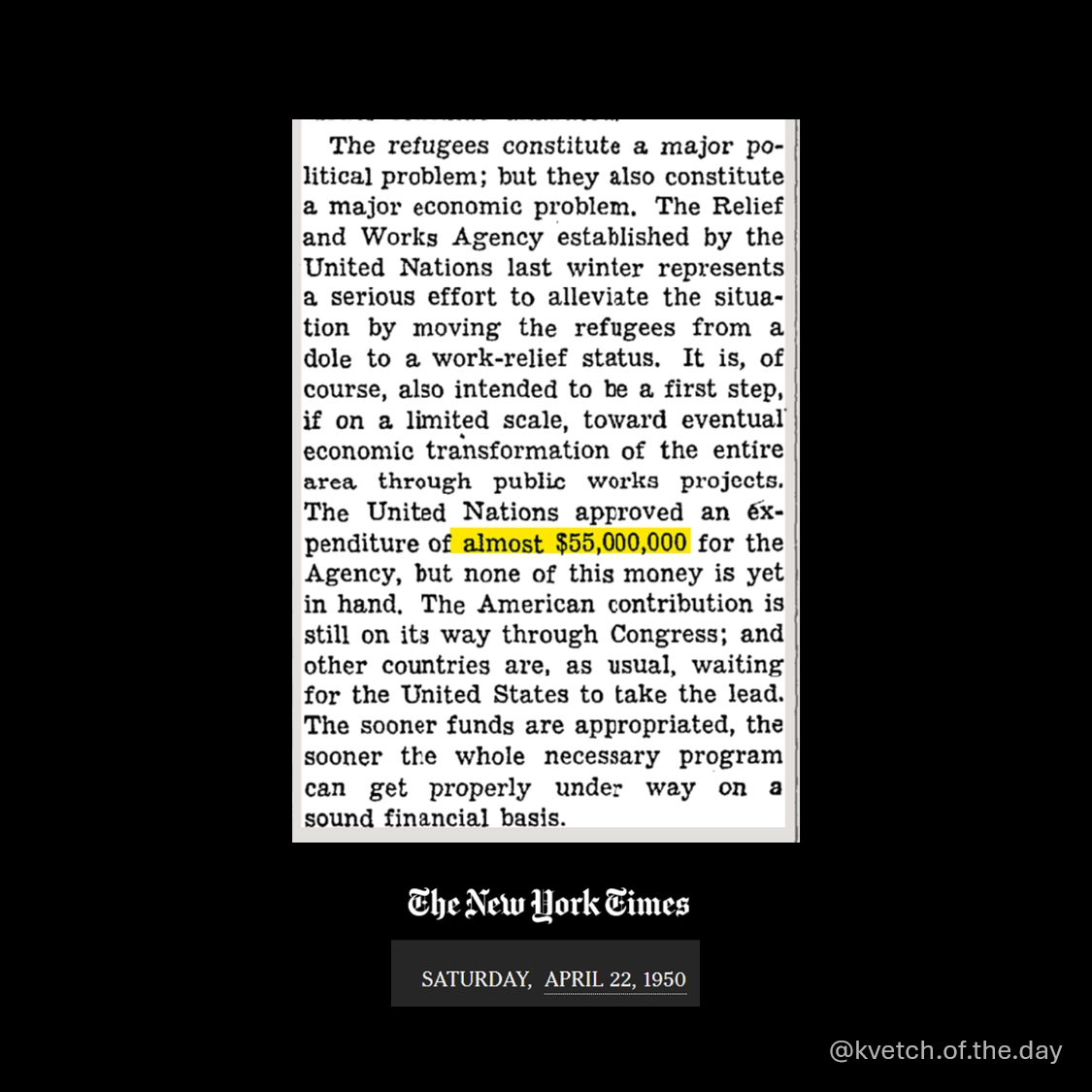
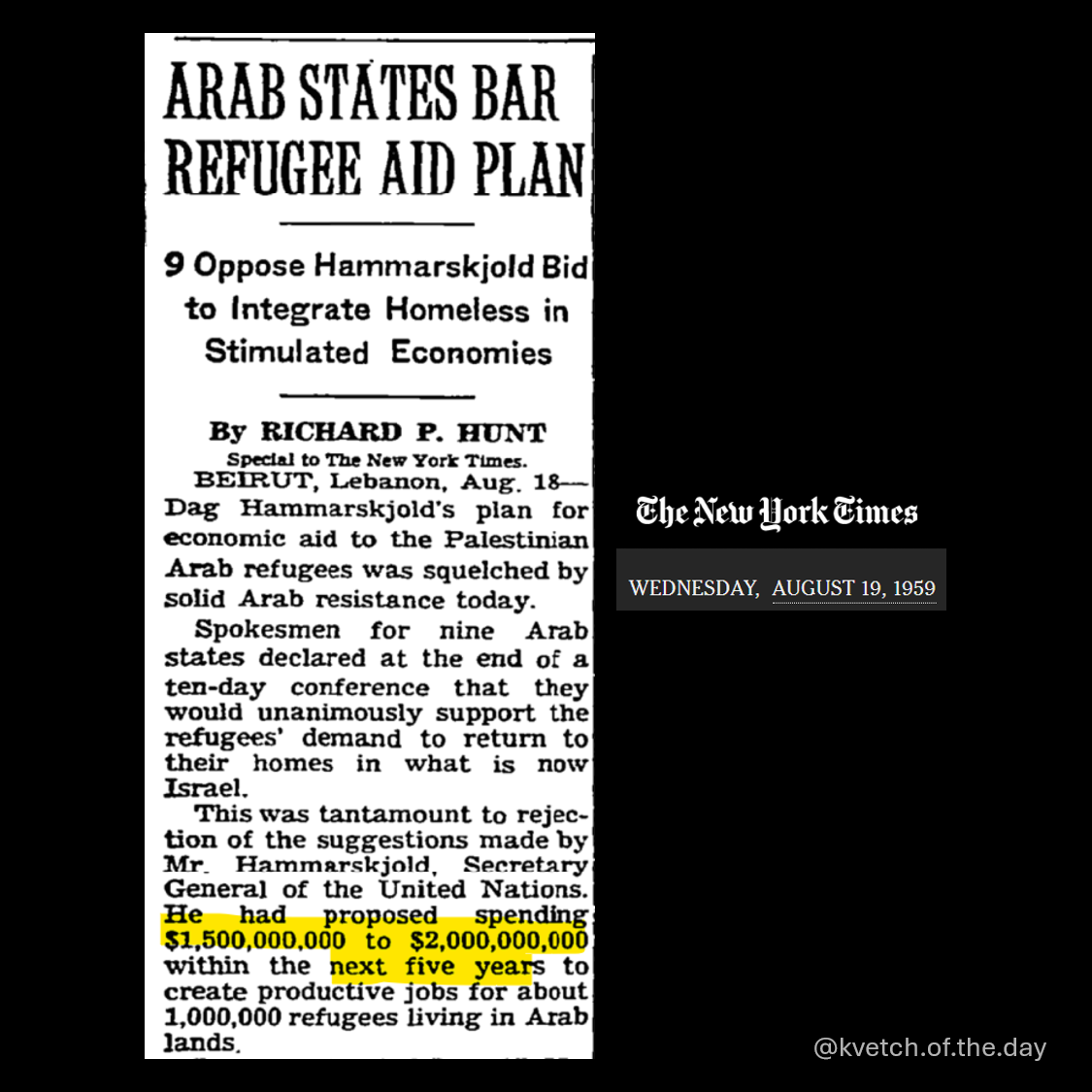
The Palestinians left voluntarily in 1948 — their own leaders told them to go.The Nakba was a pre-planned ethnic cleansing — Plan Dalet was the blueprint.UNRWA keeps millions of Palestinians as refugees forever — a problem kept alive on purpose.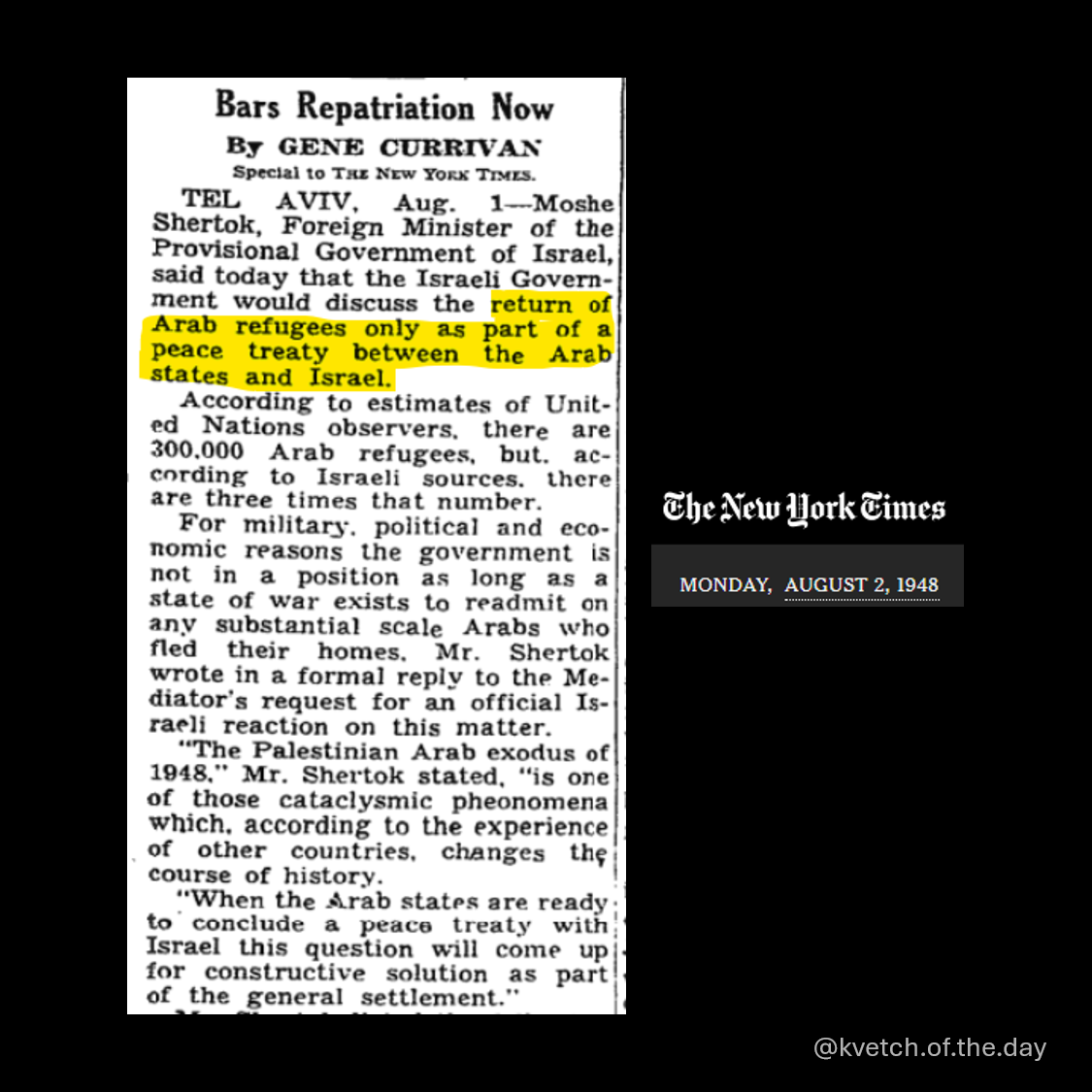 1948-08-02 · The New York Times · ✓Bars Repatriation Now
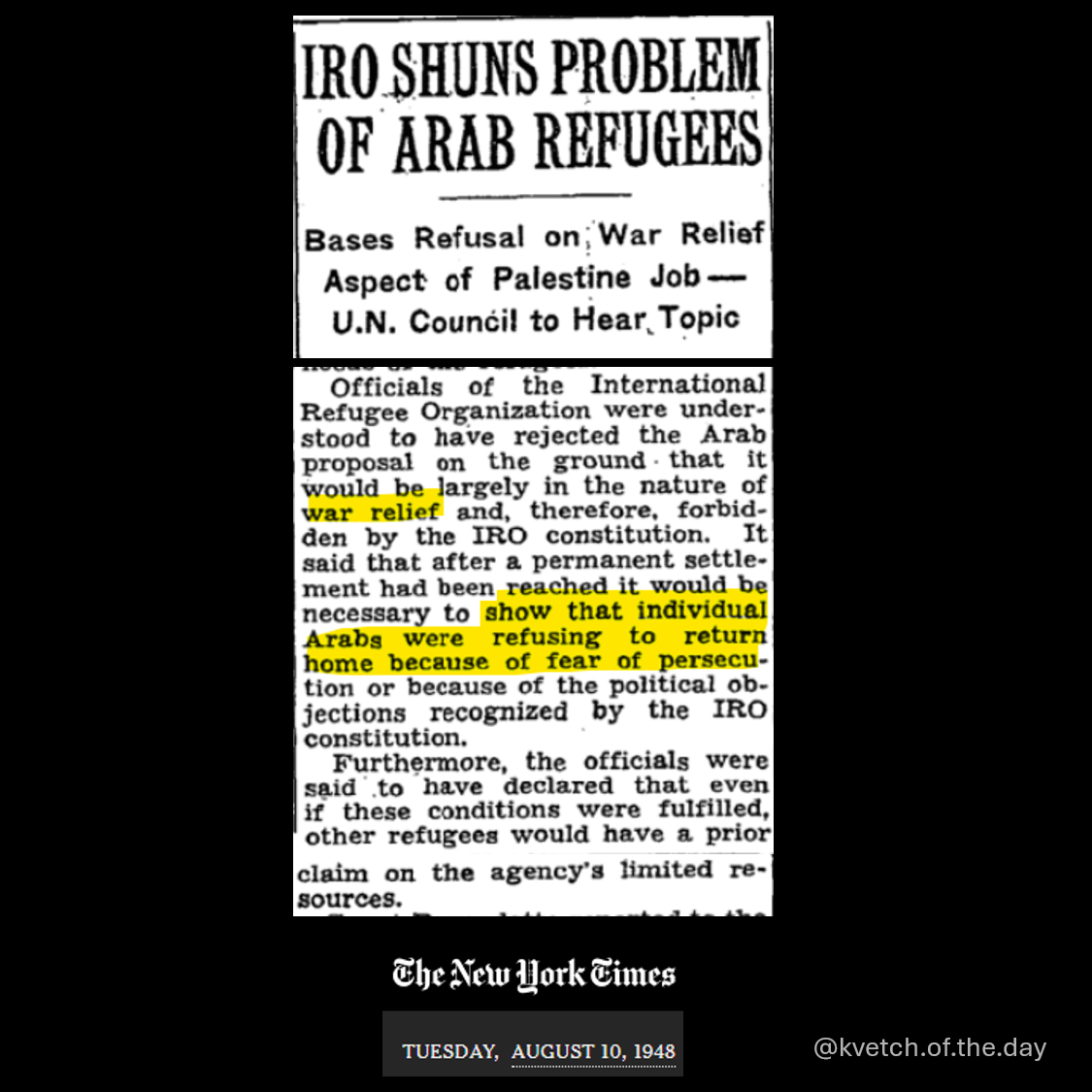 1948-08-10 · The New York Times · ✓IRO Shuns Problem of Arab Refugees
Further reading: Nice Jewish Girl in NYC: 'About the Nakba' pro-Israel · Nice Jewish Girl in NYC: 'How did Jewish refugees end up in Palestinian homes' pro-Israel · Palquest (Institute for Palestine Studies): encyclopedia of the Palestine question pro-Palestinian
- 1948–1970s
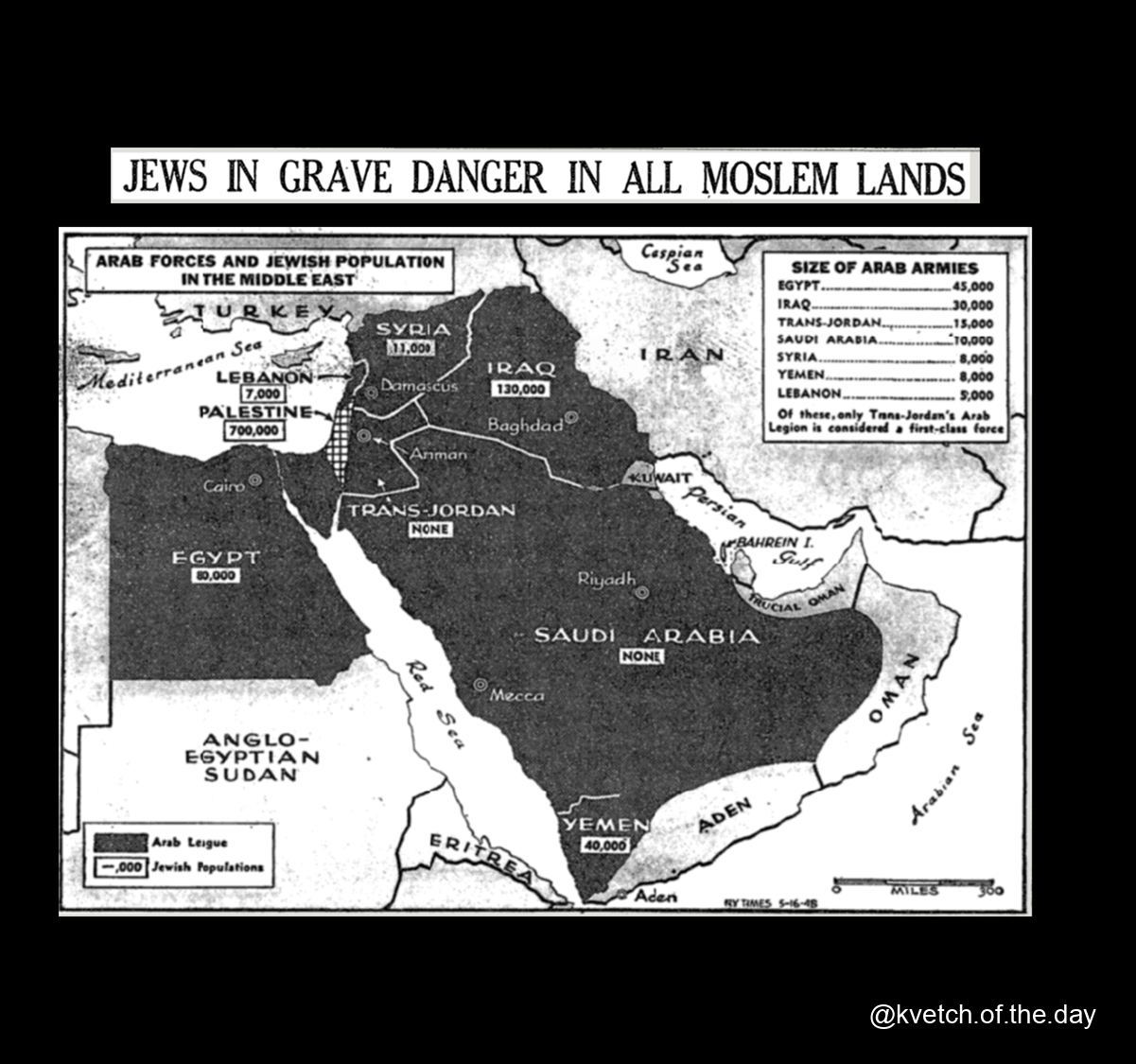
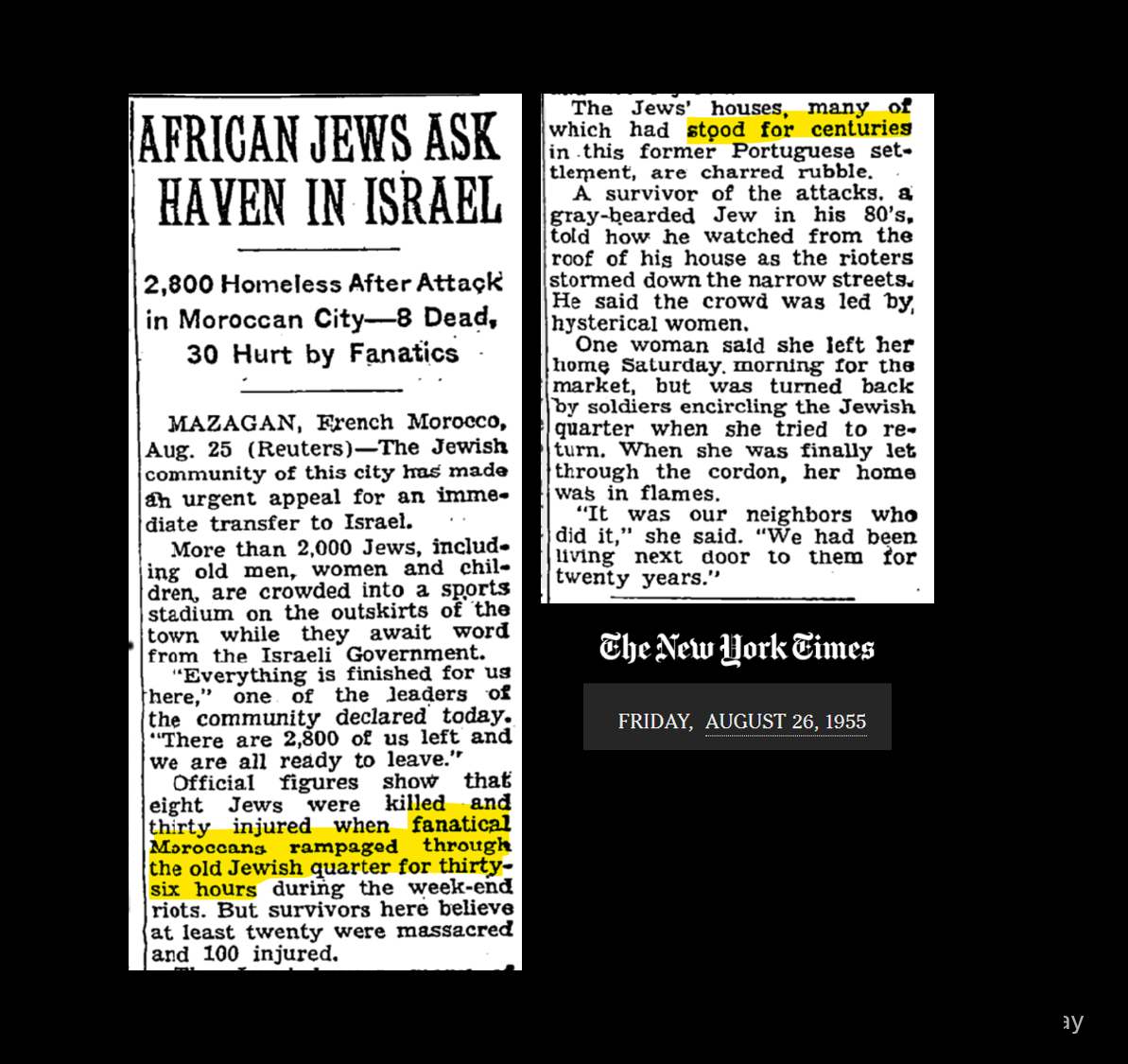
Exodus of Jews from Arab countries
Israeli story: central
Around 850,000 Jews leave or are driven out of Arab countries, through pogroms, legal persecution, denationalisation and expulsion; most go to Israel.
- As Israelis are usually taught
- The forgotten refugees — a population exchange, in effect.
- As the pro-Palestinian story tells it
- Largely absent, or framed as Zionist-engineered emigration.
- 1949
Armistice lines (the 'Green Line')
Armistice agreements end the war. Jordan holds the West Bank and East Jerusalem, and Egypt holds Gaza; no Palestinian state is created. UNRWA is set up in December.
- As Israelis are usually taught
- Jordan and Egypt could have created a Palestinian state and didn't.
- As the pro-Palestinian story tells it
- The line that became the basis of the '1967 borders'.
1949–1967
- 1948–1966
Military rule, absentee property, Iqrit and Kafr Bir'im ⚠
Palestinian story: central
The Arabs who stay in Israel become citizens but live under military rule until 1966, with permits to travel and work. The Absentees' Property Law (1950) transfers refugees' land, and that of 'present absentees' who never left the country, to the state. The Christian villages of Iqrit and Kafr Bir'im are evacuated in 1948 with a promise of return; the Supreme Court rules for the villagers in 1951, but the army demolishes the villages and they have never been allowed back.
- As Israelis are usually taught
- Security measures in a state surrounded by enemies; Arab citizens got the vote from the start.
- As the pro-Palestinian story tells it
- The Nakba continued inside Israel: land taken by law, and a people governed by permits.
- 1950
Iran recognises Israel de facto ⚠
Under the Shah, Iran becomes the second Muslim-majority country (after Turkey) to recognise Israel de facto. For three decades the two are quiet partners: oil, trade, security cooperation, and Israel's 'periphery doctrine' of alliances with non-Arab neighbours. Iran's Jewish community, one of the oldest in the world, numbers around 80,000–100,000.
- 1948–1953
Stalin turns on the Jews: 'rootless cosmopolitans' ⚠
Israeli story: central
Stalin's campaign against 'rootless cosmopolitans' purges Jews from Soviet cultural life. On 12 August 1952 thirteen Yiddish writers and other members of the Jewish Anti-Fascist Committee are executed ('the Night of the Murdered Poets'). In Czechoslovakia the Slánský trial (1952) convicts mostly Jewish Communist leaders as 'Zionist' conspirators, and in January 1953 the 'Doctors' Plot' accuses Jewish doctors of plotting to kill Soviet leaders. 'Zionist' becomes a code word for Jew.
- 1953-10
Qibya ⚠
Palestinian story: central
After a grenade attack killed an Israeli mother and two children, Israel's Unit 101 under Ariel Sharon raids the Jordanian-held village of Qibya. Around 69 villagers are killed, most in their demolished homes, and Israel is condemned internationally.
- 1955
The Czech arms deal with Egypt ⚠
The Soviet bloc, through Czechoslovakia, sells Egypt large quantities of modern weapons. Moscow switches sides: from now on it arms and backs the Arab states against Israel.
- 1956-10-29
Kafr Qasim massacre and the Suez war ⚠
Palestinian story: central
On the eve of the Suez war, Israeli Border Police kill 48 Arab citizens of Israel returning home unaware of a curfew; officers are later convicted. Israel, Britain and France attack Egypt, and Israel withdraws from Sinai in 1957.
- As Israelis are usually taught
- Taught as the origin of the 'blatantly illegal order' doctrine: soldiers must refuse such orders.
- As the pro-Palestinian story tells it
- A massacre of citizens under military rule, whose perpetrators were soon pardoned.
- 1964
The PLO is founded
Israeli story: central
The Palestine Liberation Organization is established. Its Charter (1964, revised 1968) defines Palestine as the whole Mandate territory and Palestinians as Arab nationals.
- As Israelis are usually taught
- Founded to destroy Israel three years before there was any occupation.
- As the pro-Palestinian story tells it
- The birth of the national movement.
1967–1993
- 1967-06
Six-Day War; the occupation begins
Israeli story: centralPalestinian story: central
After Egypt closes the Straits of Tiran and masses troops, Israel strikes first and takes Sinai, Gaza, the West Bank, East Jerusalem and the Golan. Its occupation of the West Bank and Gaza begins. In September the Arab League's Khartoum summit answers with 'no peace, no recognition, no negotiation'. For religious Zionists, the capture of Jerusalem's Old City and the biblical heartland was read as a step in redemption; the settler movement Gush Emunim (1974) grew from that messianic reading.
- As Israelis are usually taught
- A war of survival and the reunification of Jerusalem; the territories as a bargaining chip, and then, for some, a homeland regained.
- As the pro-Palestinian story tells it
- The Naksa ('setback'): the start of the occupation, and for many the start of the story.
◆ Which territory?Israel is a settler-colonial state.Israel's real goal is 'Greater Israel' — from the Nile to the Euphrates.Further reading: Nice Jewish Girl in NYC: 'Israeli occupation, 1967–1987' pro-Israel
- 1967-06
The Temple Mount Status Quo ⚠
Israeli story: centralPalestinian story: central
Days after Israeli paratroopers reach the Western Wall, Defence Minister Moshe Dayan hands day-to-day control of the Temple Mount compound back to the Jordanian-run Islamic Waqf. Jews may visit but not pray there, and Jewish prayer moves to the Western Wall below. The Chief Rabbinate rules that Jews should not enter the Mount at all, for reasons of ritual purity. This 'Status Quo' is what every later crisis is about.
- As Israelis are usually taught
- A remarkable act of restraint: the holiest site in Judaism left in Muslim hands.
- As the pro-Palestinian story tells it
- The occupier's arrangement, which it has been chipping away at ever since.
- —
'Which al-Aqsa?': the compound, the mosque, the Mount
In Muslim usage 'al-Aqsa' means the whole walled compound (the Haram al-Sharif, about 14 hectares, including the Dome of the Rock and its courtyards). In Western usage it often means only the silver-domed mosque at the south end. For Jews the same platform is the Temple Mount (Har HaBayit), the holiest site in Judaism. So 'Israelis stormed al-Aqsa' can mean police entering a mosque building or Jewish visitors walking on the compound, and 'Jews on the Temple Mount' can mean either a visit or an attempt to pray. Each side's headlines use the word that makes the other side the aggressor.
- 1967–1970s
Soviet 'anti-Zionism': Zionism as Nazism ⚠
Israeli story: central
After the Six-Day War the Soviet bloc breaks relations with Israel and launches a massive propaganda campaign: books such as Yuri Ivanov's 'Beware: Zionism!' (1969) and cartoons portraying Israelis as Nazis, alleging Zionist–Nazi collaboration and a worldwide Zionist conspiracy. Much of today's 'Zionism is Nazism' and 'Zionism is racism' vocabulary was developed here and spread through the Soviet bloc, Arab state media and the Western far left.
- 1970s–1980s
Refuseniks and the fight to emigrate ⚠
Israeli story: central
Soviet Jews who apply to emigrate to Israel are refused, fired from their jobs and sometimes imprisoned (Natan Sharansky, 1977–1986). The 1970 'Dymshits–Kuznetsov' attempt to hijack a plane out of Leningrad draws the world's attention; the US Jackson–Vanik amendment (1974) ties trade to the right to emigrate.
- 1975-11-10
UN: 'Zionism is a form of racism'
Israeli story: centralPalestinian story: central
The UN General Assembly adopts Resolution 3379, backed by the Soviet bloc and Arab and many non-aligned states, determining that 'Zionism is a form of racism and racial discrimination'. It is revoked in 1991 (Resolution 46/86), after the end of the Cold War.
- As Israelis are usually taught
- A Soviet-Arab propaganda victory at the UN, later revoked.
- As the pro-Palestinian story tells it
- International recognition that Zionism is a colonial, discriminatory project.
- 1970-09
Black September in Jordan
Jordan's army crushes PLO forces that were trying to topple King Hussein. Thousands are killed, and the PLO moves to Lebanon.
- 1969-08-21
The al-Aqsa arson ⚠
Palestinian story: central
Denis Michael Rohan, an Australian Christian extremist, sets fire to the al-Aqsa mosque, destroying Saladin's historic pulpit. Israel arrests and tries him (he is found insane), but across the Muslim world the fire is blamed on Israel and 'the Jews'. In direct response, Muslim states found the Organisation of the Islamic Conference in Rabat a month later.
- 1972-09-05
Munich Olympics massacre
Israeli story: central
Black September militants take the Israeli Olympic team hostage; 11 Israeli athletes and coaches are killed.
- 1973-10
Yom Kippur War
Israeli story: central
Egypt and Syria attack on Yom Kippur. After early losses, Israel pushes back. The war leads, through Egyptian–Israeli talks, to the 1979 peace treaty that returns Sinai.
Further reading: Nice Jewish Girl in NYC: 'The war that almost broke Israel' pro-Israel
- 1979
Iran's Islamic Revolution; Quds Day ⚠
Ayatollah Khomeini's revolution turns Iran from Israel's partner into its most determined enemy. Khomeini declares the last Friday of Ramadan 'Quds (Jerusalem) Day'. The new doctrine of rule by the jurist (velayat-e faqih) casts the state as guardian of the community until the return of the Hidden Imam, the Mahdi of Twelver Shia belief, which gives the enmity an end-times horizon. Most of Iran's Jews emigrate over the following decades; about 9,000–10,000 remain, with one reserved seat in parliament.
- 1982–1994
Hezbollah, and Iran's reach abroad ⚠
Israeli story: central
Iran's Revolutionary Guards help found Hezbollah in Lebanon during the 1982 war. The 1992 bombing of Israel's embassy in Buenos Aires (29 killed) and the 1994 AMIA Jewish community centre bombing there (85 killed) are attributed by Argentine prosecutors and courts to Hezbollah and Iranian officials.
- 1982
Mahmoud Abbas's Moscow thesis ⚠
Israeli story: central
Mahmoud Abbas, later President of the Palestinian Authority, completes a doctoral thesis at the Institute of Oriental Studies in Moscow on alleged Zionist–Nazi relations. Published in 1984 as a book, it questions the number of Holocaust victims. In 2014 Abbas called the Holocaust 'the most heinous crime against humanity in the modern era'; in 2023 he drew wide condemnation for saying Hitler killed Jews because of their 'social role'.
- 1982
Lebanon war; Sabra and Shatila ⚠
Palestinian story: central
Israel invades Lebanon to expel the PLO. In September, Lebanese Christian Phalange militiamen massacre hundreds of Palestinians and Lebanese Shia in the Sabra and Shatila camps, in an area under Israeli army control; estimates of the dead vary widely. Israel's Kahan Commission finds defence minister Ariel Sharon indirectly responsible.
- As Israelis are usually taught
- The Phalange did the killing; Israel held its own inquiry and hundreds of thousands protested in Tel Aviv.
- As the pro-Palestinian story tells it
- Sharon's massacre.
Further reading: Nice Jewish Girl in NYC: First Israel–Lebanon War, Episode 5 — Sabra and Shatila pro-Israel
- 1987-12
First Intifada; Hamas is founded
Palestinian story: central
A mass Palestinian uprising against the occupation begins in Gaza and spreads. Hamas grows out of the Muslim Brotherhood and issues its 1988 charter. Article 7 of the charter quotes an end-times hadith (Sahih Muslim): 'The Day of Judgement will not come until Muslims fight the Jews… when the Jew will hide behind stones and trees.' It is a hadith, not a verse of the Qur'an.
- As Israelis are usually taught
- Violent riots; Hamas's founding charter calls for killing Jews.
- As the pro-Palestinian story tells it
- A popular uprising — stones against tanks.
Further reading: Nice Jewish Girl in NYC: 'The first intifada' pro-Israel · Nice Jewish Girl in NYC: 'All roads to October 7: the history of Hamas' pro-Israel
Oslo
- 1993-09
Oslo Accords
Israeli story: centralPalestinian story: central
Israel and the PLO exchange letters of recognition and sign the Declaration of Principles, which creates the Palestinian Authority and an interim framework.
- As Israelis are usually taught
- Land for peace — answered with suicide bombings.
- As the pro-Palestinian story tells it
- A trap that entrenched the occupation while settlements kept growing.
- 1990 / 1996
Temple Mount flashpoints ⚠
Palestinian story: central
October 1990: after rumours that a Jewish group will lay a cornerstone for a Third Temple, stones are thrown from the compound onto worshippers at the Western Wall, and Israeli police kill some 17–20 Palestinians. September 1996: Israel opens an exit to the Western Wall tunnel near the compound; rumours that it threatens al-Aqsa set off three days of clashes in which about 17 Israeli soldiers and some 70 Palestinians are killed.
- 1989–2000
The million: Soviet Jews come to Israel ⚠
Israeli story: central
As the Soviet Union opens and then collapses, about a million Jews and their families from the former USSR immigrate to Israel in a decade, changing its population, economy and politics. Moscow restores relations with Israel in October 1991 and co-sponsors the Madrid peace conference.
- 1994-02-25
Cave of the Patriarchs massacre
Palestinian story: central
Baruch Goldstein, a Kahanist settler, kills 29 Palestinian worshippers in Hebron; the Kach movement is later banned as a terrorist organisation. Hamas begins suicide bombings inside Israel that spring.
- As Israelis are usually taught
- Condemned as the act of a lone fanatic.
- As the pro-Palestinian story tells it
- Settler terror, followed by years of Israeli restrictions on Hebron's Palestinians.
- 1995-11-04
Rabin assassinated
Israeli story: central
Prime Minister Yitzhak Rabin is murdered by a Jewish extremist opposed to the Oslo process.
- 2000
Camp David and the Second Intifada ⚠
Israeli story: centralPalestinian story: central
Talks at Camp David fail, and the Second Intifada follows: suicide bombings in Israeli cities and major Israeli military operations. By 2005 around 1,000 Israelis and more than 3,000 Palestinians have been killed.
- As Israelis are usually taught
- Arafat turned down a state and chose terror.
- As the pro-Palestinian story tells it
- The offer was a patchwork of cantons; Sharon's visit to the Temple Mount set off an uprising against an occupation that wasn't ending.
Gaza
- 2005
Gaza disengagement
Israeli story: central
Israel withdraws its soldiers and all settlers from Gaza.
- As Israelis are usually taught
- We left Gaza completely and got rockets in return.
- As the pro-Palestinian story tells it
- Israel still controlled Gaza's borders, airspace and sea, so the occupation continued in another form.
- 2006–2007
Hamas wins the elections and takes Gaza
Israeli story: centralPalestinian story: central
Hamas wins the 2006 legislative elections, and in 2007 seizes Gaza from Fatah by force. Israel and Egypt impose a blockade.
- As Israelis are usually taught
- Gaza chose Hamas.
- As the pro-Palestinian story tells it
- The blockade: Gaza as an 'open-air prison'.
- 2008–2021
Recurring Gaza wars
Palestinian story: central
Wars between Israel and Hamas in 2008–09, 2012, 2014 and 2021, with heavy Palestinian casualties and rocket fire on Israel.
- 2023-02-26
Huwara ⚠
Palestinian story: central
After a Palestinian gunman kills two Israeli brothers near Huwara, hundreds of settlers rampage through the town, burning homes and cars; one Palestinian is killed. The IDF's Central Command chief calls it a 'pogrom', and a government minister says Huwara should be 'wiped out' (he later says he misspoke).
- 2015–2017
'Israel will not see the next 25 years'
After the 2015 nuclear deal, Supreme Leader Ali Khamenei says Israel will not exist in 25 years. In 2017 a countdown clock to that date (2040) goes up in Tehran's Palestine Square. Iran arms and funds the 'Axis of Resistance': Hezbollah, Hamas, Palestinian Islamic Jihad, the Houthis and Iraqi militias.
- 2020
Abraham Accords
Israel normalises relations with the UAE, Bahrain, Morocco and Sudan without a Palestinian settlement.
- As Israelis are usually taught
- Peace with the Arab world is possible.
- As the pro-Palestinian story tells it
- A betrayal that bypassed the Palestinians.
- 2017 / 2021
Metal detectors and the 2021 war ⚠
Palestinian story: central
July 2017: after gunmen kill two Israeli (Druze) police officers at the compound, Israel installs metal detectors at the entrances. Muslim leaders call a boycott, mass prayers are held in the streets, and the detectors are removed after two weeks. May 2021: clashes inside the compound during Ramadan, together with evictions in Sheikh Jarrah, lead Hamas to fire rockets at Jerusalem, starting an eleven-day war.
- 2023–2025
Ministers on the Mount ⚠
Palestinian story: central
National Security Minister Itamar Ben-Gvir visits the compound repeatedly, and in 2025 openly prays there, breaking the Status Quo. The Prime Minister's office says the policy hasn't changed. Jewish visits and quiet prayer have grown steadily, and Temple movements prepare red heifers and Temple vessels. For many Muslims this confirms the 'al-Aqsa in danger' warnings; for Temple activists it corrects an injustice to the holiest site in Judaism.
- 2023-10-07
October 7
Israeli story: centralPalestinian story: central
Hamas-led attackers kill about 1,200 people in Israel, mostly civilians, and take 251 hostages — the deadliest day for Jews since the Holocaust. Hamas named the attack 'Al-Aqsa Flood'. In January 2024 its military spokesman listed among its causes the 'bringing of red cows', red heifers imported from Texas in 2022 by Temple Mount activist groups, which some Jews associate with rebuilding the Temple.
- As Israelis are usually taught
- A pogrom — the reason the war had to be fought.
- As the pro-Palestinian story tells it
- Framed by some as resistance with 'context'; by others as a crime whose scale is doubted or denied.
- 2023–2025
The Gaza war
Israeli story: centralPalestinian story: central
Israel's war on Hamas in Gaza kills tens of thousands, destroys most housing and displaces nearly the whole population. South Africa brings a genocide case at the ICJ (provisional measures in January 2024). Famine is declared in Gaza Governorate in August 2025, and a ceasefire takes hold in October 2025.
- As Israelis are usually taught
- A war of self-defence against an enemy that hides behind civilians.
- As the pro-Palestinian story tells it
- A genocide.
- 2025-03-25
'Hamas out': protests inside Gaza ⚠
Thousands of Gazans in Beit Lahia march against Hamas rule in the middle of the war, chanting 'Hamas out' and 'We want to live'. Protests spread for a few days and flare again in April. Amnesty International documents Hamas reprisals against protesters.
- As Israelis are usually taught
- Proof that Hamas rules Gaza by fear, not by consent.
- As the pro-Palestinian story tells it
- Often left out, or dismissed as Israeli-orchestrated; for others, a voice of Gazans themselves against both the war and Hamas.
- 2024–2025
Iran and Israel fight directly ⚠
In April and October 2024 Iran fires missiles and drones directly at Israel for the first time; Israel strikes back. In June 2025 Israel, joined by the United States, strikes Iran's nuclear and military sites in a twelve-day war, and Iranian missiles hit Israeli cities. The shadow war becomes an open one.
Walkthroughs to read further
Longer histories, labelled by perspective. Read at least one from each side, and check them against the sources they cite (see how to read sources).
- Nice Jewish Girl in NYC pro-Israel — long, sourced walkthroughs: the Nakba, Deir Yassin, 1967–87, the Lebanon war, the history of Hamas and of Palestinian politics.
- Palquest pro-Palestinian — the Institute for Palestine Studies' encyclopedia of the Palestine question, with a chronology and primary documents.