Trap · reasoning move
◆ Which Palestine?
Sounds like: “Palestine is [X] / Free Palestine”
'Palestine' and 'Palestinian' used as if they named one thing — a people, a territory, a state, a cause — so that a claim true in one sense travels unnoticed into another.
Signs
the word 'Palestine' in a claim with no borders or time attached; a conclusion about the whole land drawn from facts about part of it (usually the West Bank or Gaza); a slogan whose supporters give incompatible answers to 'what would freedom look like?'.
Questions to ask
Which Palestine — people, Mandate territory, the 1967 territories, the 1988 state? Freed from whom, and what happens to the people living there now? Would the speaker accept the same claim phrased with the specific meaning?
Example
'Palestine has been occupied for 75 years' — 1967 facts, 1948 conclusion.
The mirror
'there's no such thing as a Palestinian' — the absence of a pre-1948 Arab state (meaning 3/7) used to deny the people (meaning 6).
The word has at least eight meanings, and many arguments work by sliding between them.
1) Syria Palaestina — the Roman renaming of Judea after the Bar Kokhba revolt (c. 135 CE). 2) A geographic region, loosely bounded, used by travellers and pilgrims for centuries. 3) The British Mandate territory (1920/1922–1948), which for a time included Transjordan. 4) The Arab state of the 1947 UN partition plan (Resolution 181). 5) Before 1948, largely the Jewish national project in English usage — the Palestine Post, the Palestine Orchestra, the Anglo-Palestine Bank, Mandate passports held by Jews. 6) The Arab national identity: a regional identity of the land's Arabs, visible in the Jaffa newspaper Filastin (1911) and the 'Palestine Arab' congresses and parties, codified by the PLO Charter (1964/1968) as an exclusive national identity — Palestinians defined as Arab nationals, Jews admitted only individually and conditionally, Judaism declared 'not an independent nationality' (1968, Arts. 5, 6, 20). 7) The State of Palestine proclaimed in 1988, today recognised by most UN members, with non-member observer status (2012). 8) The Holy Land / Eretz Yisrael as a religious-cultural category.
primary documentUN General Assembly Resolution 181 (II): Future government of Palestine (1947)
Partition plan.
primary documentFilastin (newspaper), Jaffa, founded 1911 by Issa El-Issa and Yousef El-Issa (1911)
Archive issues via the National Library of Israel's historical Arabic press collection; cite a specific issue.
primary documentUN General Assembly Resolution 67/19: Status of Palestine in the United Nations (2012)
Non-member observer state status.
primary documentLeague of Nations Mandate for Palestine (1922)
Preamble: 'recognition has thereby been given to the historical connection of the Jewish people with Palestine'.
'Free Palestine' itself changed hands — a primary source from 1945.
On 17 August 1945 the New York Times reported a statement by former Senator Guy Gillette as president of the American League for a Free Palestine, calling Palestine 'the historic national territory of the Hebrew people' and demanding it be opened to Jewish refugees (NYT, 'Truman Discloses Plea on Palestine'). The same slogan now means the opposite cause. That doesn't make today's usage illegitimate — words change owners — but it shows why a slogan can't settle anything: you have to ask which Palestine, freed from whom, for whom.
newspaper'Truman Discloses Plea on Palestine' (sub-article 'Gillette Pleads for "Hebrews"') (1945) ✓
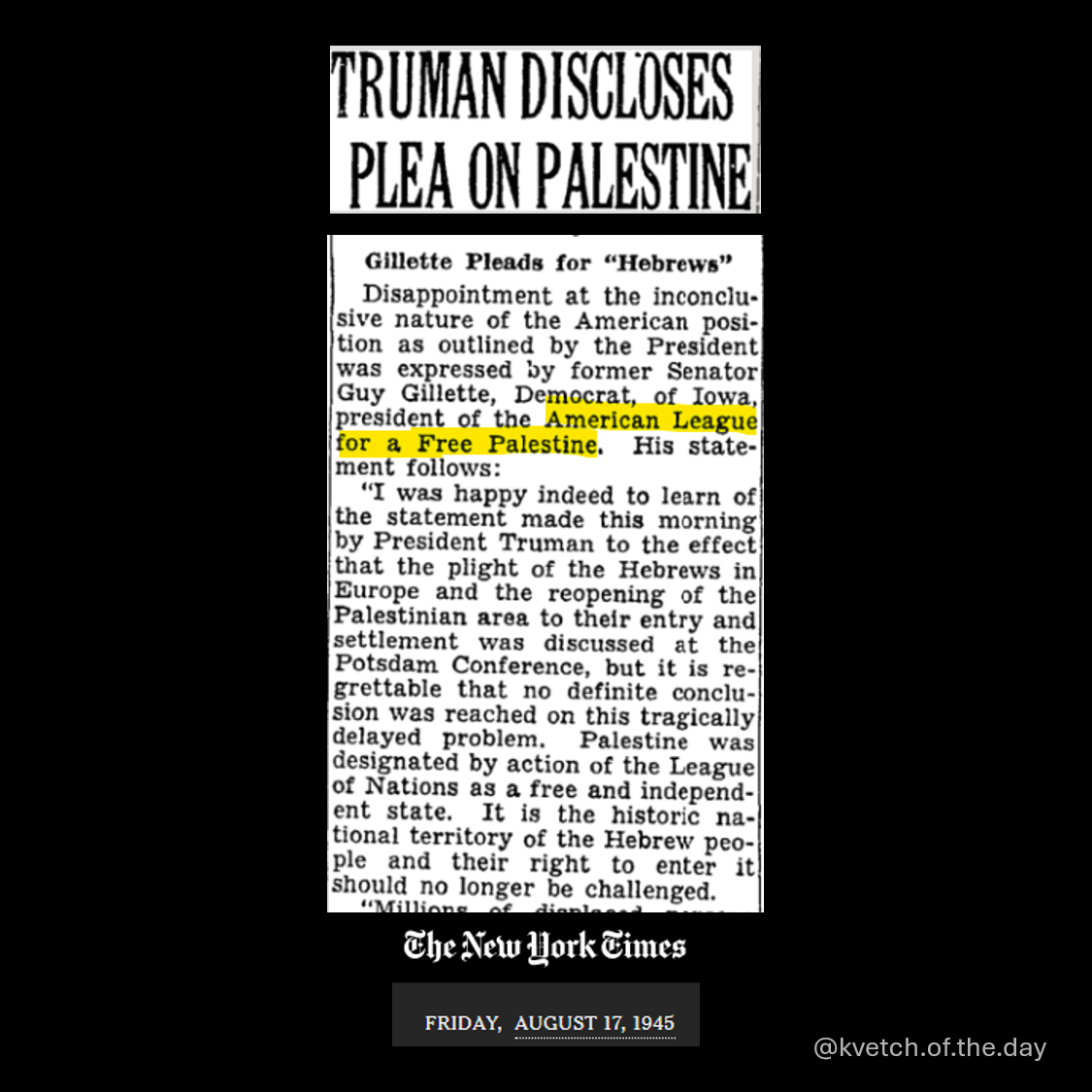
Scan from the kvetch-of-the-day news archive.
NYT 1945-08-17; kvetch-of-the-day archive clipping 3aad6f94-3ef1-809a-bd4c-faa40e659e27.
How the slide works: meaning 6 when challenged, meaning 3 when not.
'Free Palestine' defended as 'Palestinians (the people, 6) deserve freedom and a state' — almost everyone agrees — advanced as 'Palestine (the whole Mandate territory, 3) must be freed', which implies the end of Israel. 'Occupied Palestine' moves the same way: the West Bank since 1967 when challenged, all of Israel since 1948 when not. The Arabic chant 'min al-nahr ila al-bahr, Filastin 'arabiyya' ('Palestine will be Arab') resolves the ambiguity where the English 'free' leaves it open.
Why it works on us
- There is a real Palestinian people with a real history, and the word is theirs today; questioning its meanings can feel like questioning their existence.
- The territory, the people and the cause are bound up together in lived experience — the land is where the families come from.
- Everyone, supporters of Israel included, uses the word loosely, so the looseness feels normal rather than suspicious.
Where this trap shows up
Your side does it too — look at both columns.