Argument · heard from pro-Israel voices
“There's no such thing as a Palestinian people — it was invented in 1964.”
Palestinian identity is a recent political invention of the PLO; before that, the Arabs of the land were just Arabs, so they have no national claim.
Traps in play:◆ Which Palestine?◆ "They all…"
Why people find it convincing
- There was never an independent Palestinian Arab state before 1948, and under the Mandate the unmarked word 'Palestinian' often referred to Jewish institutions — the Palestine Post, the Palestine Orchestra.
- Golda Meir said in 1969 that 'there was no such thing as Palestinians', and a PLO official, Zuheir Mohsen, said in 1977 that the Palestinian people exists only for political reasons (verify both quotes and contexts).
- Pan-Arab nationalism before 1948 often saw the land as southern Syria rather than a separate nation.
- Palestinian national identity as a political movement did consolidate in the 20th century, largely in relation to Zionism.
What's true
No pre-1948 state, overlapping identities, and a nationalism shaped by conflict with Zionism.
There was no sovereign Palestinian Arab state; identities were layered (family, village, religion, Arab, Ottoman, Syrian); and the national movement consolidated in the 20th century, as most modern nationalisms did. The pre-1948 English usage of 'Palestinian' for Jewish institutions is real (see 'equivocation-palestine').
What's left out
A regional identity of the Arabs of Palestine is visible long before 1964 — marked as Arab.
The Jaffa newspaper Filastin ('Palestine', 1911) was named after the region and spoke for its Arab population; the Palestine Arab congresses (from 1919) and the Palestine Arab Party (1935) organised politically; the 1936–39 revolt was a mass uprising. Note the wording: these bodies called themselves the Arabs of Palestine — the qualifier 'Arab' is in the name — while in English institutional usage the unmarked 'Palestine'/'Palestinian' often meant Jewish or Mandate bodies. Even Israel's Foreign Minister in August 1948 spoke of 'the Palestinian Arab exodus' (NYT, 2 August 1948). What this shows: 'invented in 1964' is wrong; a regional Arab identity tied to this land existed and organised politically. What it does not show: an unmarked Palestinian nation in today's sense stretching back centuries — identities were layered (Arab, Ottoman, Syrian, religious, local), and the national identity consolidated in the 20th century. A people's existence doesn't depend on having had a state, and identity formed in response to a rival is still identity; the careful claim is strong enough without the inflated one. What 1964 did create — and this is the defensible core of 'invented in 1964' — is the exclusive national claim on the whole term. The PLO's Charter defined Palestinians as 'those Arab nationals who, until 1947, normally resided in Palestine' (1968, Art. 5); Jews counted only individually — in 1964 'if they are willing to live peacefully and loyally in Palestine' (Art. 7), in 1968 only if resident 'until the beginning of the Zionist invasion' (Art. 6) — and 'Judaism, being a religion, is not an independent nationality' (1968, Art. 20). After 1948 the Jewish side had dropped the word itself (the Palestine Post became the Jerusalem Post in 1950); the Charter filled that space with an Arab-only definition that denies Jews peoplehood. So: a regional Arab identity is older; the coherent national identity that owns 'Palestinian' and excludes Jews as a people was codified in 1964/68.
Traps here:◆ Which Palestine?◆ "They all…"
primary documentFilastin (newspaper), Jaffa, founded 1911 by Issa El-Issa and Yousef El-Issa (1911)
Archive issues via the National Library of Israel's historical Arabic press collection; cite a specific issue.
newspaper'Bars Repatriation Now' by Gene Currivan (1948) ✓
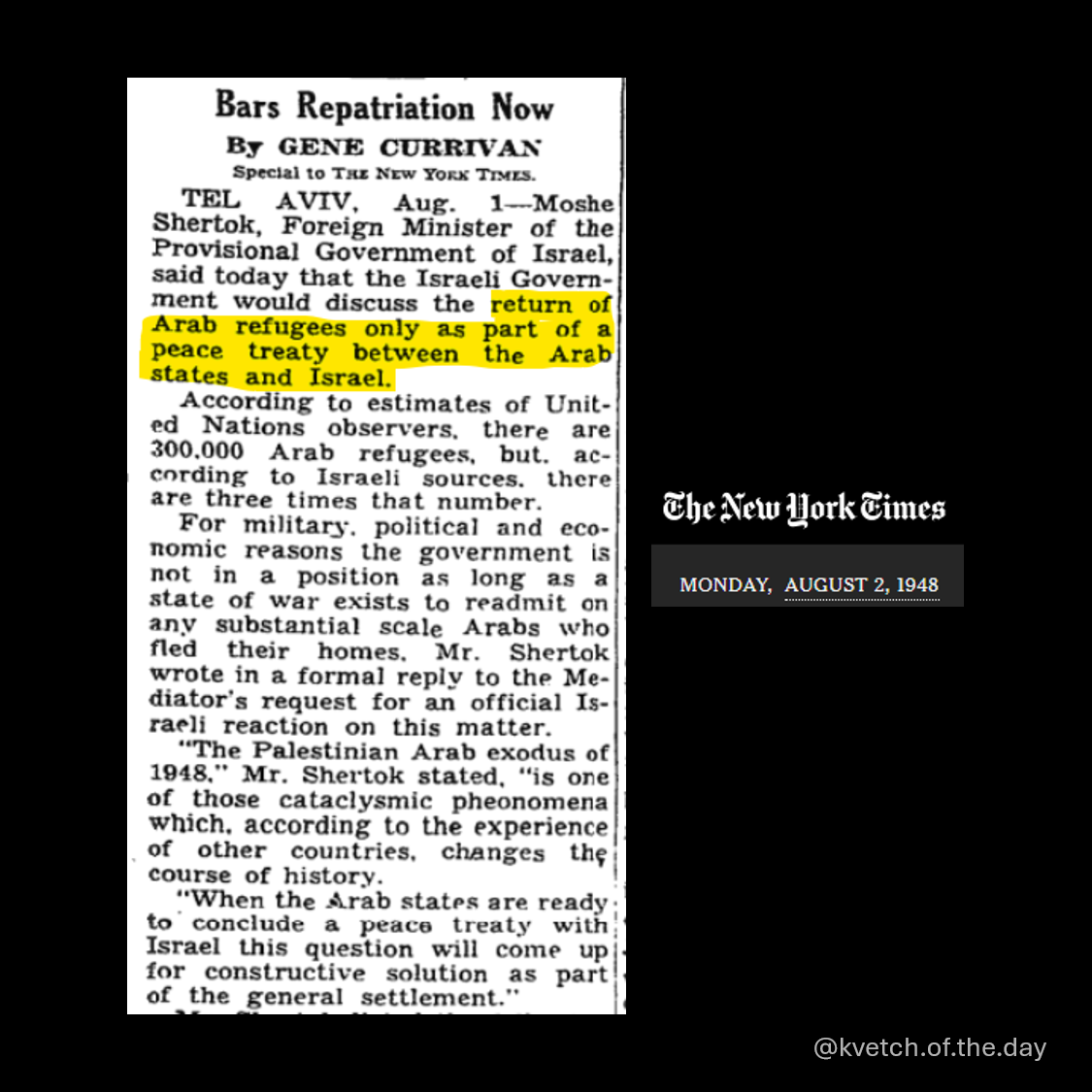
Scan from the kvetch-of-the-day news archive.
NYT 1948-08-02; vision-verified; Shertok's reply to the UN Mediator.
primary documentPalestinian National Charter (1964, Art. 7) and Palestinian National Charter (1968, Arts. 5, 6, 20) (1968)
Avalon Project text (1968); 1964 text via Jewish Virtual Library / Palquest. Quote exactly.
Where it leads if pressed
The mirror of 'Jews are just a religion'.
Telling a people it doesn't exist is the same move as telling Jews they are 'only a religion' with no national claim (see 'religion-no-basis-for-state'). Both deny the other side's self-understanding instead of dealing with its claims. The careful point — that Palestinian nationalism is modern and was shaped partly in reaction to Zionism — is defensible and interesting; the reckless one discredits whoever makes it, and hands the other side its easiest rebuttal.
The usual reply — and its own traps
Arguments travel in pairs. Here is what the other side typically answers. Check whether both lean on the same trick.
heard from pro-Palestinian voices“Palestine was definitely a thing — there was even a newspaper called Filastin in 1911 — and almost no Jews lived there, so Israel was a hostile takeover.” heard from pro-Palestinian voices“A religion doesn't justify having a country.”Where this argument points
Followed through, this argument is used to support: