Argument · heard from pro-Palestinian voices
“Israel was a British colonial project — the Empire planted the Jews in Palestine.”
Zionism succeeded only as a tool of British imperialism: the Balfour Declaration and the Mandate imposed a settler population on the Arabs.
Made publicly as a pro-Palestinian argument by Palestine National Council (PLO)
Where it's been said
“Zionism is a political movement organically associated with international imperialism … Israel is the instrument of the Zionist movement, and geographical base for world imperialism placed strategically in the midst of the Arab homeland to combat the hopes of the Arab nation for liberation, unity, and progress.”
Traps in play:◆ "They all…"◆ Which Palestine?
Why people find it convincing
- The Balfour Declaration (1917) promised a 'national home for the Jewish people' in a land whose Arab majority was not consulted.
- The League of Nations Mandate (1922) wrote that promise into international law: Britain was to secure 'the establishment of the Jewish national home' (Art. 2), recognise 'an appropriate Jewish agency' as a public body to advise and co-operate with the Administration (Art. 4), and 'facilitate Jewish immigration' and 'encourage … close settlement by Jews on the land, including State lands' (Art. 6). The Arab majority is not named: the text speaks of 'safeguarding the civil and religious rights of all the inhabitants of Palestine, irrespective of race and religion' (Art. 2) and of 'other sections of the population', whose 'rights and position' were not to be 'prejudiced' (Art. 6); no Arab agency was created.
- Under British rule Jewish immigration and institutions grew: by the UN study's figures about 232,000 legal immigrants arrived in the 1930s, and the Jewish share of the population rose from under 10% to 'nearly 30 per cent' by 1939. When the Palestinian rebellion broke out in 1936, the British administration 'called in troop reinforcements from Britain, Egypt and Malta, and resorted to mass arrests, collective fines' (UN study 'The Origins and Evolution of the Palestine Problem').
- British officials said the imperial interest out loud. Ronald Storrs, appointed Britain's military governor of Jerusalem in 1917, wrote in his memoir that Jewish settlement could prove the enterprise 'blessed him that gave as well as him that took by forming for England “a little loyal Jewish Ulster” in a sea of potentially hostile Arabism' (Orientations, 1937; he put the phrase itself in quotation marks).
- Arthur Balfour wrote to Lord Curzon in August 1919: 'Whatever deference should be paid to the views of those living there, the Powers, in their selection of a mandatory do not propose, as I understand the matter, to consult them' (quoted by Patrick Terry from Ingrams, Palestine Papers, FO 371/4183). The same memorandum also says: 'in Palestine we do not propose even to go through the form of consulting the wishes of the present inhabitants of the country', and that Zionism is 'of far profounder import than the desires and prejudices of the 700,000 Arabs who now inhabit that ancient land' (as quoted in the UN study 'The Origins and Evolution of the Palestine Problem').
What's true
British imperial policy made the national home possible, over Arab objections.
The Mandate bound Britain to secure 'the establishment of the Jewish national home' (Art. 2), and the Arab majority's consent was never sought: 'in Palestine we do not propose even to go through the form of consulting the wishes of the present inhabitants of the country', Balfour wrote in 1919. In the same memorandum: 'The contradiction between the letters of the Covenant and the policies of the Allies is even more flagrant in the case of ‘independent’ Palestine' (as quoted by Patrick Terry, 2017, who argues the Palestinian Arab legal position). The Palestinian objection to the Mandate's legitimacy can quote both documents.
primary documentBalfour Declaration (1917) ✓
2 November 1917. Text read on the Avalon Project: 'His Majesty's Government view with favour the establishment in Palestine of a national home for the Jewish people … it being clearly understood that nothing shall be done which may prejudice the civil and religious rights of existing non-Jewish communities in Palestine, or the rights and political status enjoyed by Jews in any other country.'
primary documentLeague of Nations Mandate for Palestine (1922) ✓
Read on the Avalon Project (2026-09-30). Art. 2: conditions 'as will secure the establishment of the Jewish national home … and also for safeguarding the civil and religious rights of all the inhabitants of Palestine, irrespective of race and religion'; Art. 4: 'An appropriate Jewish agency shall be recognised as a public body …'; Art. 6: 'while ensuring that the rights and position of other sections of the population are not prejudiced, shall facilitate Jewish immigration under suitable conditions and shall encourage … close settlement by Jews on the land, including State lands and waste lands'. Preamble: 'recognition has thereby been given to the historical connection of the Jewish people with Palestine'. Art. 22 (re-read 2026-10-12): 'English, Arabic and Hebrew shall be the official languages of Palestine. Any statement or inscription in Arabic on stamps or money in Palestine shall be repeated in Hebrew and any statement or inscription in Hebrew shall be repeated in Arabic.' Art. 6 in full (Avalon, re-read 2026-10-15): 'The Administration of Palestine, while ensuring that the rights and position of other sections of the population are not prejudiced, shall facilitate Jewish immigration under suitable conditions and shall encourage, in co-operation with the Jewish agency referred to in Article 4, close settlement by Jews on the land, including State lands and waste lands not required for public purposes.'
referenceUnited Nations (prepared for the Committee on the Exercise of the Inalienable Rights of the Palestinian People), 'The Origins and Evolution of the Palestine Problem', Part I: 1917–1947 ✓
Read (2026-09-28). Quotes Balfour's memorandum to Curzon of 11 August 1919: 'For in Palestine we do not propose even to go through the form of consulting the wishes of the present inhabitants of the country'; 'The four Great Powers are committed to zionism … of far profounder import than the desires and prejudices of the 700,000 Arabs who now inhabit that ancient land'; 'I do not think that zionism will hurt the Arabs, but they will never say they want it.' The study was prepared under a UN committee on Palestinian rights. Re-read 2026-10-01 (1936–39): 'In April 1936, what started as minor Arab-Jewish clashes quickly flared into a widespread revolt. A new union of Palestinian political parties was formed, the Arab Higher Committee, headed by the Mufti of Jerusalem … The Committee called for a general strike to support the demand for national government'; 1938 casualties 'reached a total of 3,717, as against 246 in 1937'; 'the Jewish side also conducted its own retaliations and reprisals'; by 1933 'the various Palestinian political parties and groupings had united to form an Arab Executive Committee'. The study's own framing ('Palestinian resistance to foreign rule and to foreign colonization'). Re-read 2026-10-01: it quotes 'an official British document': 'On the 22nd July 1946, the campaign conducted by terrorist organizations reached a new climax with an explosion which wrecked a wing of the King David Hotel in Jerusalem, containing the offices of the Government Secretariat as well as part of military headquarters, and killed 86 public servants, Arab, Jewish and British, as well as five members of the public'; and 'That the Irgun Tzeva'i Leumi and the Stern Group have worked since last autumn in co-operation with the Haganah High Command on certain of these operations'. Re-read 2026-10-01 (immigration): the population rose 'from the 750,000 of the 1922 census to almost 1,850,000 at the end of 1946'; the Jewish population 'from 56,000 after the First World War to 84,000 in 1922 to 608,000 in 1946'; 'A good part of this was due to births within Palestine but legal immigration alone accounted for over 376,000, with illegal immigration being estimated at another 65,000 – a total of 440,000'; the Jewish community 'in 1947 constituted nearly a third'. Re-read 2026-10-12: 'Compared to the 100,000 in the 1920s, Palestine received about 232,000 legal immigrants in the 1930s. The Jewish population in 1939 numbered over 445,000 out of a total of about 1,500,000 – nearly 30 per cent compared to the less than 10 per cent 20 years before'; 1936 revolt: attacks 'on British troops and police posts as well as on Jewish settlements, sabotage of roads, railways, pipelines'; 'The British administration imposed curfews, called in troop reinforcements from Britain, Egypt and Malta, and resorted to mass arrests, collective fines, and internments in concentration camps and other emergency measures'.
advocacy / viewPatrick C. R. Terry, 'Britain in Palestine (1917–1948): Occupation, the Palestine Mandate, and International Law', University of Bologna Law Review 2:2 (2017) (2017) finding ✓
Read (2026-09-28). Quotes Balfour's memorandum to Curzon (11 August 1919): 'Whatever deference should be paid to the views of those living there, the Powers, in their selection of a mandatory do not propose, as I understand the matter, to consult them'; epigraph from the same memorandum ('The contradiction between the letters of the Covenant and the policies of the Allies is even more flagrant in the case of ‘independent’ Palestine'); cites Doreen Ingrams, Palestine Papers 1917–1922 (1972), p. 73 (PRO FO 371/4183). The author argues the Palestinian Arab legal position.
What's left out
Britain turned against Zionism and fought the Jews who came.
The 1939 White Paper capped Jewish immigration at 'some 75,000 immigrants over the next five years', after which 'no further Jewish immigration will be permitted unless the Arabs of Palestine are prepared to acquiesce in it', and set the goal of 'an independent Palestine State' within ten years — as the Holocaust began. Britain kept refugee ships out. The Struma's passengers were told in Istanbul that they 'would not get visas to enter Palestine', and Turkey would not let them land 'without British agreement'; towed back to sea by Turkish police, the boat sank in February 1942, 'assumed' torpedoed by mistake by a Soviet submarine, and one passenger of some 770 survived. The Exodus 1947, with 'over 4,500' Holocaust survivors and displaced persons, was stopped by British destroyers (a crew member and two passengers killed) and its passengers shipped to Hamburg, 'interned in camps in the British zone of occupation in Germany' (USHMM). Between August 1946 and May 1948 Britain intercepted more than 50,000 Holocaust survivors (about 52,000, per the US Holocaust Memorial Museum, most of them young and many orphans) and held them in detention camps on Cyprus run 'in accordance with the harsh model of the POW camp'; the last closed only in February 1949. In August 1946, as two Royal Navy transports sailed for Cyprus with about 1,300 would-be immigrants, British soldiers in Haifa killed three Jews, among them an 18-year-old girl, when a crowd that 'in violation of the curfew, was trying to break into the port area' was fired on (United Press) — reported by the New York Times under the subheadline 'Soldiers Fire on Palestinians', because before 1948 'Palestinians' could mean Jews, as it did here. Britain abstained on the 1947 partition vote, having told the UN that if the Assembly recommended 'a policy which was not acceptable to the Jews and the Arabs, the United Kingdom Government would not feel able to implement it'; it ended the Mandate on 15 May 1948, 'several months before the time envisaged in the United Nations plan' (UN study). Both halves are on record. Britain's own officials described the national home as serving England ('a little loyal Jewish Ulster', in Storrs's memoir), and from 1939 the same empire capped the immigrants, detained them and fired on their protests. Whether 'colonial project' fits depends on which decade is meant.
Traps here:◆ "They all…"◆ Which Palestine?
primary documentBritish White Paper of 1939 (Cmd. 6019) (1939) ✓
75,000 Jewish immigrants over five years. Re-read 2026-10-12 (Avalon text): the quota 'would allow of the admission, as from the beginning of April this year, of some 75,000 immigrants over the next five years'; 'After the period of five years, no further Jewish immigration will be permitted unless the Arabs of Palestine are prepared to acquiesce in it.'
newspaper'British Battle Jews, Kill 3 in Haifa Riot as Refugees Are Sent to Cyprus Camps' (UP) (1946) incident ✓
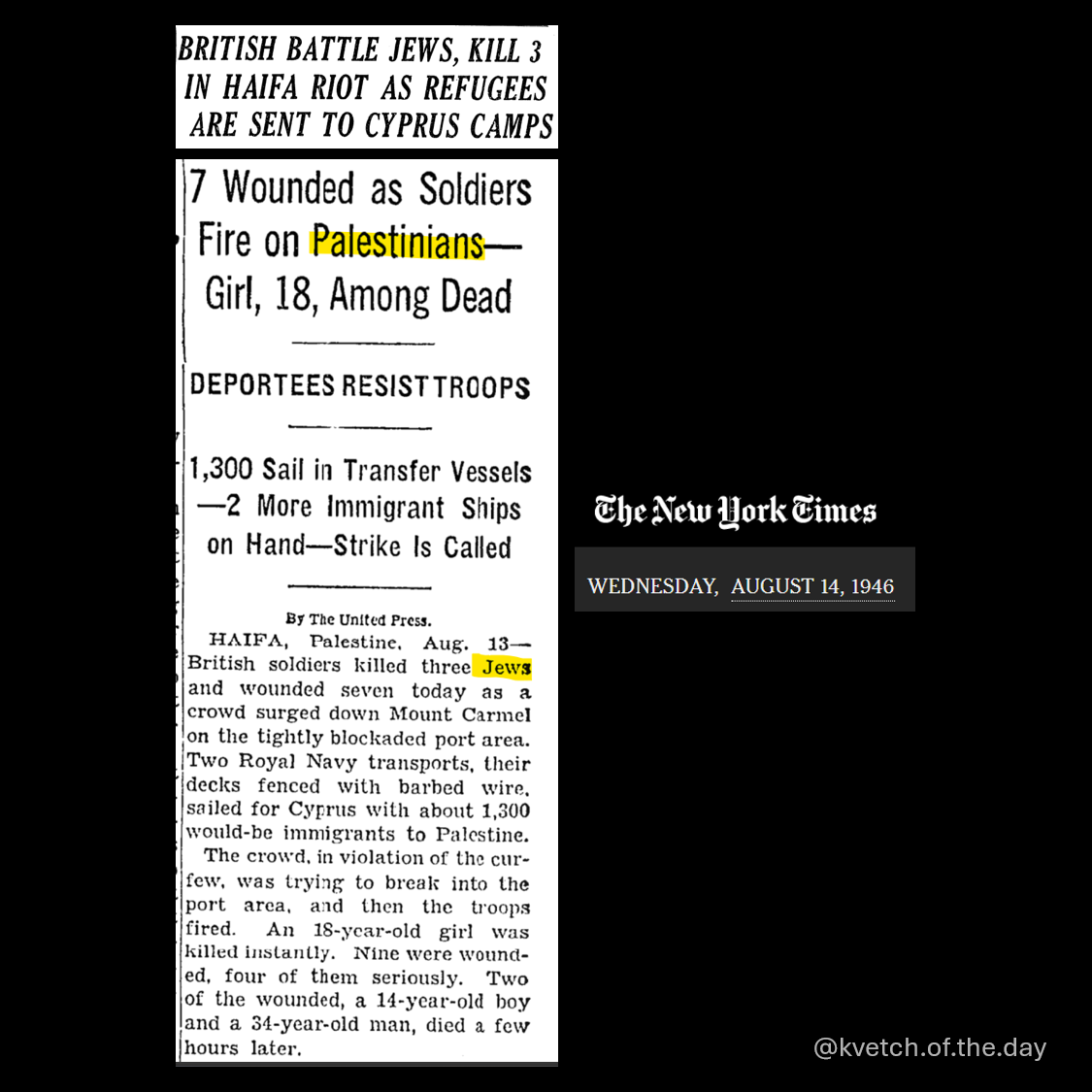
Scan from the kvetch-of-the-day news archive.
NYT 1946-08-14 (United Press); vision-verified, text re-read from the image 2026-09-30. Headline: 'British Battle Jews, Kill 3 in Haifa Riot as Refugees are sent to Cyprus Camps'; subheadline: '7 Wounded as Soldiers Fire on Palestinians — Girl, 18, Among Dead' (the 'Palestinians' are Jews). Body: 'British soldiers killed three Jews and wounded seven today as a crowd surged down Mount Carmel on the tightly blockaded port area'; 'The crowd, in violation of the curfew, was trying to break into the port area, and then the troops fired. An 18-year-old girl was killed instantly'; two Royal Navy transports 'sailed for Cyprus with about 1,300 would-be immigrants'.
historyUnited States Holocaust Memorial Museum, Holocaust Encyclopedia, 'Cyprus Detention Camps' incident ✓
Read: August 1946–May 1948, more than 50,000 intercepted; 'about 52,000' detained, ~80% aged 12–35, the majority orphans; camps run on 'the harsh model of the POW camp'; the last closed in February 1949. The number of camps is not given there (our earlier '12' dropped). Re-read 2026-10-12: 'The British military ran the detention camps in accordance with the harsh model of the POW camp.'
primary documentRonald Storrs, 'Orientations' (London: Ivor Nicholson and Watson, 1937), Internet Archive scan (Digital Library of India) (1937) incident ✓
Read (2026-09-28; OCR full text), p. 405 (chapter on the Hebrew language): '…enough could return, if not to form The Jewish State (which a few extremists publicly demanded), at least to prove that the enterprise was one that blessed him that gave as well as him that took by forming for England “a little loyal Jewish Ulster” in a sea of potentially hostile Arabism.' Storrs puts the phrase in quotation marks.
historyUS Holocaust Memorial Museum, Holocaust Encyclopedia, 'Voyage of the Struma' incident ✓
Read 2026-09-30. 'In December 1941, in Constanta, 767 Jews boarded' (the same page's oral-history note says 'Out of 769 Jewish passengers'); in Istanbul 'the passengers were informed they would not get visas to enter Palestine and, furthermore, would not be permitted entry into Turkey'; 'Turkish authorities denied the passengers permission to land without British agreement'; on 23 February 1942 Turkish police towed the boat out; it sank the next day; 'it is assumed that it was mistakenly torpedoed by a Soviet submarine'; one survivor, David Stoliar; the sinking 'led to widespread international protest against Britain's policy on immigration into Palestine'.
historyUS Holocaust Memorial Museum, Holocaust Encyclopedia, 'Exodus 1947' incident ✓
Read 2026-09-30. The ship 'carried over 4,500 Jewish men, women, and children, all displaced persons (DPs) or survivors of the Holocaust'; British destroyers surrounded it; on 18 July 1947 'A Jewish crew member and two passengers were killed'; after weeks off France 'The British government then transported the passengers to Hamburg, where they were interned in camps in the British zone of occupation in Germany'.
historyUN study 'The Origins and Evolution of the Palestine Problem', Part II (1947–1977), UNISPAL (1978) finding ✓
Read 2026-09-30. Partition voted on 29 November 1947: '33 votes in favour and 13 against with 10 abstentions'. The Palestine Arab Higher Committee condemned the plan as 'An excess of injustice to Palestine … a flagrant violation of the natural rights of the Arabs in their own country'; 'The Zionist Organization approved of the partition resolution, although objecting the Jewish state had not been allotted enough territory'. Prepared for the UN Committee on the Exercise of the Inalienable Rights of the Palestinian People. Also (re-read 2026-09-30): the UK told the UN that if the Assembly recommended 'a policy which was not acceptable to the Jews and the Arabs, the United Kingdom Government would not feel able to implement it'; abstentions on 29 November 1947 included the 'United Kingdom'; Britain 'announced that it would terminate the Mandate on 15 May 1948, several months before the time envisaged in the United Nations plan'. Re-read 2026-10-01: the partition resolution 'awarded 56 per cent of the territory of Palestine to 32 per cent of its population'; within the Jewish State 'there would remain a very large number of Palestinian Arabs: 497,000 (including 90,000 Bedouin) against 498,000 Jews', with about 10,000 Jews left in the Arab State; 'The partition resolution contained detailed safeguards to ensure the rights of minorities'. The study includes a chapter on the UN Committee on the Exercise of the Inalienable Rights of the Palestinian People and that Committee's recommendations. Re-read 2026-10-12, on the end of the Mandate: 'Jewish forces moved to occupy further territory beyond the boundaries specified by the Partition resolution. Irregular units from neighbouring Arab States had already entered Palestine in the final weeks of the Mandate, and now regular forces from these countries crossed into Palestine. The Arab League informed the United Nations Secretary-General by cable of the reasons for the Arab action.' Partition resolution as quoted there (re-read 2026-10-12): Jewish State '498 000' Jews and '407 000' Arabs and others, 'In addition there will be in the Jewish State about 90,000 (Arab) Bedouins'; citizens and residents 'shall, upon the recognition of independence, become citizens of the State in which they are resident'.
More context
How to talk about this.
Acknowledge first: Britain did sponsor the Jewish national home, and its own officials saw imperial uses in it ('a little loyal Jewish Ulster', Storrs), and it ruled the land without its inhabitants' consent. Ask one question: 'if Zionism was Britain's project, why did Britain restrict Jewish immigration in 1939 and fight the Jewish underground until 1948?'; both halves are true. Share one checkable thing: the 1939 White Paper, which capped Jewish immigration during the Holocaust. What not to say: 'the British were always anti-Zionist', which erases Balfour. From the other side: grant the White Paper, then ask what the Mandate owed the Arab majority it governed.
primary documentRonald Storrs, 'Orientations' (London: Ivor Nicholson and Watson, 1937), Internet Archive scan (Digital Library of India) (1937) incident ✓
Read (2026-09-28; OCR full text), p. 405 (chapter on the Hebrew language): '…enough could return, if not to form The Jewish State (which a few extremists publicly demanded), at least to prove that the enterprise was one that blessed him that gave as well as him that took by forming for England “a little loyal Jewish Ulster” in a sea of potentially hostile Arabism.' Storrs puts the phrase in quotation marks.
Where it leads if pressed
Working it out: two periods of British policy, and who made the state.
The claim treats thirty years of British policy as one project. The record shows two phases, and a state Britain did not deliver. 1917 to the 1930s, sponsorship: the Balfour Declaration and the Mandate bound Britain to secure 'the establishment of the Jewish national home', without consulting the Arab majority ('we do not propose even to go through the form of consulting the wishes of the present inhabitants', Balfour, 1919); Ronald Storrs, in his 1937 memoirs, described the enterprise as forming for England 'a little loyal Jewish Ulster in a sea of potentially hostile Arabism', in quotation marks. On this phase, the Palestinian objection is well grounded. 1939 to 1948, restriction and conflict: the White Paper capped Jewish immigration at 75,000 over five years as the Holocaust began; the Struma's refugees were refused visas and the ship sank in 1942; more than 50,000 intercepted immigrants were held in camps on Cyprus between 1946 and 1948; British troops killed three Jews in a Haifa riot as refugees were shipped there; and in July 1947 British destroyers stopped the Exodus, which 'carried over 4,500 Jewish men, women, and children, all displaced persons (DPs) or survivors of the Holocaust'; three were killed, and the passengers were taken back to Hamburg and 'interned in camps in the British zone of occupation in Germany' (US Holocaust Memorial Museum). At the UN in 1947 Britain abstained on partition, said it would not implement a plan 'not acceptable to the Jews and the Arabs', and left the Mandate early. Israel was declared on the day the Mandate ended, without British support. The worst case for each side. For 'a British colonial project': grant the sponsorship phase in full; Britain then restricted the immigration it had sponsored, fought the Jewish underground, abstained at the UN and left. For 'Britain had nothing to do with it': grant the restriction phase in full; without the Balfour Declaration and the Mandate's national-home clause, the Jewish community could not have grown as it did, and the Arab majority was never asked. Holds on the evidence here: British imperial policy made the national home possible and then turned against Jewish immigration. Arguable: that the first phase decided the outcome despite the second. Not supported: that Israel was planted and protected by Britain to the end, or that Britain played no founding role.
What the labels (Holds, Open, Arguable …) mean
primary documentBalfour Declaration (1917) ✓
2 November 1917. Text read on the Avalon Project: 'His Majesty's Government view with favour the establishment in Palestine of a national home for the Jewish people … it being clearly understood that nothing shall be done which may prejudice the civil and religious rights of existing non-Jewish communities in Palestine, or the rights and political status enjoyed by Jews in any other country.'
primary documentLeague of Nations Mandate for Palestine (1922) ✓
Read on the Avalon Project (2026-09-30). Art. 2: conditions 'as will secure the establishment of the Jewish national home … and also for safeguarding the civil and religious rights of all the inhabitants of Palestine, irrespective of race and religion'; Art. 4: 'An appropriate Jewish agency shall be recognised as a public body …'; Art. 6: 'while ensuring that the rights and position of other sections of the population are not prejudiced, shall facilitate Jewish immigration under suitable conditions and shall encourage … close settlement by Jews on the land, including State lands and waste lands'. Preamble: 'recognition has thereby been given to the historical connection of the Jewish people with Palestine'. Art. 22 (re-read 2026-10-12): 'English, Arabic and Hebrew shall be the official languages of Palestine. Any statement or inscription in Arabic on stamps or money in Palestine shall be repeated in Hebrew and any statement or inscription in Hebrew shall be repeated in Arabic.' Art. 6 in full (Avalon, re-read 2026-10-15): 'The Administration of Palestine, while ensuring that the rights and position of other sections of the population are not prejudiced, shall facilitate Jewish immigration under suitable conditions and shall encourage, in co-operation with the Jewish agency referred to in Article 4, close settlement by Jews on the land, including State lands and waste lands not required for public purposes.'
referenceUnited Nations (prepared for the Committee on the Exercise of the Inalienable Rights of the Palestinian People), 'The Origins and Evolution of the Palestine Problem', Part I: 1917–1947 ✓
Read (2026-09-28). Quotes Balfour's memorandum to Curzon of 11 August 1919: 'For in Palestine we do not propose even to go through the form of consulting the wishes of the present inhabitants of the country'; 'The four Great Powers are committed to zionism … of far profounder import than the desires and prejudices of the 700,000 Arabs who now inhabit that ancient land'; 'I do not think that zionism will hurt the Arabs, but they will never say they want it.' The study was prepared under a UN committee on Palestinian rights. Re-read 2026-10-01 (1936–39): 'In April 1936, what started as minor Arab-Jewish clashes quickly flared into a widespread revolt. A new union of Palestinian political parties was formed, the Arab Higher Committee, headed by the Mufti of Jerusalem … The Committee called for a general strike to support the demand for national government'; 1938 casualties 'reached a total of 3,717, as against 246 in 1937'; 'the Jewish side also conducted its own retaliations and reprisals'; by 1933 'the various Palestinian political parties and groupings had united to form an Arab Executive Committee'. The study's own framing ('Palestinian resistance to foreign rule and to foreign colonization'). Re-read 2026-10-01: it quotes 'an official British document': 'On the 22nd July 1946, the campaign conducted by terrorist organizations reached a new climax with an explosion which wrecked a wing of the King David Hotel in Jerusalem, containing the offices of the Government Secretariat as well as part of military headquarters, and killed 86 public servants, Arab, Jewish and British, as well as five members of the public'; and 'That the Irgun Tzeva'i Leumi and the Stern Group have worked since last autumn in co-operation with the Haganah High Command on certain of these operations'. Re-read 2026-10-01 (immigration): the population rose 'from the 750,000 of the 1922 census to almost 1,850,000 at the end of 1946'; the Jewish population 'from 56,000 after the First World War to 84,000 in 1922 to 608,000 in 1946'; 'A good part of this was due to births within Palestine but legal immigration alone accounted for over 376,000, with illegal immigration being estimated at another 65,000 – a total of 440,000'; the Jewish community 'in 1947 constituted nearly a third'. Re-read 2026-10-12: 'Compared to the 100,000 in the 1920s, Palestine received about 232,000 legal immigrants in the 1930s. The Jewish population in 1939 numbered over 445,000 out of a total of about 1,500,000 – nearly 30 per cent compared to the less than 10 per cent 20 years before'; 1936 revolt: attacks 'on British troops and police posts as well as on Jewish settlements, sabotage of roads, railways, pipelines'; 'The British administration imposed curfews, called in troop reinforcements from Britain, Egypt and Malta, and resorted to mass arrests, collective fines, and internments in concentration camps and other emergency measures'.
primary documentRonald Storrs, 'Orientations' (London: Ivor Nicholson and Watson, 1937), Internet Archive scan (Digital Library of India) (1937) incident ✓
Read (2026-09-28; OCR full text), p. 405 (chapter on the Hebrew language): '…enough could return, if not to form The Jewish State (which a few extremists publicly demanded), at least to prove that the enterprise was one that blessed him that gave as well as him that took by forming for England “a little loyal Jewish Ulster” in a sea of potentially hostile Arabism.' Storrs puts the phrase in quotation marks.
primary documentBritish White Paper of 1939 (Cmd. 6019) (1939) ✓
75,000 Jewish immigrants over five years. Re-read 2026-10-12 (Avalon text): the quota 'would allow of the admission, as from the beginning of April this year, of some 75,000 immigrants over the next five years'; 'After the period of five years, no further Jewish immigration will be permitted unless the Arabs of Palestine are prepared to acquiesce in it.'
historyUS Holocaust Memorial Museum, Holocaust Encyclopedia, 'Voyage of the Struma' incident ✓
Read 2026-09-30. 'In December 1941, in Constanta, 767 Jews boarded' (the same page's oral-history note says 'Out of 769 Jewish passengers'); in Istanbul 'the passengers were informed they would not get visas to enter Palestine and, furthermore, would not be permitted entry into Turkey'; 'Turkish authorities denied the passengers permission to land without British agreement'; on 23 February 1942 Turkish police towed the boat out; it sank the next day; 'it is assumed that it was mistakenly torpedoed by a Soviet submarine'; one survivor, David Stoliar; the sinking 'led to widespread international protest against Britain's policy on immigration into Palestine'.
historyUnited States Holocaust Memorial Museum, Holocaust Encyclopedia, 'Cyprus Detention Camps' incident ✓
Read: August 1946–May 1948, more than 50,000 intercepted; 'about 52,000' detained, ~80% aged 12–35, the majority orphans; camps run on 'the harsh model of the POW camp'; the last closed in February 1949. The number of camps is not given there (our earlier '12' dropped). Re-read 2026-10-12: 'The British military ran the detention camps in accordance with the harsh model of the POW camp.'
newspaper'British Battle Jews, Kill 3 in Haifa Riot as Refugees Are Sent to Cyprus Camps' (UP) (1946) incident ✓
Scan from the kvetch-of-the-day news archive.
NYT 1946-08-14 (United Press); vision-verified, text re-read from the image 2026-09-30. Headline: 'British Battle Jews, Kill 3 in Haifa Riot as Refugees are sent to Cyprus Camps'; subheadline: '7 Wounded as Soldiers Fire on Palestinians — Girl, 18, Among Dead' (the 'Palestinians' are Jews). Body: 'British soldiers killed three Jews and wounded seven today as a crowd surged down Mount Carmel on the tightly blockaded port area'; 'The crowd, in violation of the curfew, was trying to break into the port area, and then the troops fired. An 18-year-old girl was killed instantly'; two Royal Navy transports 'sailed for Cyprus with about 1,300 would-be immigrants'.
historyUN study 'The Origins and Evolution of the Palestine Problem', Part II (1947–1977), UNISPAL (1978) finding ✓
Read 2026-09-30. Partition voted on 29 November 1947: '33 votes in favour and 13 against with 10 abstentions'. The Palestine Arab Higher Committee condemned the plan as 'An excess of injustice to Palestine … a flagrant violation of the natural rights of the Arabs in their own country'; 'The Zionist Organization approved of the partition resolution, although objecting the Jewish state had not been allotted enough territory'. Prepared for the UN Committee on the Exercise of the Inalienable Rights of the Palestinian People. Also (re-read 2026-09-30): the UK told the UN that if the Assembly recommended 'a policy which was not acceptable to the Jews and the Arabs, the United Kingdom Government would not feel able to implement it'; abstentions on 29 November 1947 included the 'United Kingdom'; Britain 'announced that it would terminate the Mandate on 15 May 1948, several months before the time envisaged in the United Nations plan'. Re-read 2026-10-01: the partition resolution 'awarded 56 per cent of the territory of Palestine to 32 per cent of its population'; within the Jewish State 'there would remain a very large number of Palestinian Arabs: 497,000 (including 90,000 Bedouin) against 498,000 Jews', with about 10,000 Jews left in the Arab State; 'The partition resolution contained detailed safeguards to ensure the rights of minorities'. The study includes a chapter on the UN Committee on the Exercise of the Inalienable Rights of the Palestinian People and that Committee's recommendations. Re-read 2026-10-12, on the end of the Mandate: 'Jewish forces moved to occupy further territory beyond the boundaries specified by the Partition resolution. Irregular units from neighbouring Arab States had already entered Palestine in the final weeks of the Mandate, and now regular forces from these countries crossed into Palestine. The Arab League informed the United Nations Secretary-General by cable of the reasons for the Arab action.' Partition resolution as quoted there (re-read 2026-10-12): Jewish State '498 000' Jews and '407 000' Arabs and others, 'In addition there will be in the Jewish State about 90,000 (Arab) Bedouins'; citizens and residents 'shall, upon the recognition of independence, become citizens of the State in which they are resident'.
primary documentDeclaration of the Establishment of the State of Israel (1948) ✓
Includes 'complete equality of social and political rights to all its inhabitants irrespective of religion, race or sex'. Re-read 2026-10-12: the signatories assembled 'on the day of the termination of the British Mandate over Eretz-Israel'. Operative sentence (Avalon, re-read 2026-10-12): 'by virtue of our natural and historic right and on the strength of the resolution of the United Nations General Assembly, hereby declare the establishment of a Jewish state in Eretz-Israel'.
historyUS Holocaust Memorial Museum, Holocaust Encyclopedia, 'Exodus 1947' incident ✓
Read 2026-09-30. The ship 'carried over 4,500 Jewish men, women, and children, all displaced persons (DPs) or survivors of the Holocaust'; British destroyers surrounded it; on 18 July 1947 'A Jewish crew member and two passengers were killed'; after weeks off France 'The British government then transported the passengers to Hamburg, where they were interned in camps in the British zone of occupation in Germany'.
The Mandate's legitimacy is a fair question — 'colonial project' is not the whole answer.
Asking whether an empire had the right to promise the land is legitimate, and the Palestinian answer deserves a hearing. But from 1939, as Jews fled Europe, Britain capped their immigration (the White Paper), and the state was declared 'on the day of the termination of the British Mandate', after years in which Britain restricted the immigration it had once sponsored. Both halves belong in the story.
primary documentDeclaration of the Establishment of the State of Israel (1948) ✓
Includes 'complete equality of social and political rights to all its inhabitants irrespective of religion, race or sex'. Re-read 2026-10-12: the signatories assembled 'on the day of the termination of the British Mandate over Eretz-Israel'. Operative sentence (Avalon, re-read 2026-10-12): 'by virtue of our natural and historic right and on the strength of the resolution of the United Nations General Assembly, hereby declare the establishment of a Jewish state in Eretz-Israel'.
primary documentBritish White Paper of 1939 (Cmd. 6019) (1939) ✓
75,000 Jewish immigrants over five years. Re-read 2026-10-12 (Avalon text): the quota 'would allow of the admission, as from the beginning of April this year, of some 75,000 immigrants over the next five years'; 'After the period of five years, no further Jewish immigration will be permitted unless the Arabs of Palestine are prepared to acquiesce in it.'
The usual reply — and its own traps
Arguments travel in pairs. Here is what the other side typically answers. Check whether both lean on the same trick.
heard from pro-Palestinian voices“Israel is a settler-colonial state.”On the timeline
Keep exploring
From the archive
How newspapers reported related events at the time — suggested by the archive's own tags, not yet reviewed for this argument. Open a scan and judge for yourself.
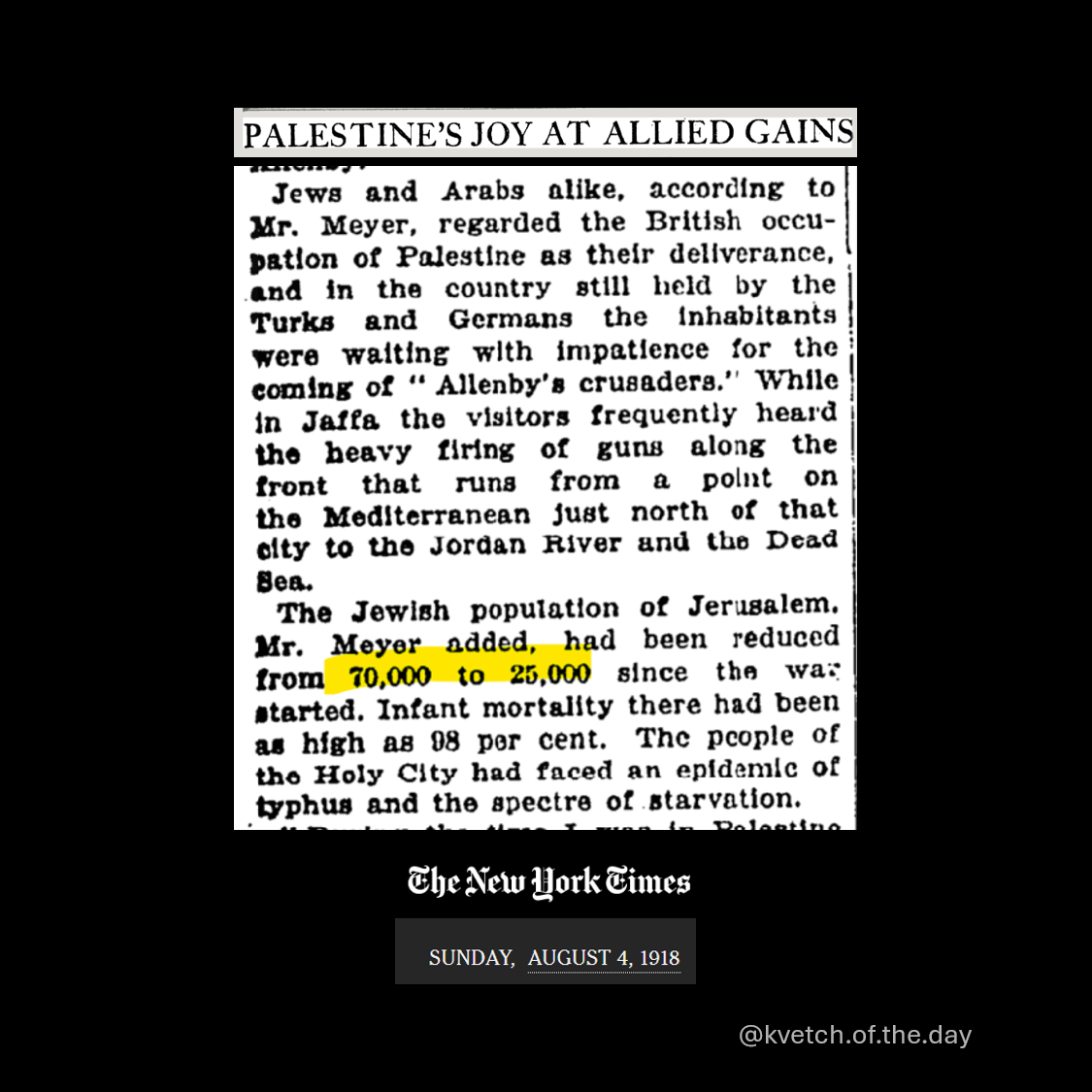
Scans: kvetch-of-the-day news archive.