Argument · heard from pro-Israel voices
“The Palestinians left voluntarily in 1948 — their own leaders told them to go.”
There was no expulsion: Arab leaders and armies told the population to leave temporarily and return after victory, so Israel bears no responsibility for the refugees.
Traps in play:◆ "They all…"
Why people find it convincing
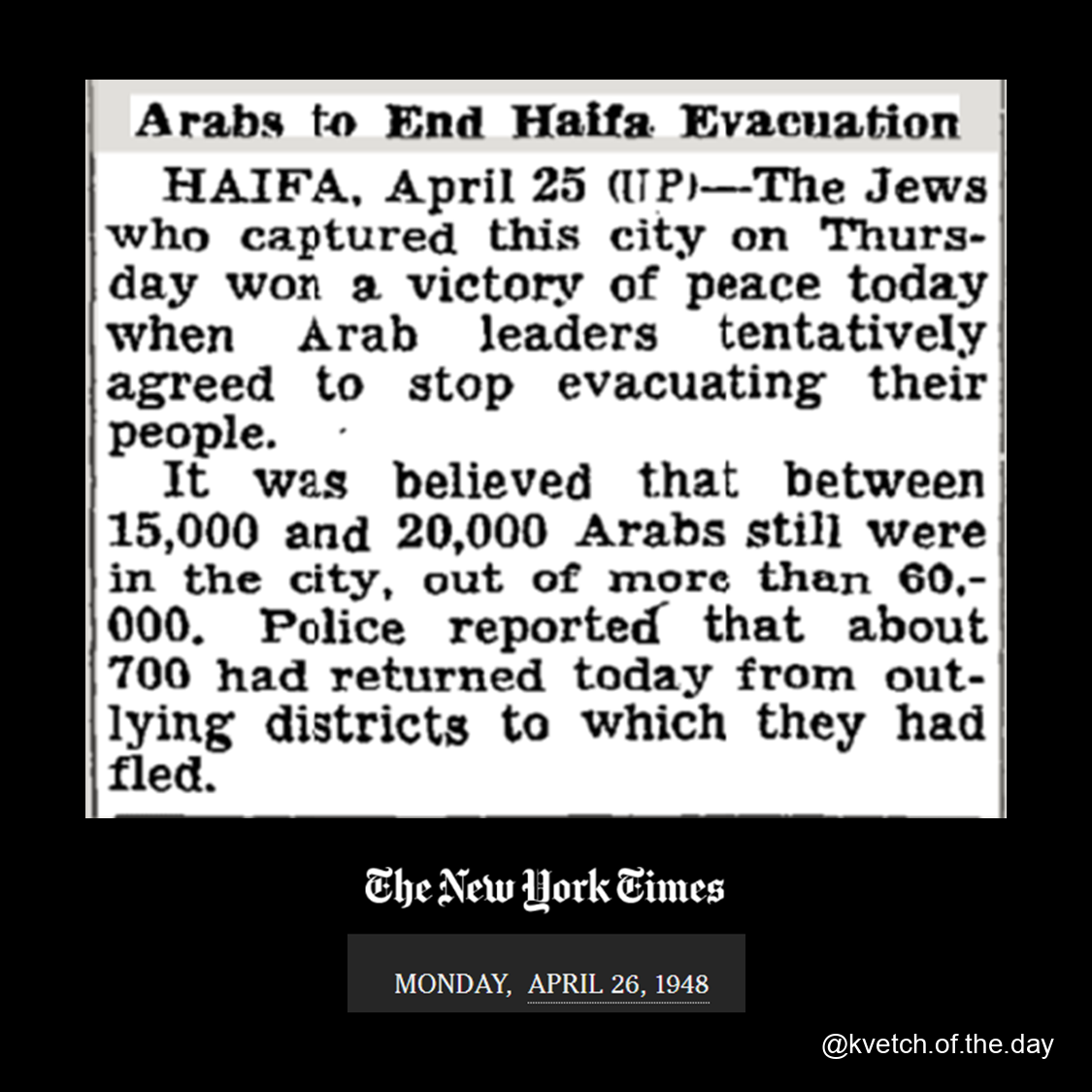
- In Haifa in April 1948, Arab leaders organised the evacuation of their own community after the Haganah took the city; the New York Times reported that only 15,000–20,000 of more than 60,000 Arabs remained, and that the leaders tentatively agreed to stop evacuating (NYT, 26 April 1948).
- Some Arab officials and commanders did urge or order evacuations in specific places, and wealthier families left early, before the fighting.
- The war was started by the rejection of partition and then an invasion by Arab states; people flee wars.
- Many Jews in Arab-held areas (e.g. the Jewish Quarter of Jerusalem's Old City, Gush Etzion) were expelled or killed, with no return either.
What's true
Flight had many causes, and in some places Arab leadership organised it.
Haifa is the best-known case: after the city fell, Arab leaders chose evacuation rather than accept terms, while some Jewish figures urged people to stay (NYT, 26 April 1948). Fear, collapse of Arab leadership and services, and early departures of the well-off all played a part. Historians of every school — including Benny Morris, whose archival work is central here — record multiple causes.
newspaper'Arabs to End Haifa Evacuation' (UP) (1948) ✓
historyBenny Morris, The Birth of the Palestinian Refugee Problem Revisited (2004)
Archival standard work; multiple causes by locality.
What's left out
Expulsions and massacres happened too, and return was then barred by policy.
In many places people were expelled: Lydda and Ramle (July 1948), where tens of thousands were forced out; villages depopulated in military operations; the Deir Yassin massacre (April 1948) spread terror that drove flight elsewhere. Whatever the cause of leaving, Israel then blocked return: in August 1948 Foreign Minister Moshe Shertok said return would be discussed only as part of a peace treaty, describing 'the Palestinian Arab exodus of 1948' as one of those 'cataclysmic phenomena' that change the course of history (NYT, 2 August 1948). Villages were subsequently razed or resettled, and the Absentees' Property Law (1950) transferred property. 'They left voluntarily' — even where true — doesn't answer why they could never come back.
Traps here:◆ "They all…"
newspaper'Bars Repatriation Now' by Gene Currivan (1948) ✓
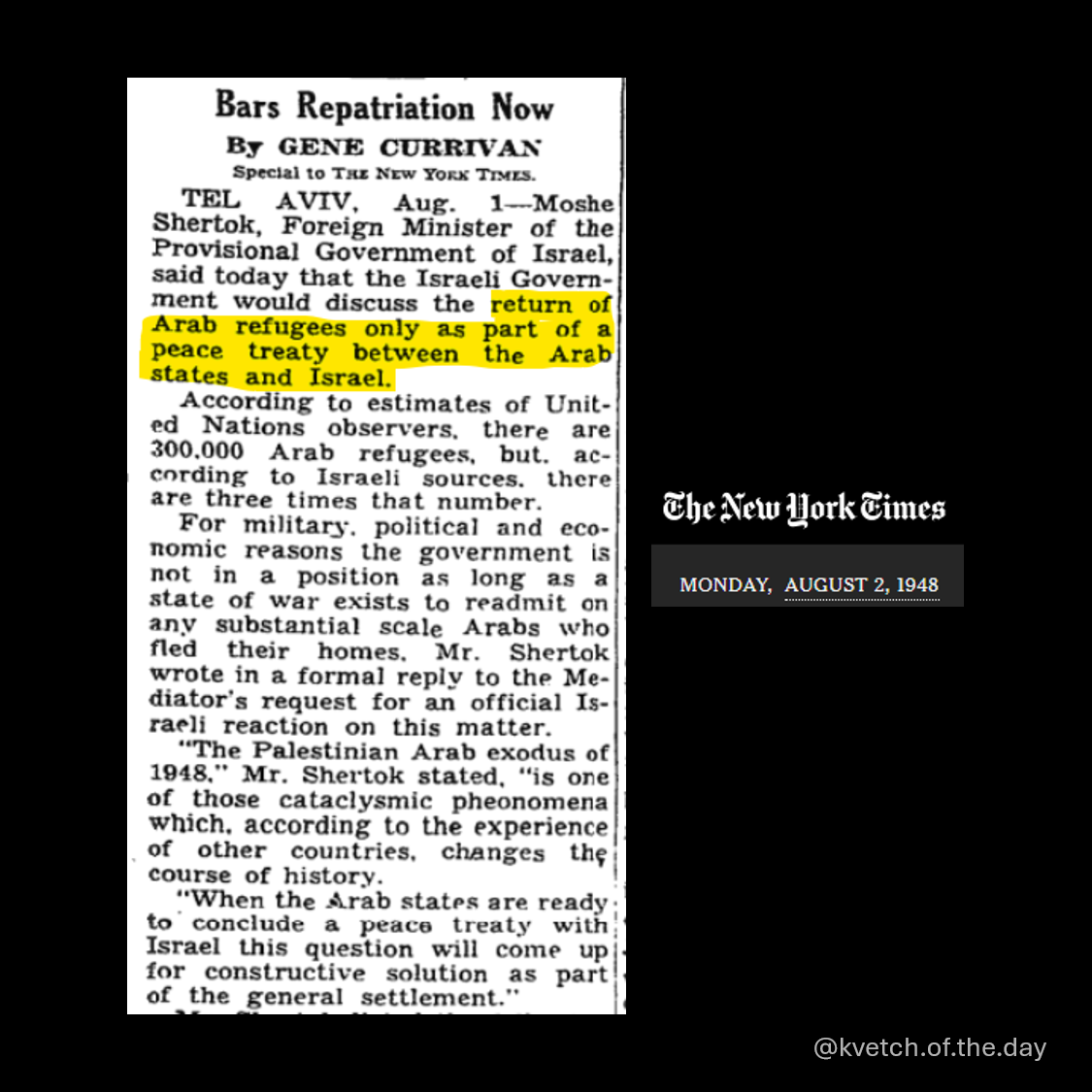
Scan from the kvetch-of-the-day news archive.
NYT 1948-08-02; vision-verified; Shertok's reply to the UN Mediator.
law / courtAbsentees' Property Law, 5710-1950 (Israel) (1950)
historyBenny Morris, The Birth of the Palestinian Refugee Problem Revisited (2004)
Archival standard work; multiple causes by locality.
Where it leads if pressed
The Nakba happened; the question is what's owed now.
Denying the expulsions is historically untenable and costs credibility with anyone who knows the record. Acknowledging them doesn't settle the political question — how many can return where, compensation, and the parallel Jewish exodus from Arab lands (see 'unrwa-refugees', 'jewish-nakba-cancels-out'). It is the starting point for answering it.
The usual reply — and its own traps
Arguments travel in pairs. Here is what the other side typically answers. Check whether both lean on the same trick.
heard from pro-Palestinian voices“The Nakba was a pre-planned ethnic cleansing — Plan Dalet was the blueprint.”Where this argument points
Followed through, this argument is used to support: