Argument · heard from pro-Palestinian voices
“The Nakba was a pre-planned ethnic cleansing — Plan Dalet was the blueprint.”
Zionist leaders planned from the start to expel the Arab population, and in 1948 they carried out a master plan to do so.
Traps in play:◆ "They all…"
Why people find it convincing
- Around 700,000 Palestinians left or were expelled, and hundreds of villages were emptied and later razed — the outcome looks like a plan.
- 'Transfer' of the Arab population was discussed by Zionist leaders before 1948, including in the context of the 1937 Peel Commission's proposal.
- Plan Dalet (March 1948) authorised the Haganah to take and hold territory, including destroying villages that resisted and expelling their inhabitants.
- Expulsions like Lydda and Ramle, and massacres like Deir Yassin, happened; return was barred afterwards.
- Historian Ilan Pappé argues this case in The Ethnic Cleansing of Palestine (2006).
What's true
Transfer ideas existed, expulsions happened, and the result was ethnic cleansing in many places.
Transfer was discussed before 1948 (the Peel Commission itself proposed population transfer in 1937). Plan Dalet gave commanders authority to destroy and expel in hostile villages. Expulsions (Lydda and Ramle), massacres (Deir Yassin) and the barring of return are documented. Calling the result ethnic cleansing in many localities is a position held by mainstream historians, not only critics.
primary documentPalestine Royal Commission Report (Peel Report) (1937)
Includes the population transfer proposal.
primary documentHaganah, Plan D (Tochnit Dalet), 10 March 1948 (1948)
Cite a translated text (e.g. Journal of Palestine Studies publication) and quote the village clauses exactly.
historyBenny Morris, The Birth of the Palestinian Refugee Problem Revisited (2004)
Archival standard work; multiple causes by locality.
What's left out
Most archival historians find no single master plan — causes varied by place, in a war the other side started.
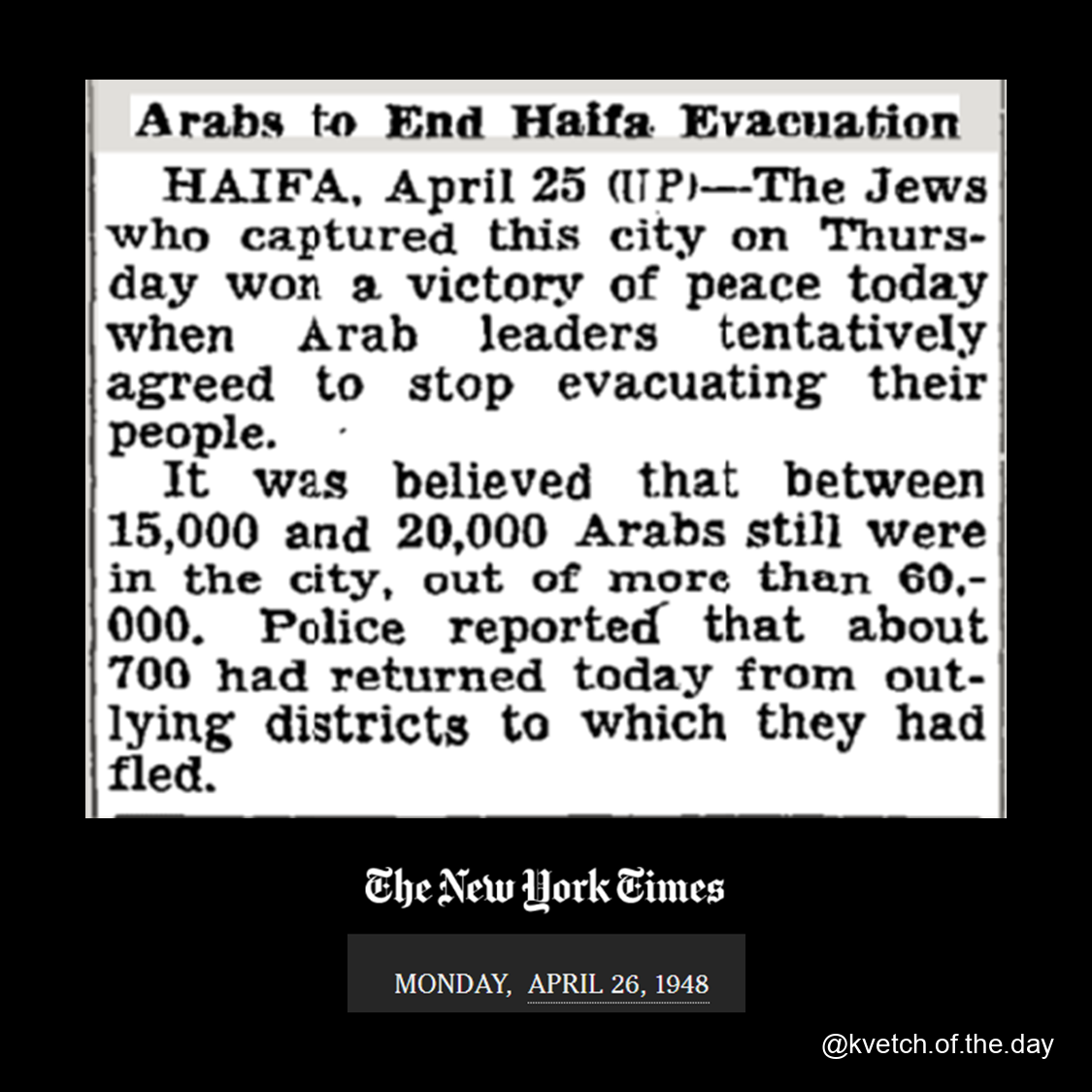
Benny Morris, who documented many expulsions, concludes that the refugee problem was 'born of war, not by design' — a mix of expulsions, fear, flight and collapse that varied by locality — while also saying transfer was 'in the air'. Plan Dalet was a military plan for holding territory against expected invasion, not an expulsion order for the whole population; some commanders expelled, others didn't, and about 150,000 Arabs remained and became citizens. In Haifa, Arab leaders organised their own community's evacuation (NYT, 26 April 1948). Pappé's master-plan thesis is contested by historians across the spectrum. The war itself followed Arab rejection of partition and an invasion by Arab armies (NYT, 16 May 1948: 'The Arab Armies Smash into Palestine').
Traps here:◆ "They all…"
historyBenny Morris, The Birth of the Palestinian Refugee Problem Revisited (2004)
Archival standard work; multiple causes by locality.
newspaper'Arabs to End Haifa Evacuation' (UP) (1948) ✓
historyIlan Pappé, The Ethnic Cleansing of Palestine (2006)
Master-plan thesis; cite alongside its critics.
Where it leads if pressed
Plan or not, the consequences are the same for the refugees — but not for the argument.
For the families, whether their expulsion was centrally planned or locally decided changes little. For the argument it matters: 'master plan' turns 1948 into proof that Israel's existence is itself a crime, while 'born of war' leaves room for a negotiated answer — acknowledgment, compensation, some return. The documented record supports serious acknowledgment; it doesn't require the master-plan version to justify it.
The usual reply — and its own traps
Arguments travel in pairs. Here is what the other side typically answers. Check whether both lean on the same trick.
heard from pro-Israel voices“The Palestinians left voluntarily in 1948 — their own leaders told them to go.”