Argument · heard on both sides
“UNRWA keeps millions of Palestinians as refugees forever — a problem kept alive on purpose.”
Pro-Israel version: inherited refugee status plus a general right of return keeps the conflict frozen around a 'solution' — mass return of ~5.9 million — that would end the Jewish majority. Pro-Palestinian mirror: UNRWA is the only thing standing between refugees and erasure, and attacks on it aim to erase the refugee question itself.
Traps in play:◆ Negotiation as a weapon◆ "What about you?"
Why people find it convincing
- Around 700,000 Palestinians fled or were expelled in 1948 and were not allowed back; the UN General Assembly's Resolution 194 (1948) said refugees wishing to return and live at peace should be permitted to do so. For those families this is a living loss, with deeds and keys still kept.
- UNRWA has run schools, clinics and relief for three generations in camps where host states gave little else; in Lebanon, refugees remain barred from many professions.
- Registered Palestine refugees now number around 5.9 million, because status passes to descendants; no comparable population from the 1940s is still counted as refugees in such numbers.
- Most other refugee populations of that era — including roughly 850,000 Jews who left or were driven out of Arab countries — were absorbed by the states that received them.
What's true
The refugees were real, return was blocked, and UNRWA filled a gap others refused to fill.
In August 1948 the International Refugee Organization declined to take on the Arab refugees, treating the task as war relief outside its constitution and demanding that each refugee show individual fear of persecution first (NYT, 10 August 1948). A separate agency followed: UNRWA, set up by the General Assembly in December 1949. Israel did not permit the return called for in Resolution 194. UNRWA's mandate is renewed by the General Assembly — it doesn't set political outcomes.
newspaper'IRO Shuns Problem of Arab Refugees' (1948) ✓
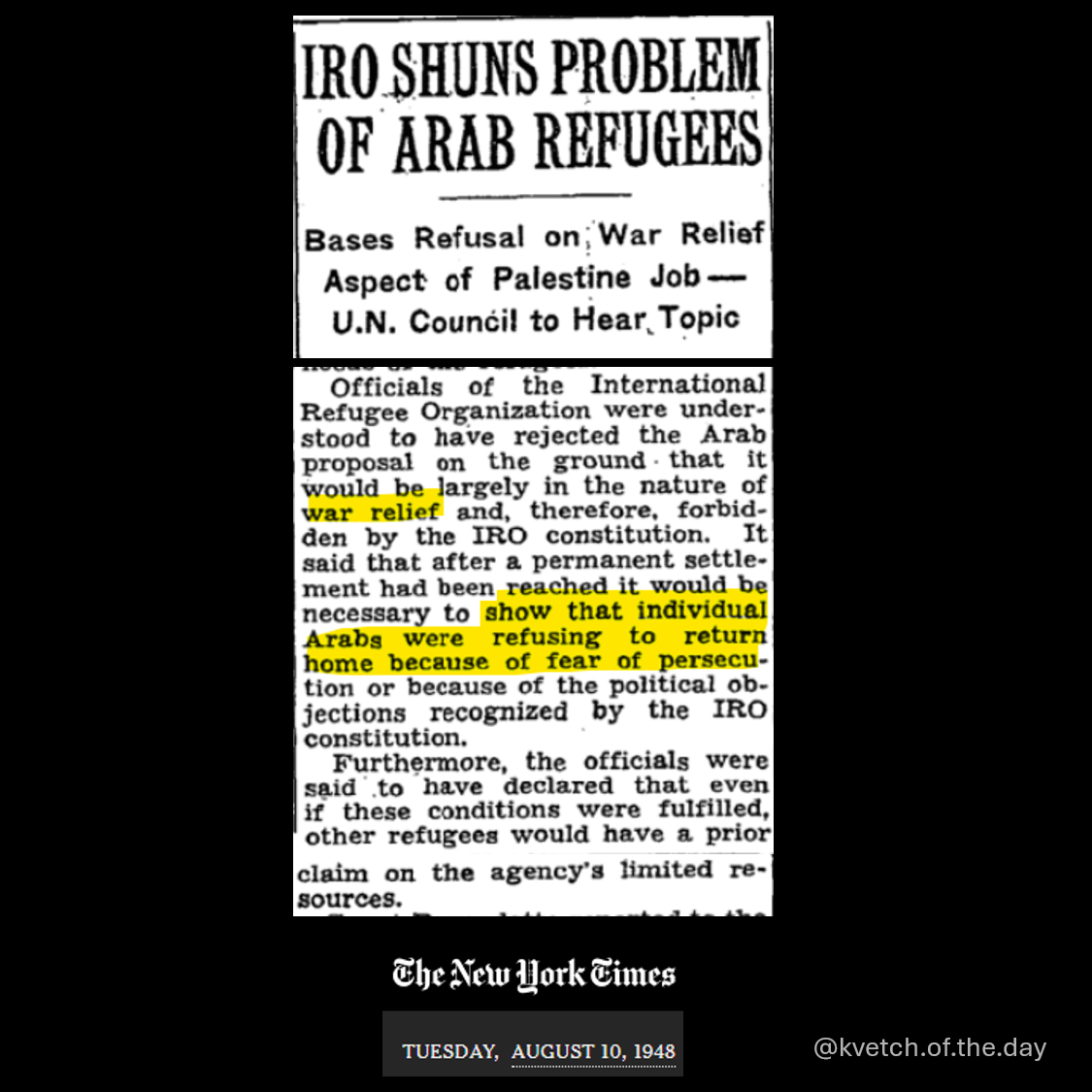
Scan from the kvetch-of-the-day news archive.
NYT 1948-08-10; vision-verified; kvetch-of-the-day clipping.
primary documentUN General Assembly Resolution 194 (III) (1948)
Paragraph 11 on refugees.
primary documentUN General Assembly Resolution 302 (IV): Assistance to Palestine refugees (1949)
Establishes UNRWA.
What's left out
It was meant to end the dole — and Arab states refused resettlement plans.
At its founding UNRWA was described as moving refugees 'from a dole to a work-relief status', a first step toward economic transformation through public works (NYT, 22 April 1950). In August 1959, nine Arab states rejected UN Secretary-General Dag Hammarskjöld's plan to spend $1.5–2 billion over five years to create productive jobs for about a million refugees in Arab lands, backing the demand for return instead (NYT, 19 August 1959). Jordan was the exception, granting citizenship to many refugees, who nevertheless stay registered. The argument that the problem was deliberately kept frozen, and that mass return would end Israel's Jewish majority, is made at length in Einat Wilf and Adi Schwartz, The War of Return (2020). A nuance to verify before using 'unique': UNHCR also recognises descendants in protracted situations.
Traps here:◆ Negotiation as a weapon◆ "What about you?"
newspaper'Problems in Palestine' (excerpt) (1950) ✓
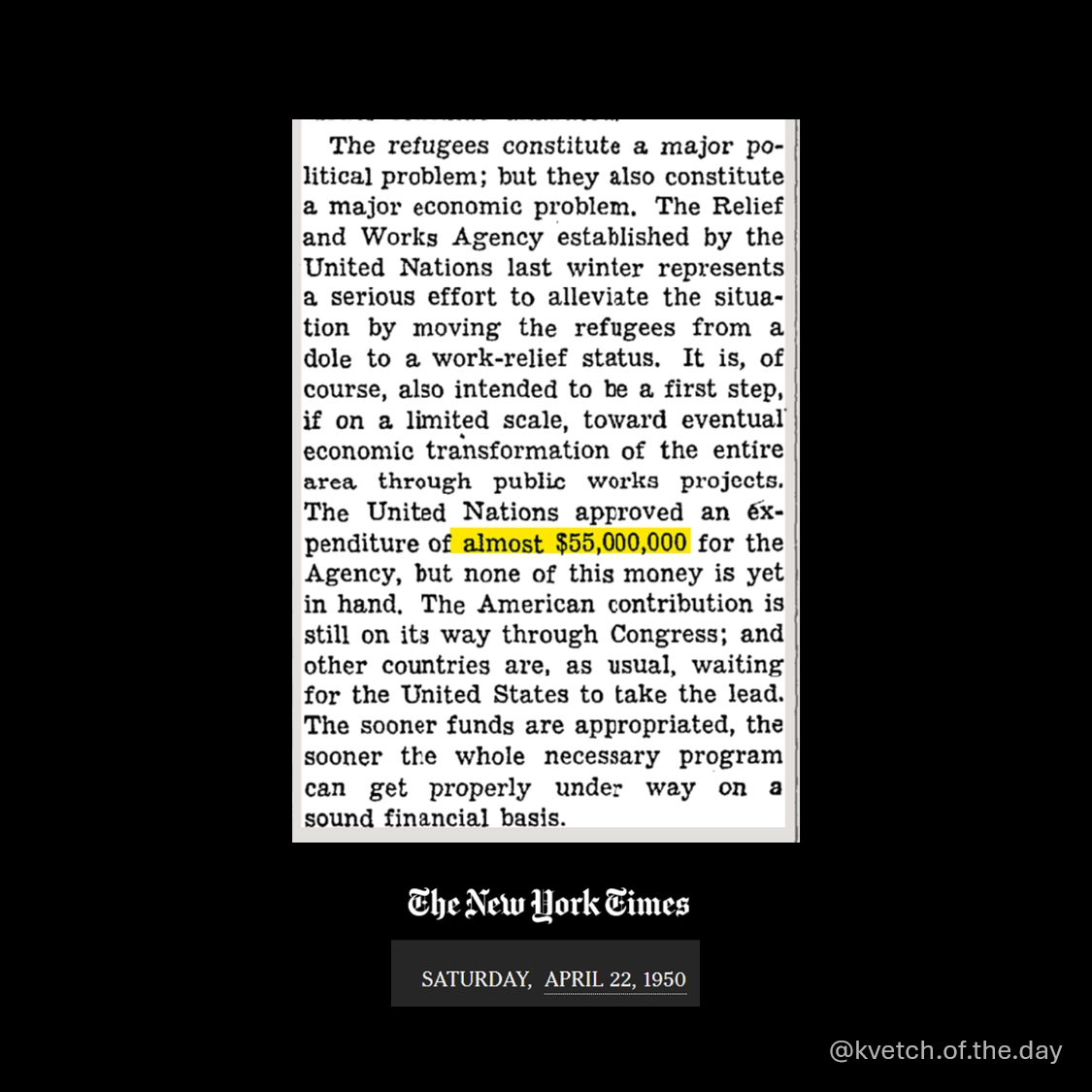
Scan from the kvetch-of-the-day news archive.
NYT 1950-04-22; vision-verified; UNRWA 'from a dole to a work-relief status'.
newspaper'Arab States Bar Refugee Aid Plan' by Richard P. Hunt (1959) ✓
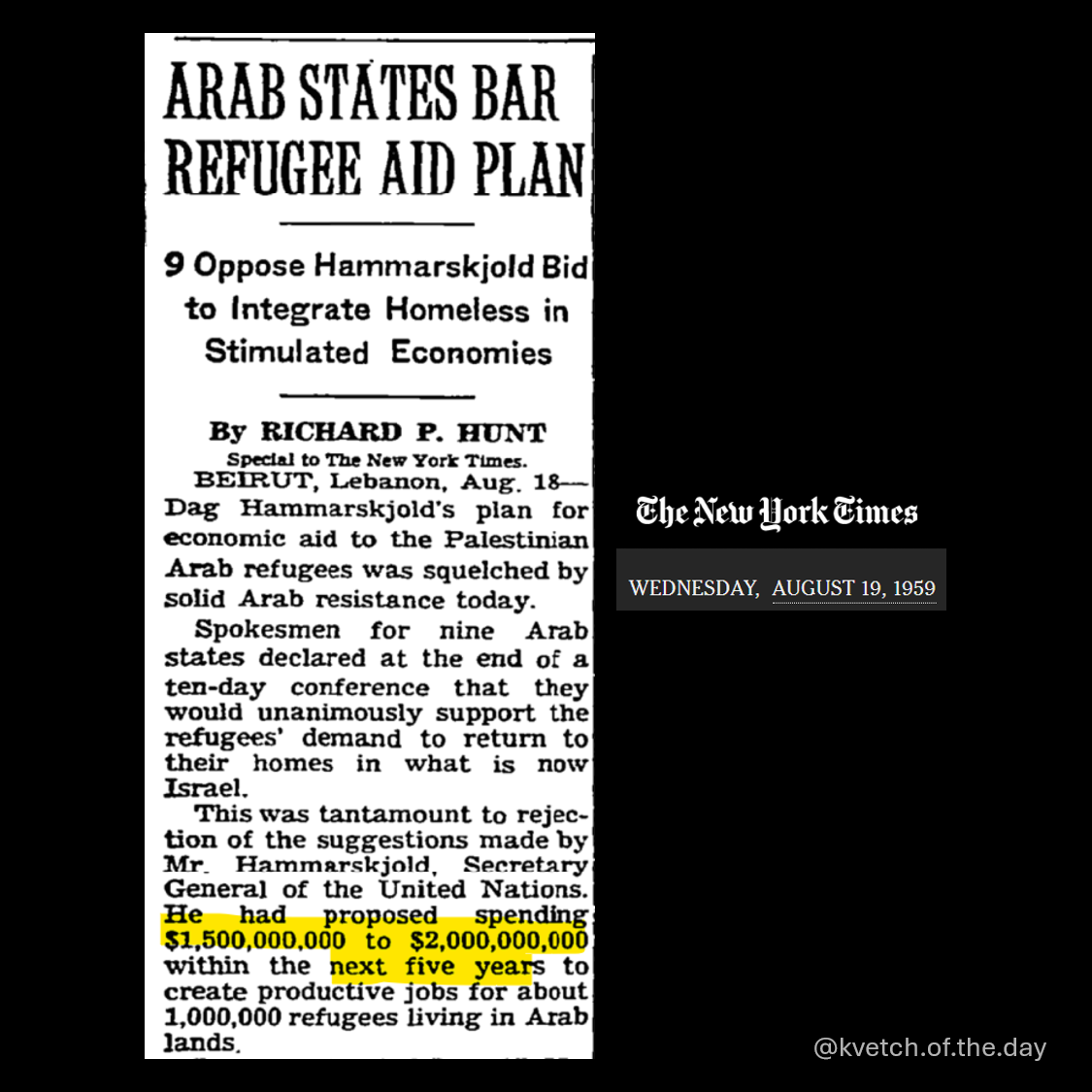
Scan from the kvetch-of-the-day news archive.
NYT 1959-08-19; vision-verified; nine Arab states reject Hammarskjöld plan.
advocacy / viewAdi Schwartz and Einat Wilf, The War of Return (2020)
Pro-Israel critique of the refugee regime; pair with a Palestinian-perspective history (e.g. Rashid Khalidi).
Where it leads if pressed
Symbolic return, compensation, resettlement — as negotiated before.
At Taba (2001) and in the Olmert–Abbas talks (2008), a model was reportedly discussed of limited, symbolic return to Israel, compensation, return to a Palestinian state, and resettlement elsewhere — suggesting maximal return has been a bargaining position rather than a fixed demand (verify how concrete those talks were). Demanding refugees drop the claim before any deal is demanding a concession up front; keeping ~5.9 million people in suspended status indefinitely is no solution either. The two displacements of 1948 — Palestinian and Jewish — are not a 'swap' that cancels out; each has individual victims owed an answer.
primary documentTaba talks (January 2001): EU Special Representative Moratinos' non-paper (2001) ⚠
Verify refugee provisions.
pressOlmert–Abbas negotiations (2008): reported refugee proposals (2008) ⚠
Verify from primary accounts.
The usual reply — and its own traps
Arguments travel in pairs. Here is what the other side typically answers. Check whether both lean on the same trick.
heard from pro-Israel voices“The Palestinians never miss an opportunity to miss an opportunity.”Where this argument points
Followed through, this argument is used to support: