Argument · heard on both sides
“Al-Aqsa is in danger.”
Jews are said to be plotting to take over or destroy the al-Aqsa mosque compound; defending it is presented as a religious duty.
Is this an actual argument? We haven't yet found it in a public source
Traps in play:◆ The strict enemy frame◆ Proxy presented as outcome
Why people find it convincing
- Since 1967 an unwritten status quo lets Jews visit but not pray on the Temple Mount / Haram al-Sharif; in August 2025 a sitting Israeli minister, Itamar Ben Gvir, openly led Jewish prayers there, and in January 2026 the prime minister backed expanded prayer while denying a change.
- Some Jewish groups openly campaign to rebuild the Temple on the site.
- Police raids on the compound during clashes, such as in 2021, are filmed and shared worldwide.
- Hamas named its October 7 attack 'Al-Aqsa Flood'.
What's true
The status quo is eroding, and parts of the Israeli right want it to.
Jewish prayer on the Mount, once a fringe demand, is now encouraged by a government minister; record numbers of Jewish visitors ascend on fast days. Israeli security experts warn that changing the status quo risks religious war. These are real grounds for concern.
pressTimes of Israel, 'In first, Ben Gvir openly leads prayers on Temple Mount, in violation of status quo' (3 August 2025) (2025)
advocacy / viewINSS, 'The Risk of Changing the Status Quo on the Temple Mount'
Israeli security think tank.
What's left out
'al-Aqsa in danger' is a century-old mobilising cry that has repeatedly preceded violence against Jews.
The rumour that Jews planned to seize al-Aqsa helped ignite the 1929 riots, including the Hebron massacre; in 1930 Muslim representatives refused Jews even the right to pray at the Western Wall below (NYT, 19 July 1930); a 1938 Baghdad fatwa called jihad a duty because 'the Mosque el Aksa and its surroundings in Palestine have been suffering' (NYT, 22 August 1938); Hamas named October 7 'Al-Aqsa Flood'. The mosque was not destroyed in any of these episodes. Real provocations exist — and the slogan turns each one into a religious call to arms, in which ordinary Jews become targets.
Traps here:◆ The strict enemy frame◆ Proxy presented as outcome
newspaper'Arabs Won't Yield on Wailing Wall' (AP/JTA) (1930) ✓
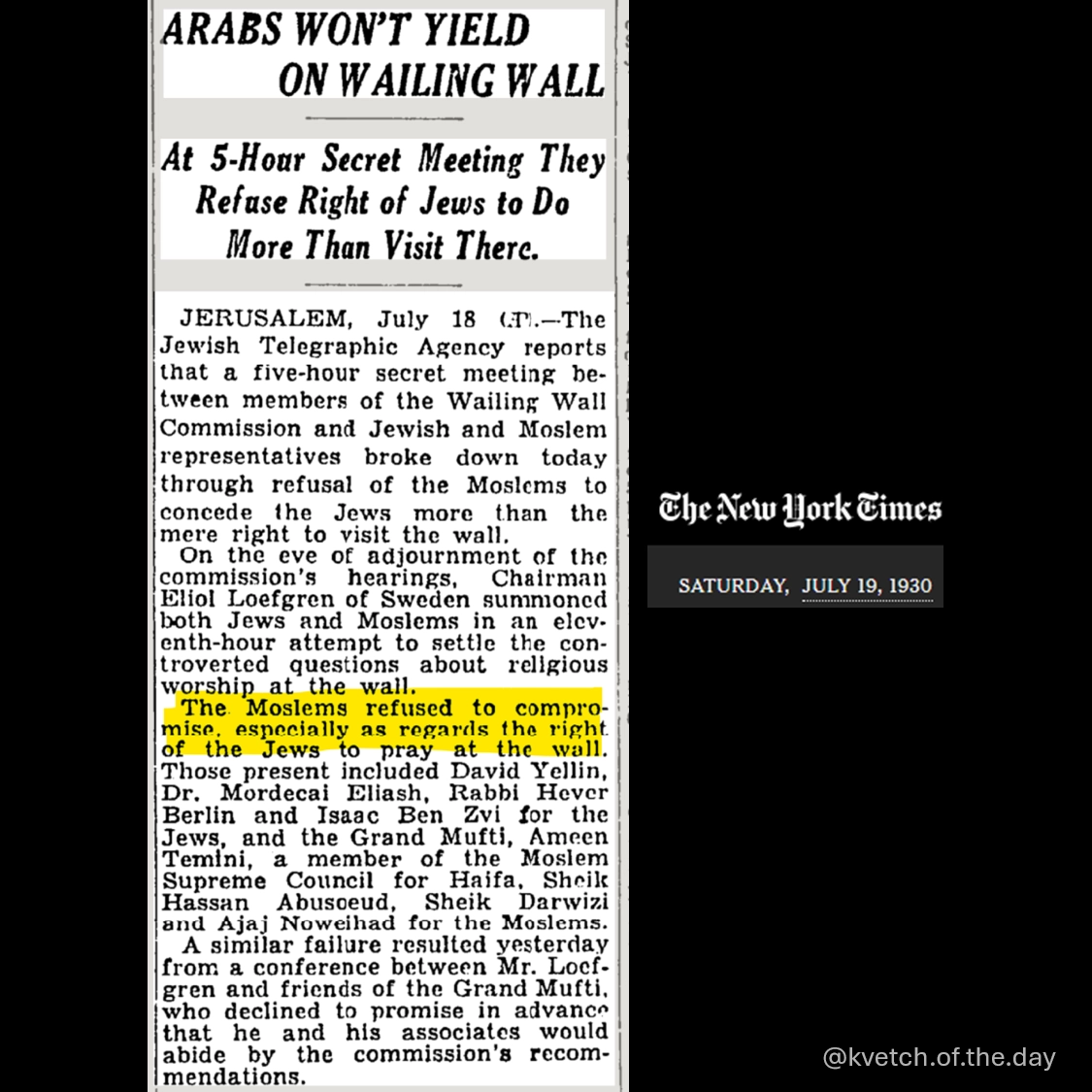
Scan from the kvetch-of-the-day news archive.
NYT 1930-07-19; vision-verified. Muslim representatives refuse the Jews' right to pray at the Wall.
newspaper'Arabs in Palestine Talk of Holy War' (incl. 'Ruling Calls for Jehad') (1938) ✓
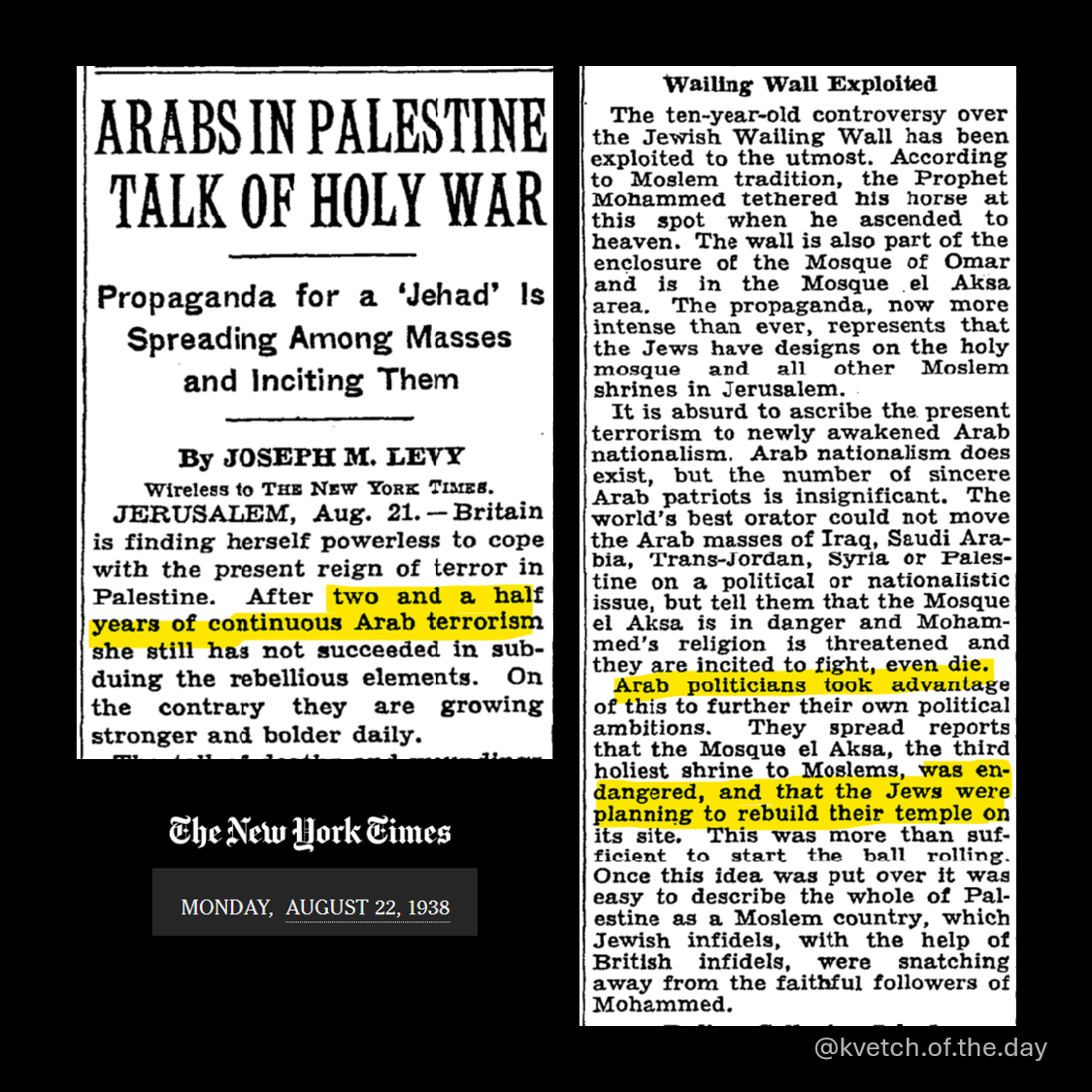
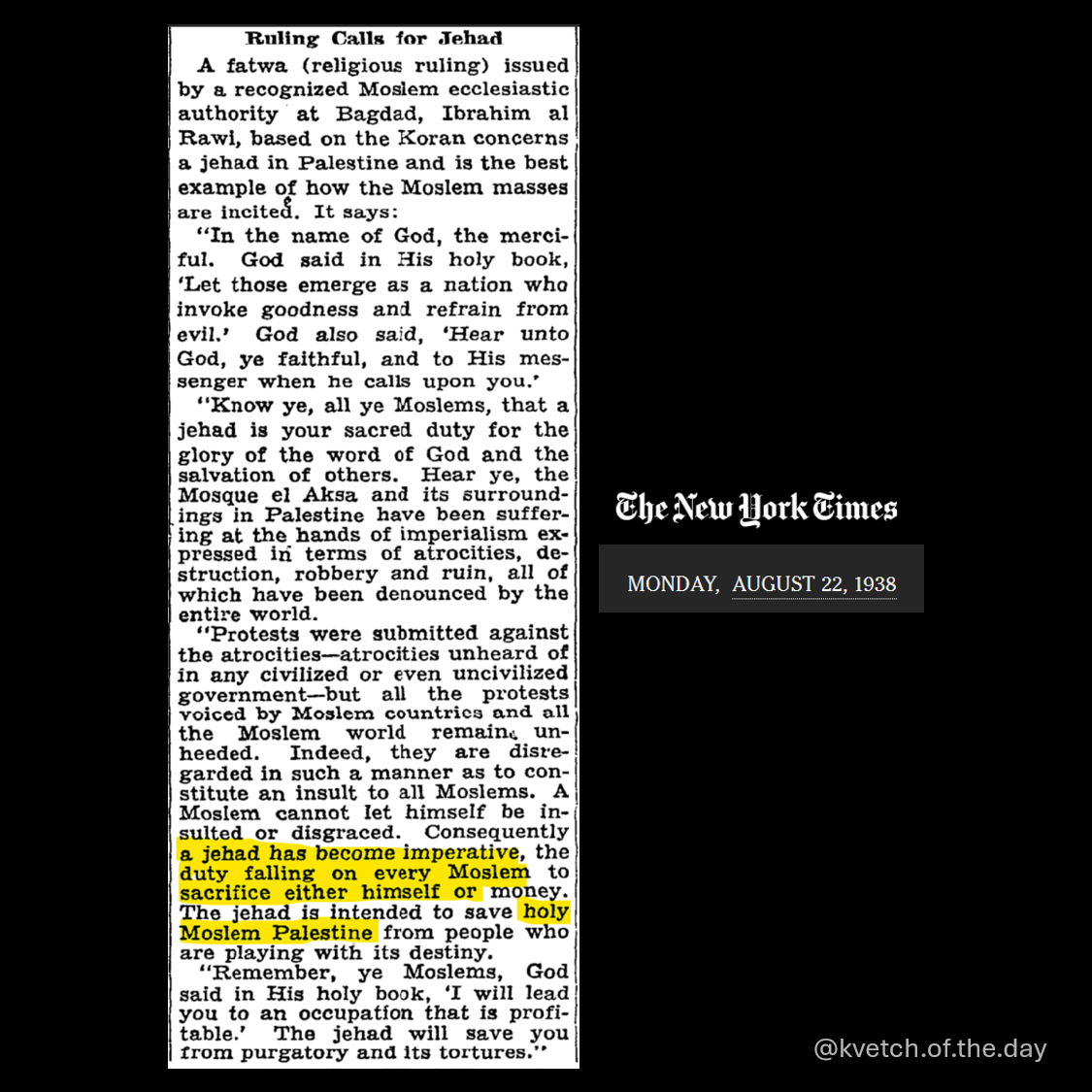
Scan from the kvetch-of-the-day news archive.
NYT 1938-08-22; image 2 vision-verified: Baghdad fatwa — 'the Mosque el Aksa and its surroundings in Palestine have been suffering'.
Which al-Aqsa? One word, three places, two holy sites.
'Al-Aqsa' can mean the whole Haram al-Sharif compound (Muslim usage), just the mosque at its southern end (common Western usage), or, seen from the other side, the Temple Mount, the holiest site in Judaism. So 'Israelis stormed al-Aqsa' and 'Jews visited the Temple Mount' can describe the same morning. The Qur'an's 'Farthest Mosque' (17:1) is identified with Jerusalem by Muslim tradition, not by the text itself, which names no city; the mosque was built decades after the Prophet's death, and some historians argue that the Umayyads raised Jerusalem's status for political reasons. None of that makes the site less holy to Muslims today: holiness lives in belief and practice, as it does for the Temple Mount.
Where it leads if pressed
Protect the status quo — from both directions.
The site is holy to both. Keeping it calm means Israeli governments restraining those who push for Jewish prayer or a Temple, and Palestinian and Arab leaders stopping the use of 'al-Aqsa in danger' as a trigger for violence. Either side's religious maximalism, left unchecked, can turn a local conflict into a religious war.