Theme
“Jews and Arabs can't live together.”
Either side's claim that coexistence is impossible — used to justify separation, expulsion, or 'decolonisation'.
Why people find it convincing
- Massacres happened between neighbours: Hebron 1929, and in 1955 in Mazagan, Morocco, a survivor said 'It was our neighbors who did it. We had been living next door to them for twenty years.'
- Decades of war, terror and occupation have left deep distrust on both sides.
- Many mixed places have separated over time.
What's true
Contact is not a guarantee.
Neighbours have turned on neighbours — the 1955 Mazagan riots in Morocco (NYT, 26 August 1955: 'African Jews Ask Haven in Israel'), Hebron 1929, and many episodes in both directions since. Any account of coexistence that hides this is not credible.
newspaper'African Jews Ask Haven in Israel' (1955) ✓
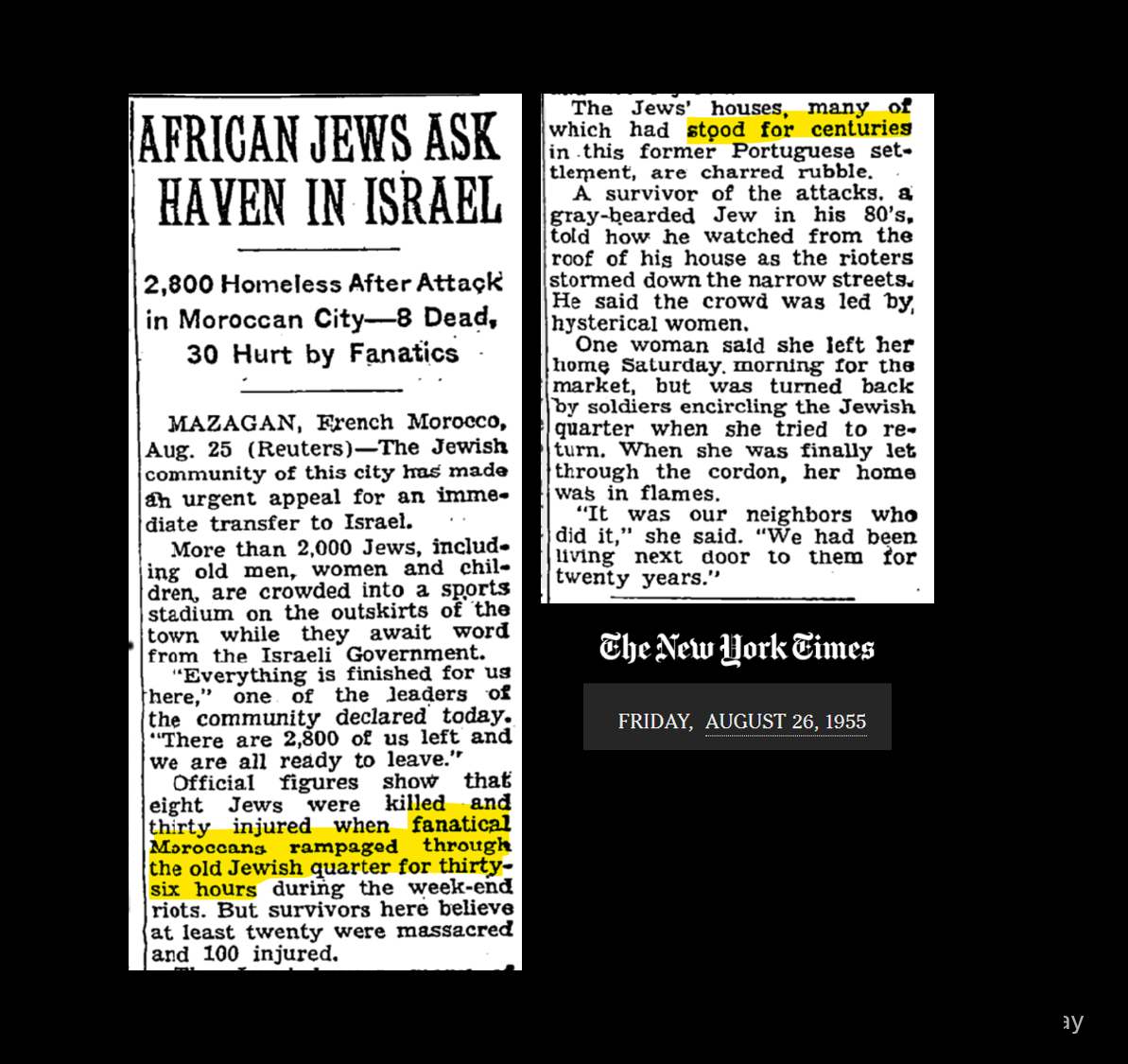
Scan from the kvetch-of-the-day news archive.
NYT 1955-08-26 (index date corrected from 1855); kvetch-of-the-day clipping 3add6f94-3ef1-800e-958c-d058f7b1ef0c.
What's left out
Where there is sustained contact, people are more pragmatic than the movements that speak for them.
Before the 1920s, the Old Yishuv and Arab neighbours lived side by side in Jerusalem, Hebron, Safed and Tiberias; many Sephardi Jews spoke Arabic. In the 1929 Hebron massacre, Arab families sheltered and saved hundreds of Jews. Mixed cities — Haifa, Jaffa, Acre — function today, with friction. Polling of Arab citizens of Israel after 2023 showed rising identification with the state, and East Jerusalem polls have found a large share preferring Israeli citizenship (verify figures). In 1860 London's Chief Rabbi asked Jews to give for Syria's Christians after massacres there, as 'children of the same Almighty Father' (NYT, 25 October 1860). The divide ran along politics and factions, not descent: old Jerusalem families produced both the Mufti Hajj Amin al-Husseini and the more moderate Nashashibis.
historyAccounts of Arab families sheltering Jews during the 1929 Hebron massacre (1929)
Cite a historian (e.g. Hillel Cohen, Year Zero of the Arab-Israeli Conflict: 1929) and contemporary lists.
dataPolls of East Jerusalem Palestinians on citizenship preferences (e.g. Washington Institute / David Pollock)
Give exact figures and years; note methodology.
press'Affairs in Syria' (Chief Rabbi Adler's appeal) (1860)
NYT 1860-10-25; kvetch-of-the-day archive.
The picture
Contact coexists with real grievance.
East Jerusalem Palestinians face residency revocations, building-permit restrictions and demolitions, and evictions such as Sheikh Jarrah (2021); Arab citizens face unequal land and planning policy. Coexistence where there's contact doesn't erase these — it is the ground on which they can be fixed.
Where it leads if pressed
Where it leads: more contact, not less.
People who build contact exist on both sides and are pushed out of view by the purity loop: Standing Together (Jewish–Arab movement), the Parents Circle – Families Forum (bereaved Israeli and Palestinian families), Combatants for Peace, Road to Recovery (Israelis driving Palestinian patients to hospital), Realign for Palestine. The line in this conflict doesn't run between peoples; it runs between ideologues who need an enemy and people who want a solution — and the second group on each side has more in common with the second group on the other than with the first on its own.
Where this argument points
Followed through, this argument is used to support: