Argument · heard from pro-Israel voices
“The Arab world loves Palestine in words and abandons Palestinians in deeds.”
Palestinians are refused everywhere in the Arab world. Gaza's most closed border is the one with Egypt; Lebanon won't let them work; Kuwait threw them out. The Arab states keep them stateless as a weapon against Israel — they care about the cause, not the people.
Is this an actual pro-Israel argument? We haven't yet found it in a public source
Traps in play:◆ The exception as proof◆ "What about you?"
Why people find it convincing
- In August 1959 nine Arab states rejected UN Secretary-General Hammarskjöld's plan to spend $1.5–2 billion over five years creating jobs for about a million refugees in Arab lands, insisting on return instead (NYT, 19 August 1959).
- Lebanon still bars Palestinians from many professions and, since 2001, from owning property; generations born there remain stateless.
- Kuwait expelled or refused re-entry to most of its large Palestinian community after the PLO sided with Saddam Hussein in 1990–91.
- Syria's government besieged the Yarmouk refugee camp from 2013, with deaths from starvation.
- Egypt kept the Rafah crossing largely closed for years, and in 2023–25 refused to let Gazans flee into Sinai.
What's true
Arab states kept the refugees as a cause while restricting them as people.
The 1959 rejection of Hammarskjöld's integration plan is on the record, in the refugees' name: the states would 'unanimously support the refugees' demand to return' instead (NYT, 19 August 1959). Lebanon's legal restrictions, Kuwait's mass expulsion after 1991, the siege of Yarmouk and Egypt's closed border are documented. Arab states have also usually provided only a small share of UNRWA's budget compared with the US and Europe. The gap between rhetoric and treatment is real, and many Palestinians say so themselves.
newspaper'Arab States Bar Refugee Aid Plan' by Richard P. Hunt (1959) ✓
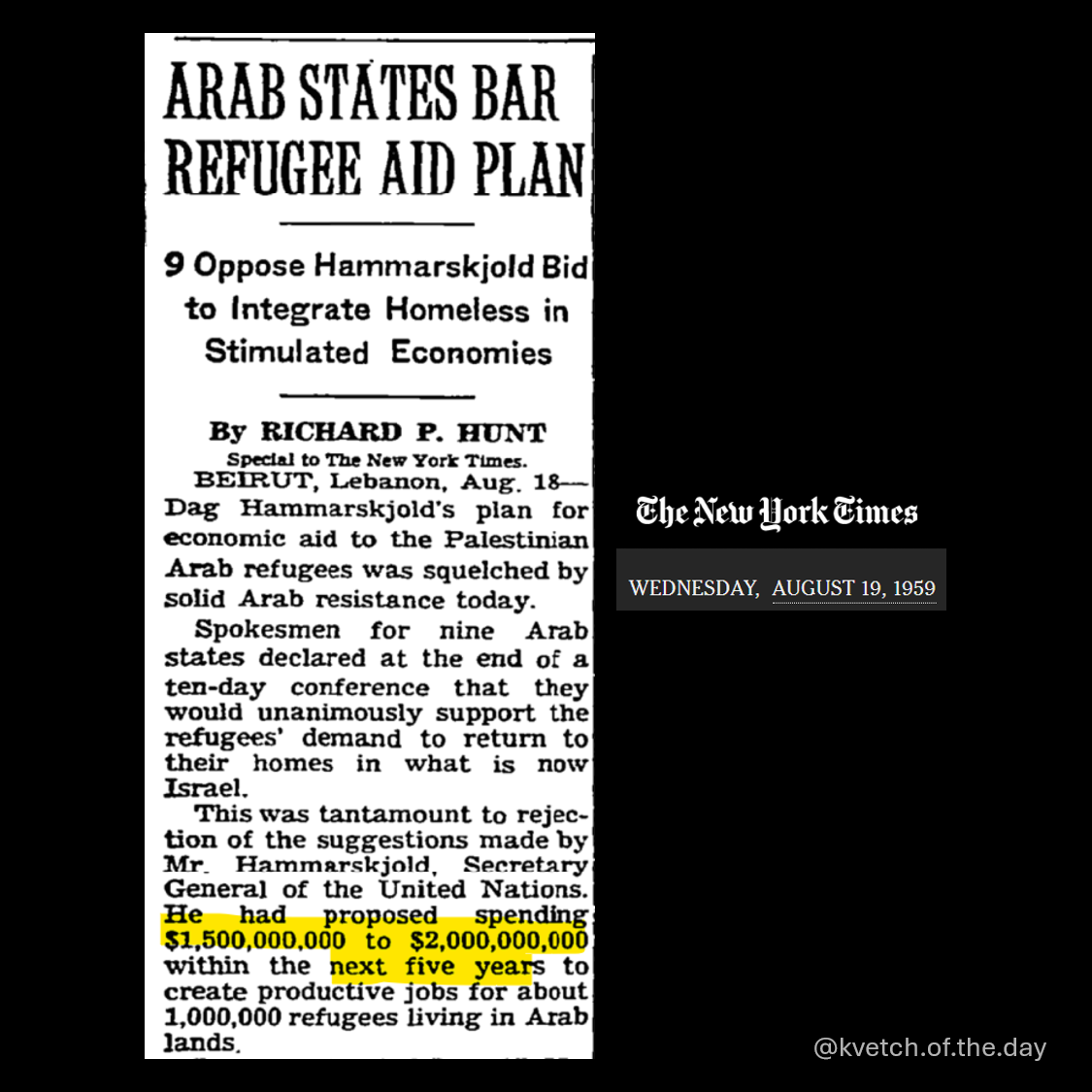
Scan from the kvetch-of-the-day news archive.
NYT 1959-08-19, Beirut; vision-verified. Nine Arab states reject Hammarskjöld's $1.5–2bn five-year jobs plan for ~1,000,000 refugees.
law / courtLebanon, Law 296 (2001) amending the foreign property ownership law (2001) ⚠
Bars persons without citizenship of a recognised state from owning property. Also verify the current list of professions closed to Palestinians.
dataUNRWA, pledges and contributions by donor (annual tables) ⚠
Compare Arab states' share with the US and EU over time; note the years (e.g. 2018) when Gulf states stepped in.
What's left out
The stated reason, the exceptions, and a great deal of state aid.
Arab governments say resettling the refugees would 'liquidate the cause', meaning the right of return, and many Palestinians share that view; it's a political choice rather than simple indifference. Jordan gave most Palestinians full citizenship. Egypt also cites the Sinai insurgency and fears that Gazans pushed across would never be allowed back. And aid is not only private: the UAE, Qatar, Saudi Arabia, Egypt, Jordan and Turkey have given large state aid (field hospitals, fuel and salaries, desalination, airdrops), and Rafah was the main route for aid into Gaza, run largely by the Egyptian Red Crescent. None of this cancels the hypocrisy point. It shows the motives were political, not just callous.
Traps here:◆ The exception as proof
Where it leads if pressed
The hypocrisy is real, but it doesn't settle anything between Israelis and Palestinians.
'The Arab states treat them badly too' is true and worth knowing: it shows how the refugees became a political instrument, including for the states that speak loudest for them. Pushed further, it slides into two traps. One is tu quoque ('others are worse, so our part doesn't count'). The other is its ironic conclusion, 'in deeds only Israel really cares', which picks the flattering facts and drops the rest. The strong version needs neither: the refugee question was kept open on purpose, by many hands, and any real solution has to close it with the Arab states taking part.
Traps here:◆ "What about you?"
The usual reply — and its own traps
Arguments travel in pairs. Here is what the other side typically answers. Check whether both lean on the same trick.
heard on both sides“UNRWA keeps millions of Palestinians as refugees forever — a problem kept alive on purpose.”