Argument · heard from pro-Palestinian voices
“Jews lived peacefully in the Arab world for centuries until Zionism ruined it; they left because Israel lured them.”
The Jewish exodus from Arab countries after 1948 was voluntary or engineered by Zionist agents, and the 'golden age' of coexistence shows the conflict is purely about Zionism, not antisemitism.
Made publicly as a pro-Palestinian argument by Hamas
Where it's been said
“Hamas is of the view that the Jewish problem, anti-Semitism and the persecution of the Jews are phenomena fundamentally linked to European history and not to the history of the Arabs and the Muslims or to their heritage.”
Traps in play:◆ "They all…"
Why people find it convincing
- Jews lived in the Arab and Muslim world for over two thousand years, often better protected than in Christian Europe; periods such as Muslim Spain and Ottoman rule are real high points.
- Many Mizrahi Jews spoke Arabic, shared music and food, and some identified as Arab Jews; some remember neighbours fondly to this day.
- Zionist emissaries did organise emigration, and there are disputed allegations of Zionist involvement in the 1950–51 Baghdad bombings.
- The rise of Zionism and the 1948 war did sharply worsen the position of Jews in Arab states.
What's true
Long coexistence, real high points, and a real turn after 1948.
Jewish life in the Muslim world spans millennia and included genuine flourishing. In al-Andalus, Cordoba and Granada each had 'five or six thousand Jews' and 'at least two dozen synagogues'; after the expulsion from Spain in 1492 'tens of thousands of Iberian Jews arrived in Ottoman territories' (My Jewish Learning). Jews were a protected (dhimmi) minority — protected, but legally subordinate (see 'Under Islam, Jews were humiliated second-class dhimmis — and Islamists want to bring it back.'). Zionist organisations did actively organise emigration: the Zionist underground in Iraq had been active since 1942, after the Farhud, and helped some Jews leave illegally. Who planted the five bombs against Jewish targets in Baghdad in 1950–51 has been 'publicly contested for 75 years, with two Israeli official commissions of inquiry' (Middle East Eye, reviewing Avi Shlaim's memoir). Shlaim, born in Baghdad, argues from Israeli archives and a former activist's testimony that 'three of the five bombings were the work of the Zionist underground'; one convicted member, Yusuf Basri, had been recruited and trained by the Mossad. His critics answer that the commissions found no evidence of Mossad's involvement, that three of the bombs went off after the March 1951 emigration deadline and caused no casualties, and that he misdates one bombing (Lyn Julius, JNS). The two reviews even describe his account of the deadliest attack, at the Mas'uda Shemtob synagogue, differently. How much of what followed the 1948 war set off is the question the next note takes up.
advocacy / viewMiddle East Eye, review of Avi Shlaim, 'Three Worlds: Memoirs of an Arab-Jew' (12 July 2023) (2023) ✓
Read (2026-09-28). The Zionist underground 'active since 1942 in the aftermath of the barbaric Farhud'; the five bombings' authorship 'publicly contested for 75 years, with two Israeli official commissions of inquiry'; Shlaim: 'three of the five bombings were the work of the Zionist underground'; Yusuf Ibrahim Basri 'recruited and trained by the Mossad', hanged January 1952; the first bombing attributed to Istiqlal 'tentatively'; the synagogue grenade (four killed) described as the revenge of an Iraqi criminal.
advocacy / viewLyn Julius, 'Beware distinguished professors rewriting history', JNS (opinion) ✓
Read (2026-09-28). Pro-Israel writer on Jews from Arab lands: 'two Israeli commissions of inquiry did not find any evidence of Mossad's involvement'; Shlaim 'falsifies the chronology' (a June 1951 explosion dated to March 1950); three bombings 'occurred three months after the March emigration deadline had passed and caused no casualties'; in her account Shlaim attributes the synagogue attack to Iraqis acting 'at the behest of "the Zionists"'; Shafik Ades executed in 1948.
referenceMy Jewish Learning, 'The Sephardic Exodus to the Ottoman Empire' ✓
Read 2026-09-29 (Jewish educational site). 'in the wake of the expulsion from Spain (1492) and the forced conversion in Portugal (1497), tens of thousands of Iberian Jews arrived in Ottoman territories'; Romaniot and Arabic-speaking Jewish communities were already there.
referenceMy Jewish Learning, 'From Golden to Grim: Jewish Life in Muslim Spain' ✓
Read 2026-09-29 (Jewish educational site). 'Cordoba and Granada, each with five or six thousand Jews, maintained at least two dozen synagogues'; the 'mass violence that followed the assassination of Joseph ibn Nagrela, a Jewish vizier to the court of Granada, in 1066'; 'Decades of brutal Almohade persecution followed—of forced conversions equally of Jews, Christians, and "backsliding" Muslims', until 1212.
What's left out
Violence before 1948, persecution after it, and roughly 850,000 people who did not leave for nothing.
The Farhud in Baghdad (1–2 June 1941), after a pro-Axis coup, killed between 150 and 180 Jews and injured about 600, by the US Holocaust Memorial Museum's account (the official Iraqi commission of inquiry counted 128 killed and 210 injured), and some 1,500 stores and homes were looted. In November 1945 a pogrom swept Tripolitania: 'About 300 Jews were reported to have been killed… houses were fired along with their occupants'; by 1950 Tripoli had become a refuge for thousands fleeing villages where 'there are no longer any Jews' (NYT, 27 August 1950). In May 1948 the NYT reported 'Jews in Grave Danger in All Moslem Lands', with a World Jewish Congress count of 899,000 Jews in Arab and Muslim lands and an Arab League draft law to treat them as 'members of the Jewish minority state of Palestine', freeze their accounts and intern suspected Zionists (NYT, 16 May 1948; the draft law needs an independent primary source). Mazagan, Morocco, August 1955: 'It was our neighbors who did it.' In March 1950 Iraq decided 'to permit the departure of her Jews', but 'all those who left for Israel would first be forced to renounce their citizenship', and 'if they did not sell their property before making such a declaration they would have no claim to it thereafter'; Israel, for its part, said it would accept 'all those who must come because of pressure upon them' and ask others 'to bide their time' (NYT, 18 March 1950). In September 1951 the representatives of Libya's 8,000 Jews asked for help to emigrate to Israel before independence, a delegate saying they 'would not feel safe once Arab tribal chiefs took control', and 'every Jewish community in Libya had been evacuated to the relative safety of the capital' (NYT, 18 September 1951). After Suez, in February 1957, the American Jewish Congress asked the United States 'to grant asylum to Jews expelled from Egypt' and accused Egypt of 'a systematic program to destroy "the ancient Jewish community of Egypt"' (NYT, 17 February 1957; the charges are the Congress's). Egypt's government denied them at the time: its foreign minister, Mahmoud Fawzi, said 'Out of 66,000 Jews in Egypt, only 120 have been interned for valid reasons of public security', and its information director called reports of persecution and expulsion 'completely false' (December 1956, as quoted by the American Jewish Committee, March 1957, which disputes them). In Libya, 'From 1949 to 1952, over thirty thousand Jews, or well over 90 percent of the 36,000 Jews then living in Libya, left for Israel'; the 'approximately 4,500' still there 'on the eve of the June 1967 war' faced 'forced evacuation', and 'During 6-9 June, some of the Tripoli Jews were murdered' (Maurice Roumani, Jewish Political Studies Review, 2007). Of about 851,000 Jews in eight Arab countries in 1948, fewer than 4,000 remain, the largest community Morocco's at about 2,100 (Jewish Virtual Library, from Sergio DellaPergola's figures in the American Jewish Year Book).
Traps here:◆ "They all…"
newspaper'Tripoli Described as Refugee Haven' (1950) incident ✓
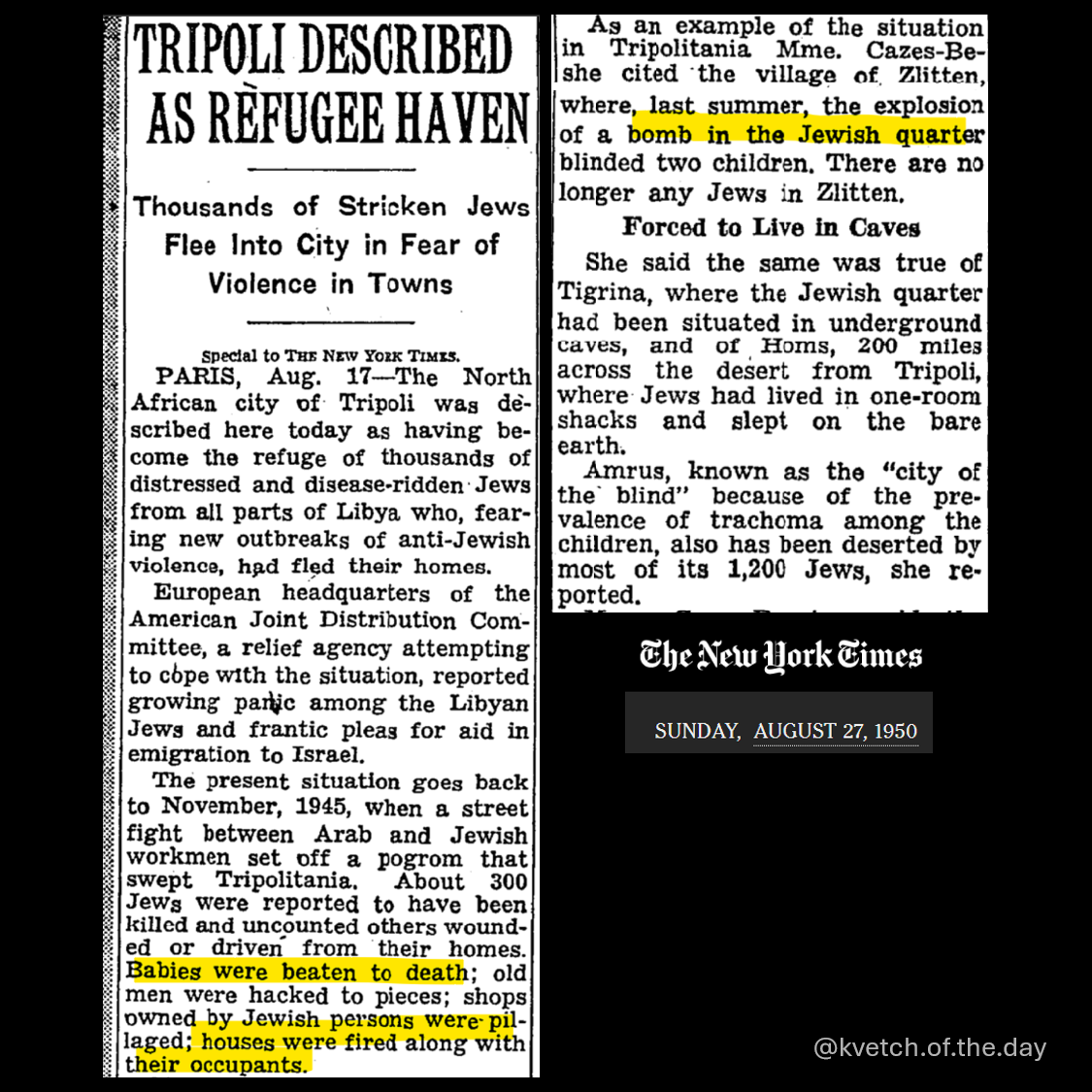
Scan from the kvetch-of-the-day news archive.
NYT 1950-08-27, Special to the NYT (Paris); vision-verified. Text read from the clipping image (OCR checked 2026-10-13): 'About 300 Jews were reported to have been killed and uncounted others wounded or driven from their homes. Babies were beaten to death; old men were hacked to pieces; shops owned by Jewish persons were pillaged; houses were fired along with their occupants' (on the November 1945 Tripolitania pogrom).
newspaper'Jews in Grave Danger in All Moslem Lands' (incl. map, and sub-article 'Nine Hundred Thousand in Africa and Asia Face Wrath of Their Foes') (1948) pattern ✓
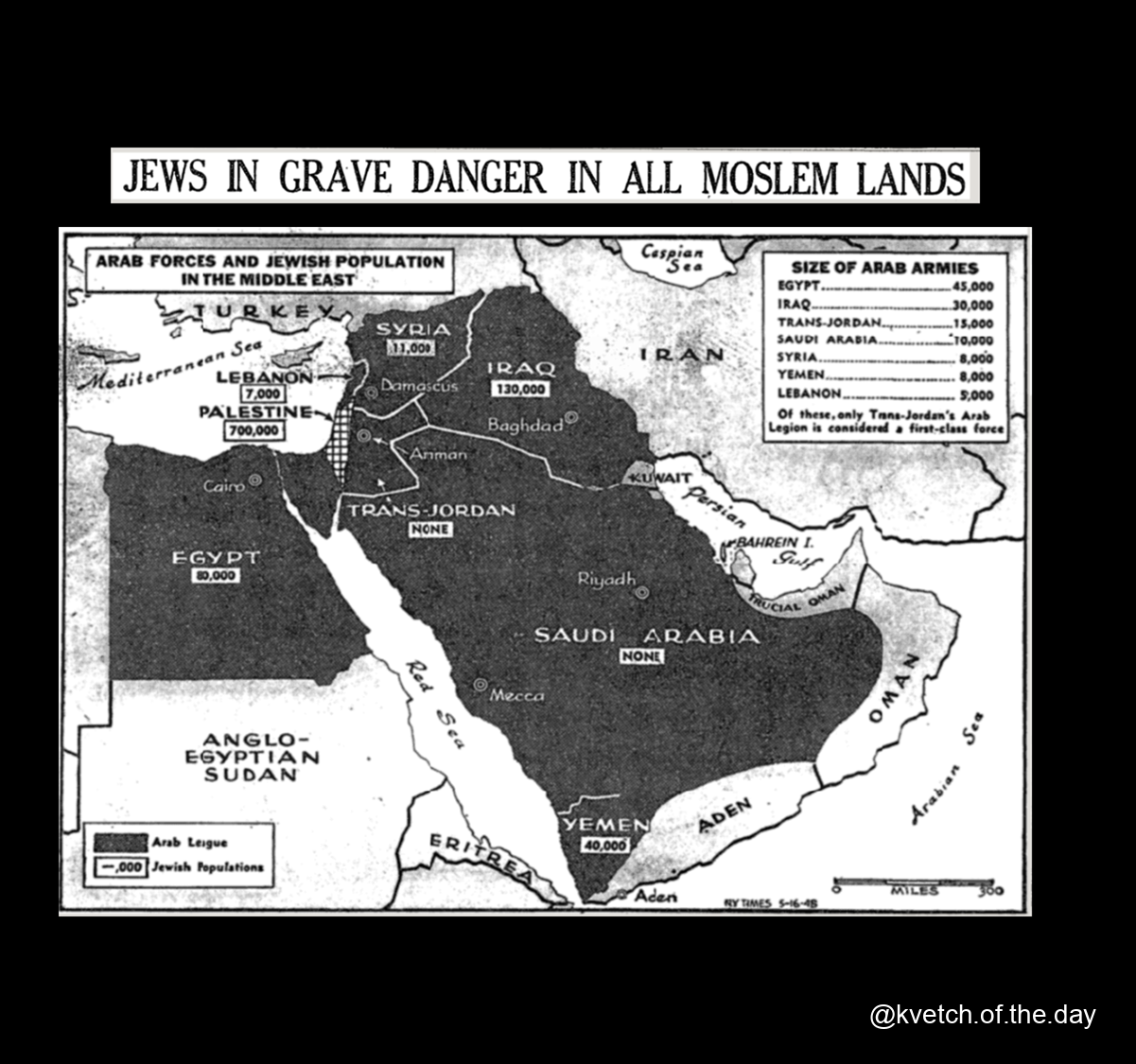
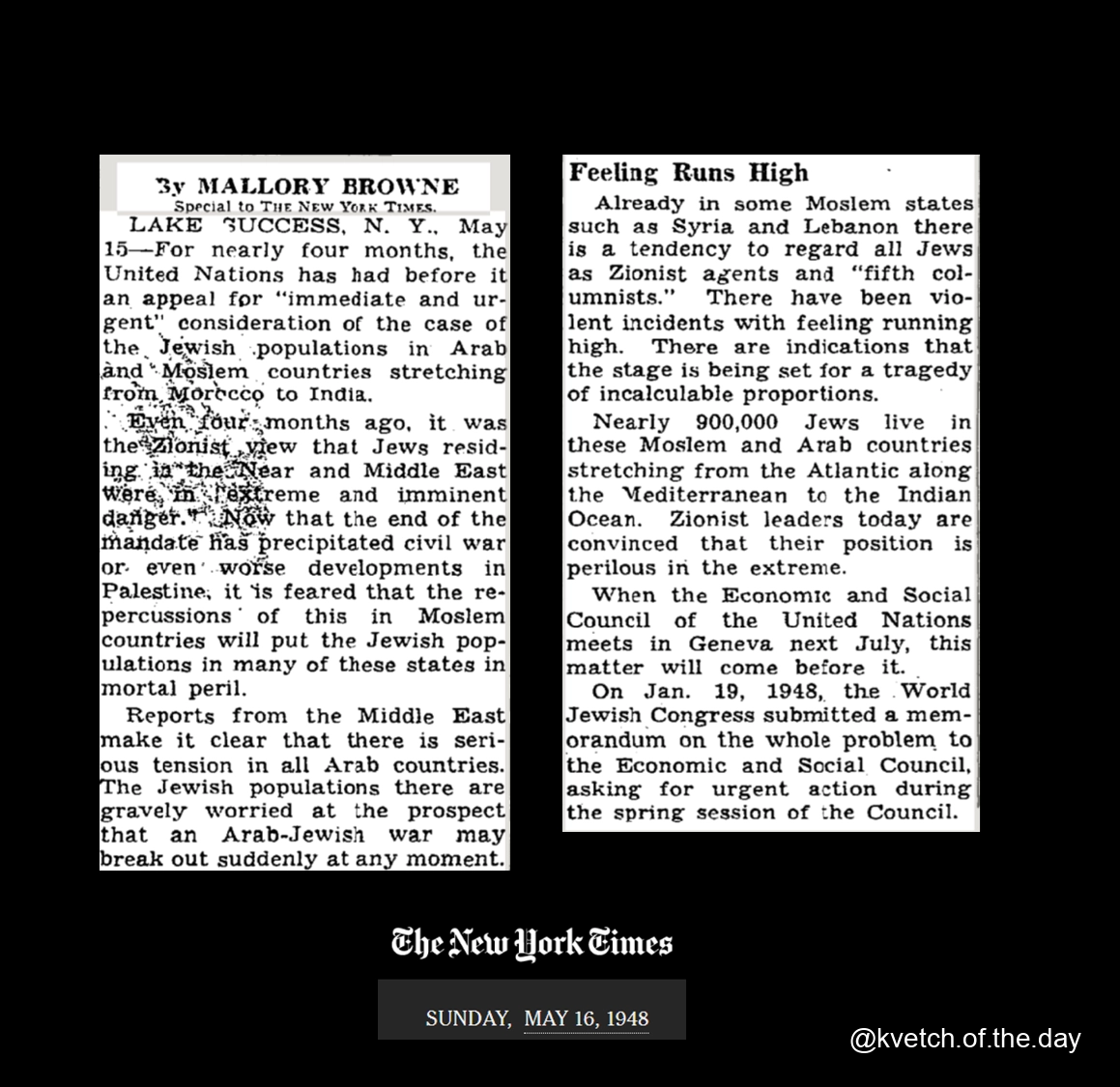
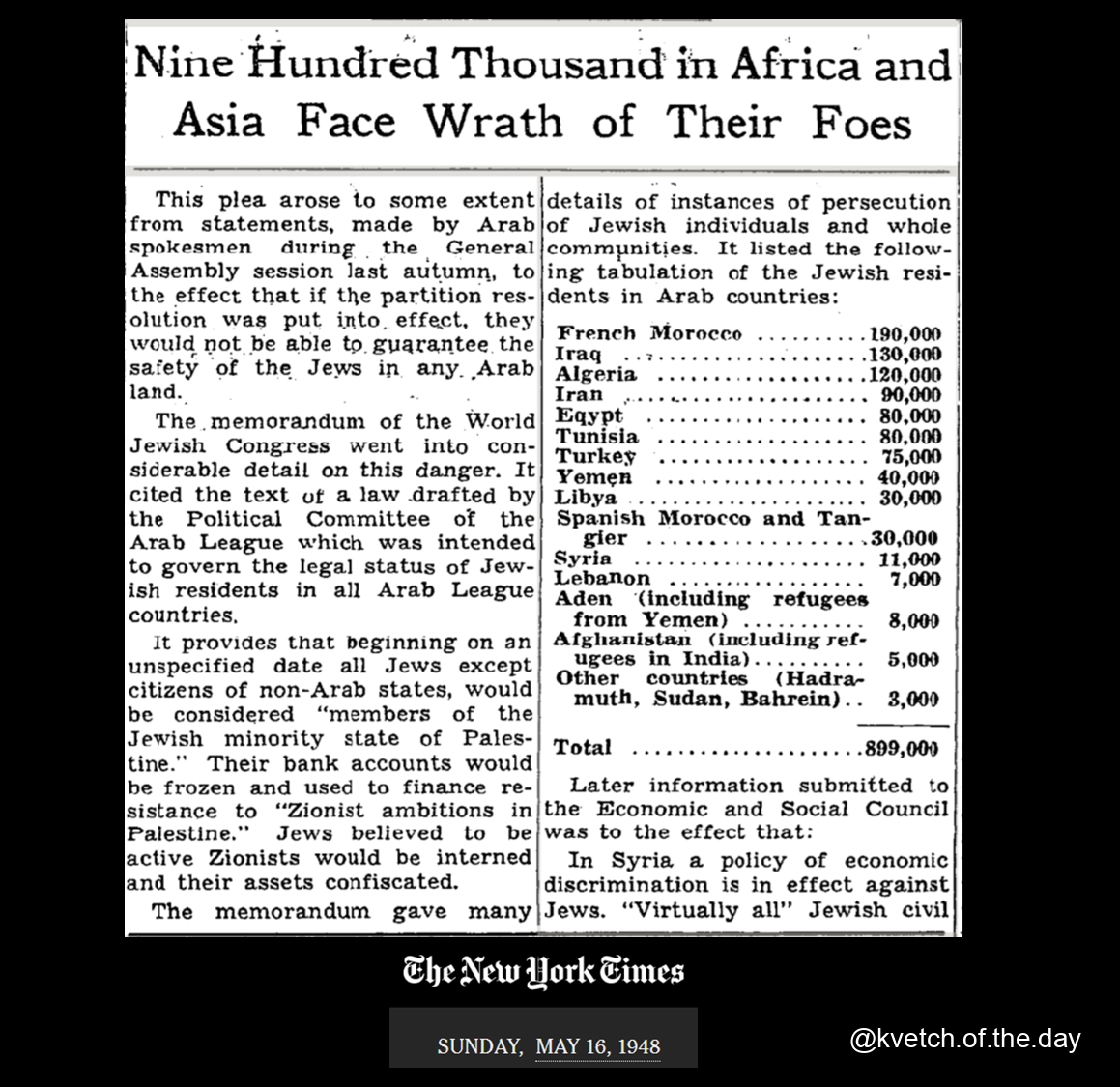
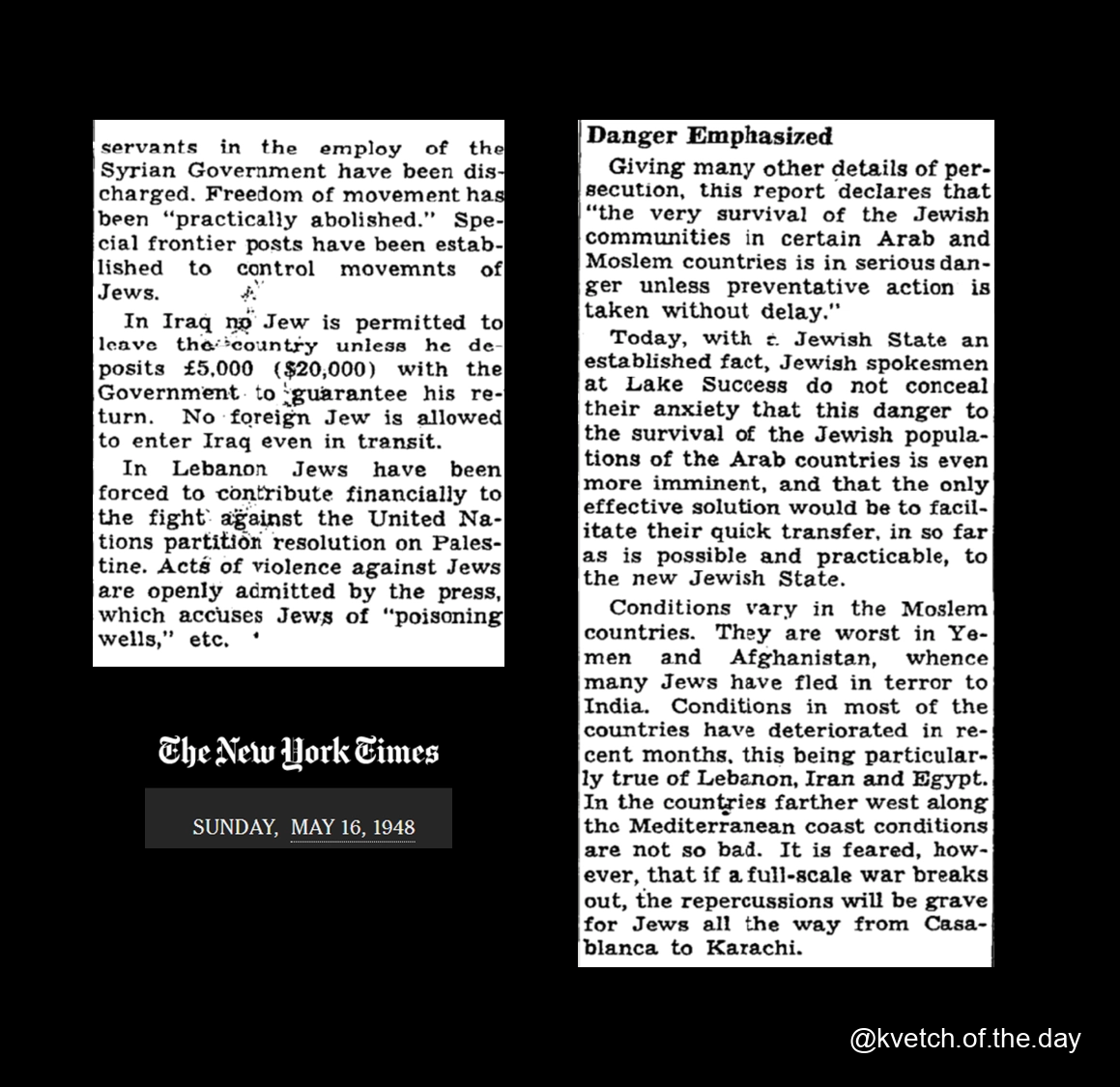
Scan from the kvetch-of-the-day news archive.
NYT 1948-05-16; vision-verified; WJC figures are an advocacy source. Images re-read 2026-10-12 (4 parts, Mallory Browne): 'Nearly 900,000 Jews live in these Moslem and Arab countries'; the World Jewish Congress memorandum of 19 Jan 1948 tabulated 'Jewish residents in Arab countries' to a 'Total … 899,000', a list that also counts Iran (90,000), Turkey (75,000) and Afghanistan (5,000); the Arab League political committee's draft law: Jews 'would be considered "members of the Jewish minority state of Palestine"', bank accounts frozen; Iraq: no Jew may leave 'unless he deposits £5,000 ($20,000)'.
newspaper'African Jews Ask Haven in Israel' (1955) incident ✓
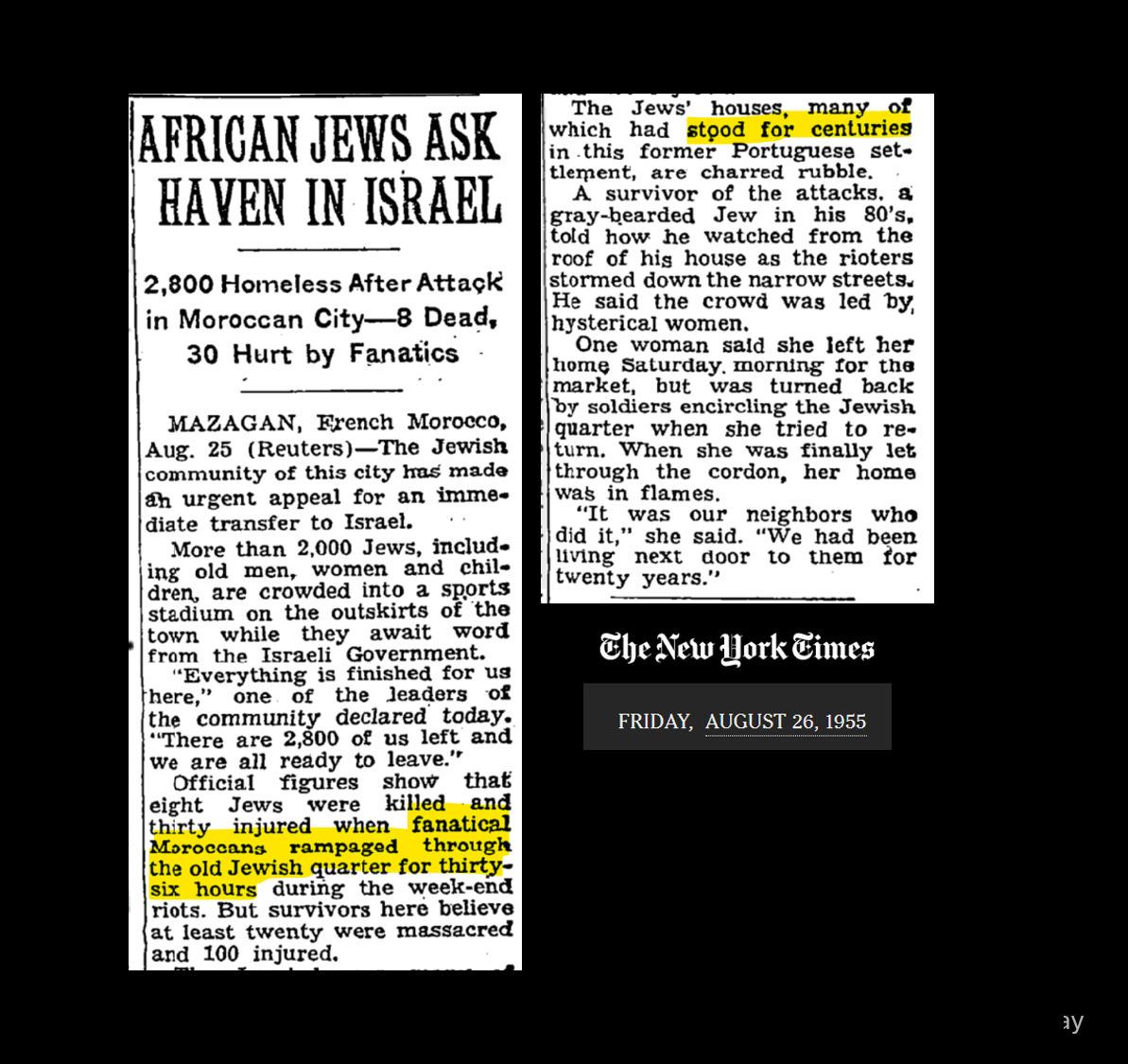
Scan from the kvetch-of-the-day news archive.
NYT 1955-08-26 (index date corrected from 1855); kvetch-of-the-day clipping 3add6f94-3ef1-800e-958c-d058f7b1ef0c. Text read from the clipping image (OCR checked 2026-10-13): officially 'eight Jews were killed and thirty injured'; a woman whose home burned: 'It was our neighbors who did it. We had been living next door to them for twenty years.'
historyThe Farhud, Baghdad, 1–2 June 1941 (1941) incident ✓
USHMM Holocaust Encyclopedia, 'The Farhud' (read 30 Sept 2026): 'rioters murdered between 150 and 180 Jews, injured 600 others'; 'According to the official report of the commission investigating the incident, 128 Jews were killed, 210 were injured'; 'about 135,000 Jews lived in Iraq (nearly 3 percent of the total population), with about 90,000 in Baghdad'. The Jews' share of Baghdad's population is not given there. Also: about 1,500 stores and homes looted; the official commission's report: 128 killed, 210 injured. Re-read 2026-10-12: 'Other Arab nationalists also perceived the Baghdad Jews as Zionists or Zionist sympathizers and justified the attacks as a response to Arab-Jewish conflict in Palestine. Nevertheless, killing helpless Jews, including women and children, was an unprecedented phenomenon that contradicted Muslim law. In this situation, antisemitic ideology, derived in part from Nazi propaganda, helped to legitimize murdering Jews in Iraq.'
pressGene Currivan, 'Ready to Aid Iraqi Jews' (Special to The New York Times) (1950) incident ✓
NYT 1950-03-18 (dateline Tel Aviv, March 17); vision-verified 2026-10-01 from the archive's scan. 'the decision of Iraq to permit the departure of her Jews, of whom 60,000 are prepared to leave immediately'; the Jewish Agency 'prepared to receive at least 20,000 at once'; 'It is considered extremely unlikely that all of Iraq's 150,000 Jews intend to emigrate'; 'Israel is committed to a program of accepting all those who must come because of pressure upon them in their countries. Those who are not subject to persecution will be asked to bide their time'; 'Under the arrangement made by the Iraqi Government all those who left for Israel would first be forced to renounce their citizenship … if they did not sell their property before making such a declaration they would have no claim to it thereafter.'
press'Libya Jews Seek to Flee' (Special to The New York Times) (1951) incident ✓
NYT 1951-09-18 (dateline Paris, Sept. 17); vision-verified 2026-10-01 from the archive's scan. 'Representatives of 8,000 Jews in Libya have appealed to the American Joint Distribution Committee for help in emigrating to Israel before Libya becomes independent on Jan. 1, 1952'; Helen Cazes Benatar, delegate for North Africa, 'asserted that Libyan Jews would not feel safe once Arab tribal chiefs took control of the government'; the JDC's Tripoli director 'reported that every Jewish community in Libya had been evacuated to the relative safety of the capital city of Tripoli.'
newspaper'Aid Urged for Jews Exiled From Egypt' (The New York Times) (1957) incident ✓
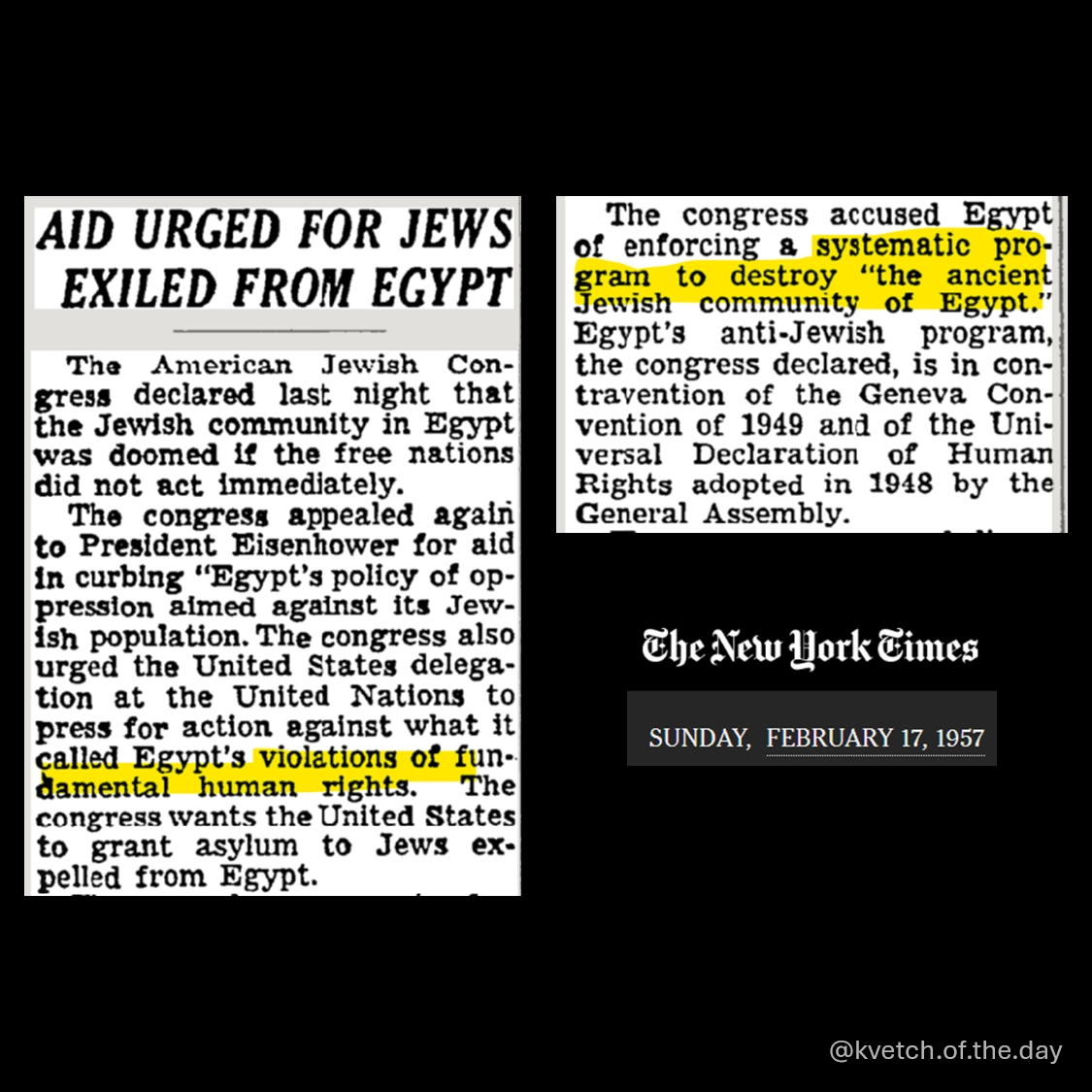
Scan from the kvetch-of-the-day news archive.
NYT 1957-02-17; vision-verified (re-read from the archive's scan 2026-10-01). 'The American Jewish Congress declared last night that the Jewish community in Egypt was doomed if the free nations did not act immediately'; appealed to Eisenhower over 'Egypt's policy of oppression aimed against its Jewish population'; 'wants the United States to grant asylum to Jews expelled from Egypt'; 'accused Egypt of enforcing a systematic program to destroy "the ancient Jewish community of Egypt."' The charges are the American Jewish Congress's, as reported.
historyMaurice Roumani, 'The Final Exodus of the Libyan Jews in 1967', Jewish Political Studies Review 19:3–4 (Fall 2007), via PolicyArchive (2007) finding ✓
Read 2026-10-01. Published by the Jerusalem Center for Public Affairs (jcpa.org on the PDF; see its org page, 'Jerusalem Center for Security and Foreign Affairs'). 'From 1949 to 1952, over thirty thousand Jews, or well over 90 percent of the 36,000 Jews then living in Libya, left for Israel'; 'The forced evacuation of the approximately 4,500 Jews (other population estimates range from 5,000 to 6,500 Jews) still living in Libya on the eve of the June 1967 war was rooted in issues that arose long before'; after independence 'the Libyan government restricted the Jews' civil and religious liberties'; 'During 6-9 June, some of the Tripoli Jews were murdered'; the government's weakness 'trying to appease young nationalist leaders' given as context.
dataJewish Virtual Library, 'Jewish Populations in the Arab World' (table) aggregate ✓
Read 2026-10-02. Table for Algeria, Egypt, Iraq, Libya, Morocco, Syria, Tunisia, Yemen/Aden: Total '851,000' (1948), '469,060' (1958), '69,600' (1968), '~6,200' (2011), '<4,000' (2023); Morocco 265,000 → 2,100. 'Source: Sergio DellaPergola, "World Jewish Population, 2021," in … The American Jewish Year Book, 2023'. Perspective: JVL is a project of the American-Israeli Cooperative Enterprise; the figures are DellaPergola's.
advocacy / viewAmerican Jewish Committee, 'The Plight of the Jews in Egypt' (fact sheet, March 1957; copy hosted by the Historical Society of Jews from Egypt) (1957) pattern ✓
Read 2026-10-02 (PDF). An advocacy fact sheet. Quotes Egypt's official denials: Interior Minister Zakaria Mohieddine (Journal d'Egypte, 10 Dec 1956): Egyptian Jews ‘treated without any discrimination whatsoever’, no more than 120 detained; Foreign Minister Mahmoud Fawzi (NYT, 13 Dec 1956): ‘Out of 66,000 Jews in Egypt, only 120 have been interned for valid reasons of public security’; Information Director Lt. Col. Hatem (17 Dec 1956): reports of persecution and expulsion ‘completely false’. Against them: a photostat of an expulsion order, the November 1956 nationality-law change, a NYT editorial of 29 Nov 1956, and a ‘voluntary’ statement required of Chief Rabbi Haim Nahoum.
More context
How to talk about this.
Acknowledge first: the historian Mark R. Cohen finds that medieval Islamic-Jewish relations, 'though not utopic, were less confrontational and violent than those between Christians and Jews in the West', and some families remember a shared life with their Muslim neighbours. Ask one question: 'if they lived peacefully, why did 850,000 leave within a generation?'; both memories are true, and the question is what changed. Share one checkable thing: the Farhud in Baghdad in 1941, before Israel existed. The US Holocaust Memorial Museum's account names the justifications used: Jews cast as collaborators with the British, and, by some Arab nationalists, as 'Zionists or Zionist sympathizers', attacked 'as a response to Arab-Jewish conflict in Palestine', with antisemitic ideology 'derived in part from Nazi propaganda'. Both halves of the argument meet here: the conflict in Palestine was invoked, against Iraqi Jews who had no part in it. What not to say: 'Jews were always persecuted under Islam', the mirror oversimplification (see 'Under Islam, Jews were humiliated second-class dhimmis — and Islamists want to bring it back.'). From the other side: grant the golden-age periods, then ask what the expulsions after 1948 say about how 'peaceful' depends on politics.
historyThe Farhud, Baghdad, 1–2 June 1941 (1941) incident ✓
USHMM Holocaust Encyclopedia, 'The Farhud' (read 30 Sept 2026): 'rioters murdered between 150 and 180 Jews, injured 600 others'; 'According to the official report of the commission investigating the incident, 128 Jews were killed, 210 were injured'; 'about 135,000 Jews lived in Iraq (nearly 3 percent of the total population), with about 90,000 in Baghdad'. The Jews' share of Baghdad's population is not given there. Also: about 1,500 stores and homes looted; the official commission's report: 128 killed, 210 injured. Re-read 2026-10-12: 'Other Arab nationalists also perceived the Baghdad Jews as Zionists or Zionist sympathizers and justified the attacks as a response to Arab-Jewish conflict in Palestine. Nevertheless, killing helpless Jews, including women and children, was an unprecedented phenomenon that contradicted Muslim law. In this situation, antisemitic ideology, derived in part from Nazi propaganda, helped to legitimize murdering Jews in Iraq.'
historyMark R. Cohen, Under Crescent and Cross: The Jews in the Middle Ages (Princeton University Press; updated edition) — publisher's page finding ✓
Publisher's description read 2026-09-29: 'Did Muslims and Jews in the Middle Ages cohabit in a peaceful "interfaith utopia"? Or were Jews under Muslim rule persecuted, much as they were in Christian lands? Rejecting both polemically charged ideas as myths, Mark Cohen offers a systematic comparison … why medieval Islamic-Jewish relations, though not utopic, were less confrontational and violent than those between Christians and Jews in the West.' The book itself is not read here.
Where it leads if pressed
Working it out: what each half of the claim needs, and the numbers.
The claim has two halves: 'they lived peacefully for centuries until Zionism', and 'they left because Israel lured them'. Each can be tested. Peace before Zionism: the historian Mark R. Cohen finds medieval relations 'though not utopic, … less confrontational and violent than those between Christians and Jews in the West', and Jews lived as a protected but subordinate minority. But the Farhud in Baghdad killed between 150 and 180 Jews in 1941, before Israel existed, and in the 1945 Tripolitania pogrom 'about 300 Jews were reported to have been killed' (NYT). So 'peacefully' holds as a comparison with Christian Europe, not as an absence of violence. Why they left: the numbers are stark. In the eight countries in DellaPergola's table, Jews numbered 851,000 in 1948, 469,060 in 1958 and 69,600 in 1968; about 45% gone in ten years and about 92% in twenty (this page's arithmetic). Some of the push and pull is documented on each side: Zionist emigration networks were active in Iraq from 1942, and the historian Avi Shlaim attributes three of the five 1950–51 Baghdad bombings to the Zionist underground, a claim contested for 75 years and examined by two Israeli commissions; on the other side, Iraq made Zionist activity a crime in July 1948, punishable 'from seven years’ imprisonment, to death', on the 'sworn testimony of two Moslem witnesses' (Moshe Gat's history, as quoted), required Jews leaving for Israel to renounce citizenship and give up unsold property, Libya's Jews faced forced evacuation in 1967, and Egypt's 1956 denials of persecution stand against the departures that followed. The worst case for each side. For 'Zionism ruined it, Israel lured them': grant Shlaim's reading of the bombings at its strongest; it explains part of one country's exodus, not a 92% fall across eight countries, nor the Farhud before 1948, and the reading itself is disputed: a critic answers that 'two Israeli commissions of inquiry did not find any evidence of Mossad's involvement' and that three of the bombings 'occurred three months after the March emigration deadline had passed and caused no casualties' (Lyn Julius, JNS); and violence long predates Zionism, as in the 'mass violence that followed the assassination of Joseph ibn Nagrela, a Jewish vizier to the court of Granada, in 1066'. For 'they were always persecuted': grant every massacre; Cohen's comparison and long periods of shared life still stand: Cordoba and Granada 'maintained at least two dozen synagogues', and after the expulsions from Spain (1492) and Portugal (1497) 'tens of thousands of Iberian Jews arrived in Ottoman territories' (My Jewish Learning). Holds on the evidence here: centuries of coexistence with legal subordination and periodic violence; a collapse of these communities within twenty years of 1948, under pressures from several directions. Holds only country by country: that Zionist recruitment, or local persecution, was the larger cause in a given place. Not supported: that they lived in unbroken peace until Zionism, or that Israel's pull alone explains why almost all of them left.
What the labels (Holds, Open, Arguable …) mean
historyMark R. Cohen, Under Crescent and Cross: The Jews in the Middle Ages (Princeton University Press; updated edition) — publisher's page finding ✓
Publisher's description read 2026-09-29: 'Did Muslims and Jews in the Middle Ages cohabit in a peaceful "interfaith utopia"? Or were Jews under Muslim rule persecuted, much as they were in Christian lands? Rejecting both polemically charged ideas as myths, Mark Cohen offers a systematic comparison … why medieval Islamic-Jewish relations, though not utopic, were less confrontational and violent than those between Christians and Jews in the West.' The book itself is not read here.
historyThe Farhud, Baghdad, 1–2 June 1941 (1941) incident ✓
USHMM Holocaust Encyclopedia, 'The Farhud' (read 30 Sept 2026): 'rioters murdered between 150 and 180 Jews, injured 600 others'; 'According to the official report of the commission investigating the incident, 128 Jews were killed, 210 were injured'; 'about 135,000 Jews lived in Iraq (nearly 3 percent of the total population), with about 90,000 in Baghdad'. The Jews' share of Baghdad's population is not given there. Also: about 1,500 stores and homes looted; the official commission's report: 128 killed, 210 injured. Re-read 2026-10-12: 'Other Arab nationalists also perceived the Baghdad Jews as Zionists or Zionist sympathizers and justified the attacks as a response to Arab-Jewish conflict in Palestine. Nevertheless, killing helpless Jews, including women and children, was an unprecedented phenomenon that contradicted Muslim law. In this situation, antisemitic ideology, derived in part from Nazi propaganda, helped to legitimize murdering Jews in Iraq.'
newspaper'Tripoli Described as Refugee Haven' (1950) incident ✓
Scan from the kvetch-of-the-day news archive.
NYT 1950-08-27, Special to the NYT (Paris); vision-verified. Text read from the clipping image (OCR checked 2026-10-13): 'About 300 Jews were reported to have been killed and uncounted others wounded or driven from their homes. Babies were beaten to death; old men were hacked to pieces; shops owned by Jewish persons were pillaged; houses were fired along with their occupants' (on the November 1945 Tripolitania pogrom).
dataJewish Virtual Library, 'Jewish Populations in the Arab World' (table) aggregate ✓
Read 2026-10-02. Table for Algeria, Egypt, Iraq, Libya, Morocco, Syria, Tunisia, Yemen/Aden: Total '851,000' (1948), '469,060' (1958), '69,600' (1968), '~6,200' (2011), '<4,000' (2023); Morocco 265,000 → 2,100. 'Source: Sergio DellaPergola, "World Jewish Population, 2021," in … The American Jewish Year Book, 2023'. Perspective: JVL is a project of the American-Israeli Cooperative Enterprise; the figures are DellaPergola's.
advocacy / viewMiddle East Eye, review of Avi Shlaim, 'Three Worlds: Memoirs of an Arab-Jew' (12 July 2023) (2023) ✓
Read (2026-09-28). The Zionist underground 'active since 1942 in the aftermath of the barbaric Farhud'; the five bombings' authorship 'publicly contested for 75 years, with two Israeli official commissions of inquiry'; Shlaim: 'three of the five bombings were the work of the Zionist underground'; Yusuf Ibrahim Basri 'recruited and trained by the Mossad', hanged January 1952; the first bombing attributed to Istiqlal 'tentatively'; the synagogue grenade (four killed) described as the revenge of an Iraqi criminal.
pressGene Currivan, 'Ready to Aid Iraqi Jews' (Special to The New York Times) (1950) incident ✓
NYT 1950-03-18 (dateline Tel Aviv, March 17); vision-verified 2026-10-01 from the archive's scan. 'the decision of Iraq to permit the departure of her Jews, of whom 60,000 are prepared to leave immediately'; the Jewish Agency 'prepared to receive at least 20,000 at once'; 'It is considered extremely unlikely that all of Iraq's 150,000 Jews intend to emigrate'; 'Israel is committed to a program of accepting all those who must come because of pressure upon them in their countries. Those who are not subject to persecution will be asked to bide their time'; 'Under the arrangement made by the Iraqi Government all those who left for Israel would first be forced to renounce their citizenship … if they did not sell their property before making such a declaration they would have no claim to it thereafter.'
historyMaurice Roumani, 'The Final Exodus of the Libyan Jews in 1967', Jewish Political Studies Review 19:3–4 (Fall 2007), via PolicyArchive (2007) finding ✓
Read 2026-10-01. Published by the Jerusalem Center for Public Affairs (jcpa.org on the PDF; see its org page, 'Jerusalem Center for Security and Foreign Affairs'). 'From 1949 to 1952, over thirty thousand Jews, or well over 90 percent of the 36,000 Jews then living in Libya, left for Israel'; 'The forced evacuation of the approximately 4,500 Jews (other population estimates range from 5,000 to 6,500 Jews) still living in Libya on the eve of the June 1967 war was rooted in issues that arose long before'; after independence 'the Libyan government restricted the Jews' civil and religious liberties'; 'During 6-9 June, some of the Tripoli Jews were murdered'; the government's weakness 'trying to appease young nationalist leaders' given as context.
advocacy / viewAmerican Jewish Committee, 'The Plight of the Jews in Egypt' (fact sheet, March 1957; copy hosted by the Historical Society of Jews from Egypt) (1957) pattern ✓
Read 2026-10-02 (PDF). An advocacy fact sheet. Quotes Egypt's official denials: Interior Minister Zakaria Mohieddine (Journal d'Egypte, 10 Dec 1956): Egyptian Jews ‘treated without any discrimination whatsoever’, no more than 120 detained; Foreign Minister Mahmoud Fawzi (NYT, 13 Dec 1956): ‘Out of 66,000 Jews in Egypt, only 120 have been interned for valid reasons of public security’; Information Director Lt. Col. Hatem (17 Dec 1956): reports of persecution and expulsion ‘completely false’. Against them: a photostat of an expulsion order, the November 1956 nationality-law change, a NYT editorial of 29 Nov 1956, and a ‘voluntary’ statement required of Chief Rabbi Haim Nahoum.
advocacy / viewLyn Julius, 'Beware distinguished professors rewriting history', JNS (opinion) ✓
Read (2026-09-28). Pro-Israel writer on Jews from Arab lands: 'two Israeli commissions of inquiry did not find any evidence of Mossad's involvement'; Shlaim 'falsifies the chronology' (a June 1951 explosion dated to March 1950); three bombings 'occurred three months after the March emigration deadline had passed and caused no casualties'; in her account Shlaim attributes the synagogue attack to Iraqis acting 'at the behest of "the Zionists"'; Shafik Ades executed in 1948.
referenceMy Jewish Learning, 'From Golden to Grim: Jewish Life in Muslim Spain' ✓
Read 2026-09-29 (Jewish educational site). 'Cordoba and Granada, each with five or six thousand Jews, maintained at least two dozen synagogues'; the 'mass violence that followed the assassination of Joseph ibn Nagrela, a Jewish vizier to the court of Granada, in 1066'; 'Decades of brutal Almohade persecution followed—of forced conversions equally of Jews, Christians, and "backsliding" Muslims', until 1212.
referenceMy Jewish Learning, 'The Sephardic Exodus to the Ottoman Empire' ✓
Read 2026-09-29 (Jewish educational site). 'in the wake of the expulsion from Spain (1492) and the forced conversion in Portugal (1497), tens of thousands of Iberian Jews arrived in Ottoman territories'; Romaniot and Arabic-speaking Jewish communities were already there.
historyMoshe Gat, The Jewish Exodus from Iraq, 1948–1951, passage as quoted by Executed Today ('1948: Shafiq Ades', 23 September 2019) pattern ✓
Read 2026-10-13 (the blog's block quotation, attributed to Gat's book; the book itself not read). 'In mid-July, both houses of the Iraqi parliament ratified a bill amending Law No. 51 of the 1938 Criminal Code. Under the 1938 law, communist or anarchist activity was defined as a criminal offence for which the punishment ranged from seven years’ imprisonment, to death. The new amendment included Zionist activity in the category of criminal activity. It stipulated that the sworn testimony of two Moslem witnesses would suffice to incriminate any Jew, whatever his standing. Under the amended law, numerous Jews, and particularly the prosperous, were arrested.' 'On 10 August 1948, the Iraqi government announced that all Jews who had left the country for Palestine since 1939 and had not returned, would henceforth be considered criminals who had defected to the enemy'; Jewish government employees dismissed 'on the grounds that official secrecy must be protected'.
Both stories are true — and neither needs the other erased.
Real coexistence and real persecution are both part of this history; 'golden age' and 'always persecuted' both oversimplify it (Cohen: 'though not utopic, … less confrontational and violent'). About half of Israeli Jews identify as Sephardi or Mizrahi, 'with roots mostly in Spain, elsewhere around the Mediterranean or the Middle East' (Pew, 2016); 'go back to Europe' does not fit families whose roots lie 'around the Mediterranean or the Middle East', which is why their history belongs in any honest account of the conflict. It does not cancel the Palestinian Nakba (see 'There was a Jewish Nakba too — it was a population exchange, so the Palestinian refugee question is settled.').
dataPew Research Center, 'Israel's Religiously Divided Society' (8 March 2016) (2016) aggregate ✓
Read (2026-09-28). 5,601 face-to-face interviews, Oct 2014 – May 2015. 'Israeli Jews are roughly evenly divided between two types of ethnic identity: Ashkenazi Jews (with ancestral roots in Central and Eastern Europe) and Sephardi or Mizrahi Jews (with roots mostly in Spain, elsewhere around the Mediterranean or the Middle East).' Also: asked whether 'Arabs should be expelled or transferred from Israel', Israeli Jews 'strongly agree (21%) or agree (27%), while a similar share disagree (29%) or strongly disagree (17%)'; 'Roughly seven-in-ten (71%)' of Datiim agree, 'Most (58%)' of Hilonim disagree (re-read 2026-09-30). Also: 'Most Israeli Jews (79%) say Jews deserve preferential treatment in Israel'; 'Roughly eight-in-ten Israeli Arabs (79%) say there is a lot of discrimination in Israeli society against Muslims'; 'the vast majority (74%) [of Jews] say they do not see much discrimination against Muslims'; majorities of all four Jewish subgroups say Israel can be both Jewish and democratic; 'Israeli Arabs generally do not think Israel can be a Jewish state and a democracy at the same time'. Also read 2026-10-10: 'About nine-in-ten Haredim (91%), eight-in-ten Datiim (80%) and roughly six-in-ten Masortim (59%) consider themselves Jewish first, while about six-in-ten Hilonim (59%) take the opposite position, saying they see themselves as Israeli first'; if halakha and democratic principles conflict, '89% of Haredim say halakha should be given preference', while 'among Hilonim, an equally lopsided share (89%) say the state should give preference to democratic principles'; 'The vast majority of Jews (98%), Muslims (85%), Christians (86%) and Druze (83%) say all or most of their close friends belong to their own religious community.'
historyMark R. Cohen, Under Crescent and Cross: The Jews in the Middle Ages (Princeton University Press; updated edition) — publisher's page finding ✓
Publisher's description read 2026-09-29: 'Did Muslims and Jews in the Middle Ages cohabit in a peaceful "interfaith utopia"? Or were Jews under Muslim rule persecuted, much as they were in Christian lands? Rejecting both polemically charged ideas as myths, Mark Cohen offers a systematic comparison … why medieval Islamic-Jewish relations, though not utopic, were less confrontational and violent than those between Christians and Jews in the West.' The book itself is not read here.
The usual reply — and its own traps
Arguments travel in pairs. Here is what the other side typically answers. Check whether both lean on the same trick.
heard from pro-Israel voices“There was a Jewish Nakba too — it was a population exchange, so the Palestinian refugee question is settled.”Where this argument points
This argument comes up in the debate about these solutions — for, against or around them:
On the timeline
Keep exploring
From the archive
How newspapers reported related events at the time — suggested by the archive's own tags, not yet reviewed for this argument. Open a scan and judge for yourself.
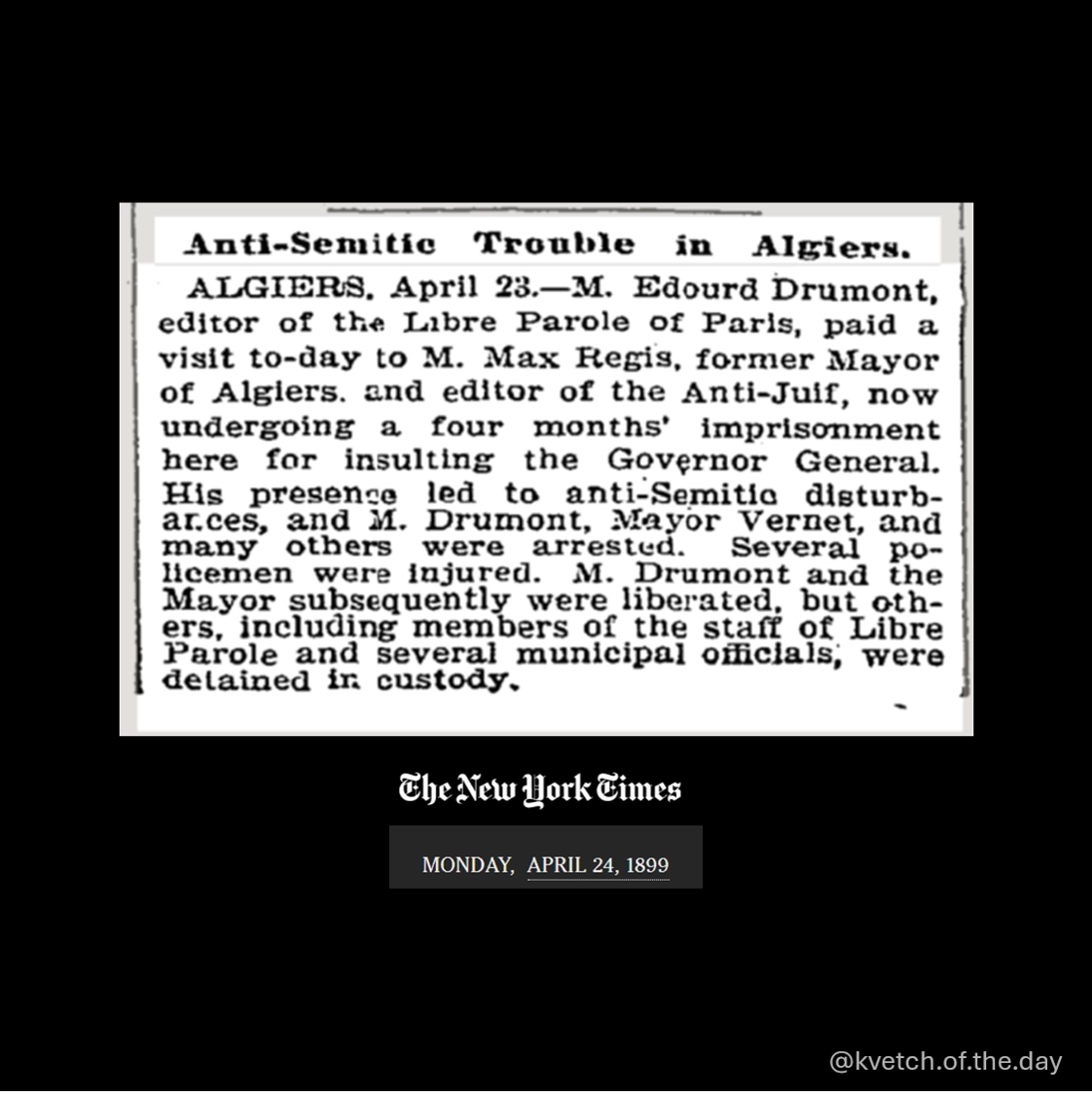 1899-04-24 · The New York TimesAnti-Semitic Trouble in Algiers
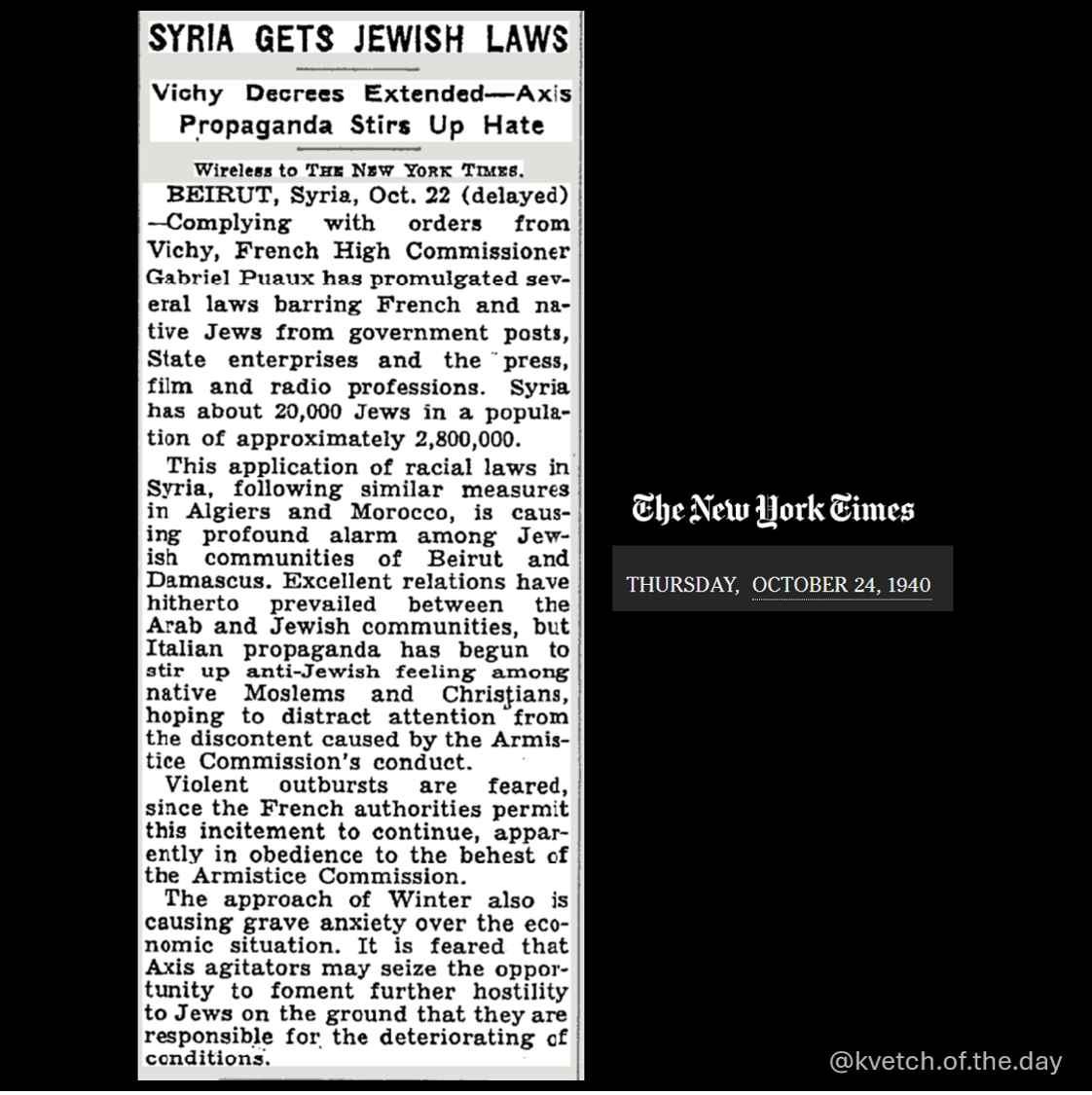 1940-10-24 · The New York TimesSyria Gets Jewish Laws
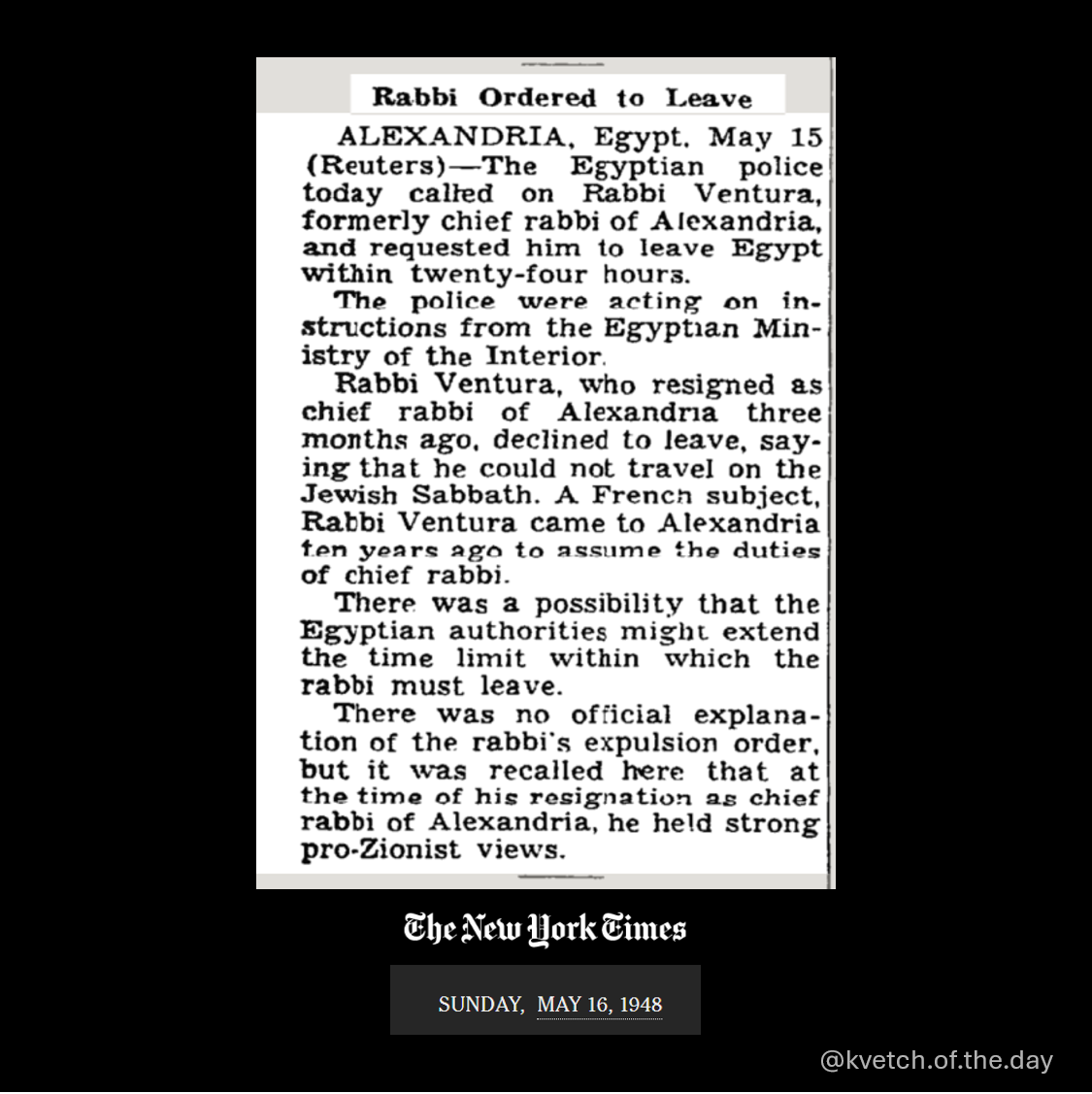 1948-05-16 · The New York Times · ✓Rabbi Ordered to Leave
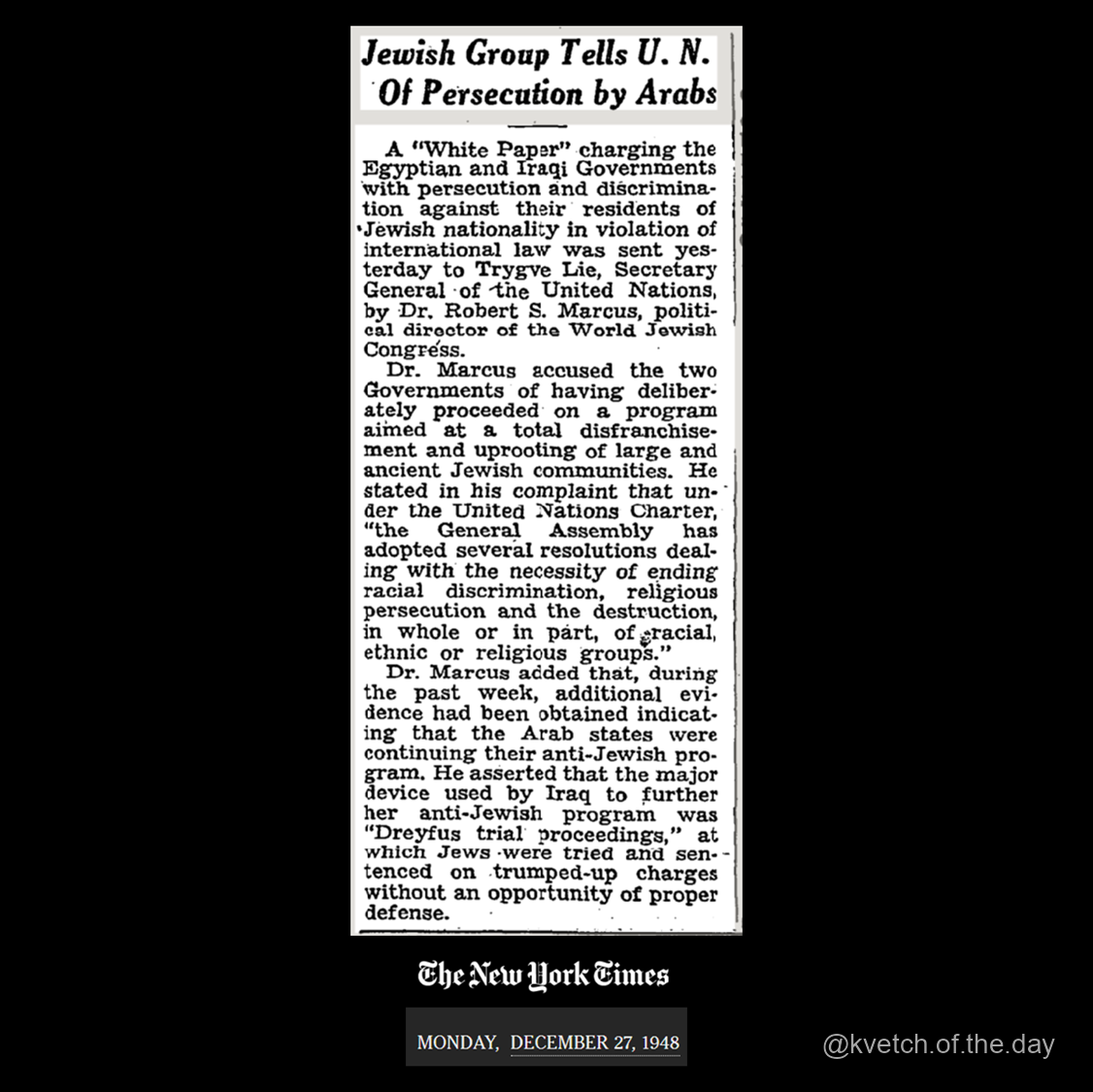 1948-12-27 · The New York TimesJewish Group tells UN of persecution by Arabs
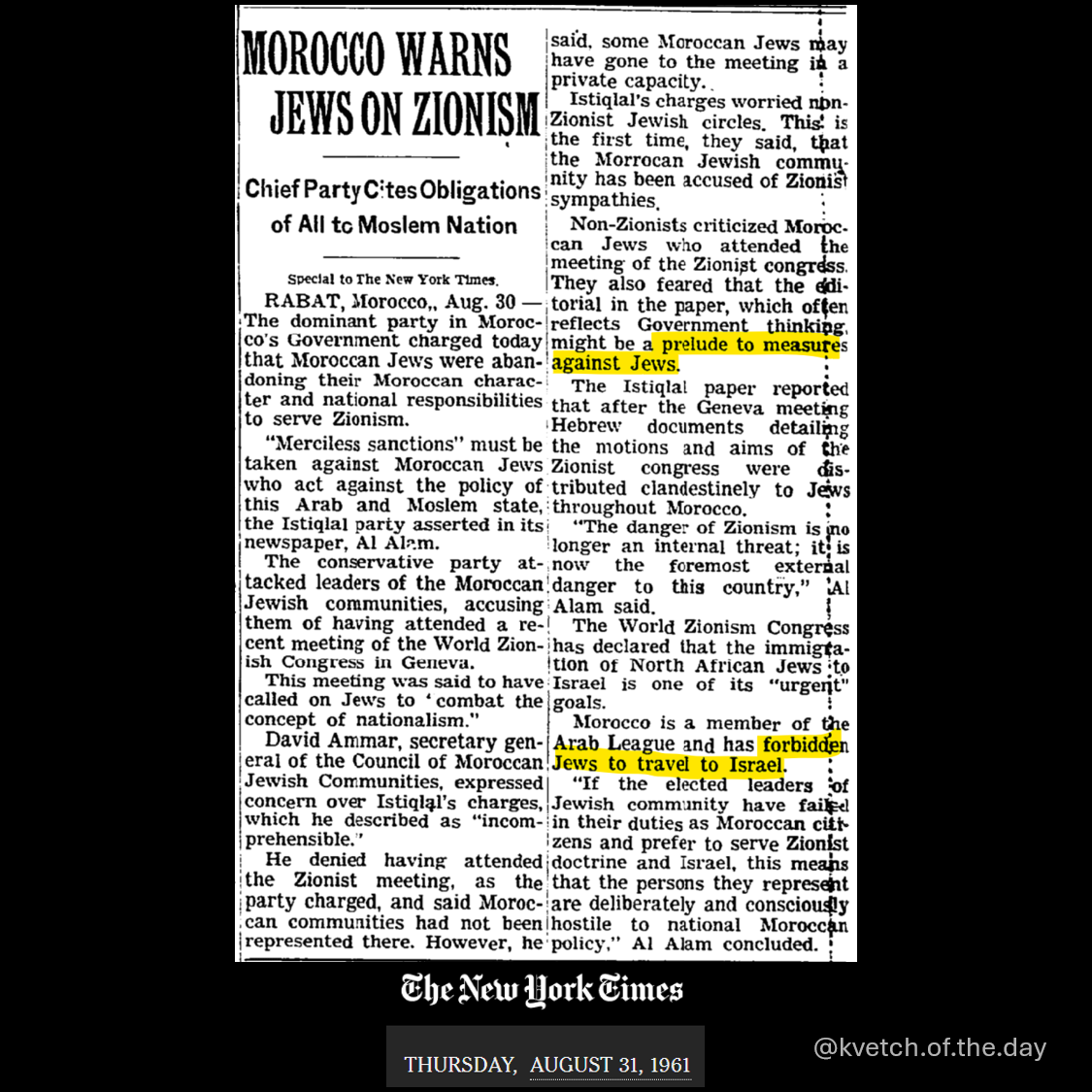 1961-08-31 · The New York TimesMorocco Warns Jews on Zionism
Scans: kvetch-of-the-day news archive.