Argument · heard from pro-Israel voices
“The Mufti was Hitler's ally — Palestinian nationalism has Nazi roots.”
Because the leading Palestinian Arab figure of the 1930s–40s collaborated with Nazi Germany, the Palestinian national cause is presented as antisemitic at its origin, and its claims as illegitimate.
Made publicly as a pro-Israel argument by Benjamin Netanyahu
Where it's been said
“Hitler didn't want to exterminate the Jews at the time, he wanted to expel the Jews. And Haj Amin al-Husseini went to Hitler and said, 'If you expel them, they'll all come here.'”
Traps in play:◆ "They all…"◆ Judging by origin◆ The exception as proof
Why people find it convincing
- Hajj Amin al-Husseini, Mufti of Jerusalem and leader of the Arab Higher Committee, met Hitler on 28 November 1941, broadcast Nazi propaganda to the Arab world from Berlin, and helped recruit Bosnian Muslims for the Waffen-SS.
- In the spring of 1943 he protested to the German, Italian, Hungarian, Romanian and Bulgarian governments against plans to let thousands of Jewish children leave for Palestine, and suggested they be sent to Poland instead, where they would be subject to 'stricter control' — by the US Holocaust Memorial Museum's reading, his preference that they be killed there 'appears to have been explicit'.
- Contemporary reporting called him an Axis 'full partner'; after the war he found asylum in Egypt and remained a leading figure — the NYT reported in 1947 that Arab delegates felt 'the Axis issue should be forgot'.
- He led the anti-Jewish mobilisation of 1929 and the 1936–39 revolt, including terror against Arab rivals.
- Modern echoes keep the claim alive: Arabic editions of Mein Kampf: AFP reported in 1999 that it was a bestseller in the PA-controlled territories, 'according to sales figures compiled by the most popular bookstore in Ramallah', and in November 2023 Israel's president showed an annotated Arabic copy that he said troops had found 'in a Gaza apartment that Hamas was using as a base of operations' (both as recounted by Rafael Medoff, Jewish Journal, 26 November 2023; sales numbers not given), shops and products named after Hitler, and President Abbas's 1982 Moscow doctorate, published as a book in 1984, which JTA describes as claiming that the number of Jewish victims 'is in the tens of thousands' (Abbas told Haaretz in 2003 that he 'did not want to discuss numbers' and called the Holocaust 'a terrible, unforgivable crime', and in 2013 defended the book's Nazi–Zionist collaboration claim on Lebanese television; JTA 2013, Ynet 2014), followed in 2023 by a speech to Fatah members asserting that European Jews were persecuted by Hitler because of what he described as their 'social functions' and predatory lending, 'rather than their religion' (AP's account). The ADL Global 100 survey (interviews July 2013 – February 2014) ranked the West Bank and Gaza first of 102 places: 93% of respondents said at least 6 of 11 negative stereotypes about Jews were 'probably true' (Iraq 92%; Middle East and North Africa average 74%).
What's true
The Mufti's collaboration was real and deliberate, and it wasn't a footnote.
The Mufti's wartime alliance with Nazi Germany is documented: from Berlin he 'disseminated pro-Axis, anti-British, and anti-Jewish propaganda', asked the Axis in 1942 to bless 'the removal of the Jewish national homeland in Palestine', and in 1943 protested against transports of Jewish children to Palestine, though 'the impact of the letters was nil'; the same account notes that Hitler 'repeatedly denied' him the recognition he sought (US Holocaust Memorial Museum). In 1943, after Hitler agreed to create the 13th Waffen-SS Mountain Division ('Handschar') from Bosnian Muslims, 'the SS Main Office sends al-Husayni to assist in recruitment efforts', and he told the division's imam trainees that Muslims would 'never have a better or more loyal ally than the Greater German Reich' (USHMM, 'Hajj Amin al-Husayni: Key Dates'). He was the dominant Palestinian Arab leader of the Mandate era, and his camp was charged with terror against Arab opponents: the 1947 NYT report relays a memorandum (an advocacy source) accusing a member of his Arab Higher Committee, 'Mr. Ghouri', of having been 'partly responsible for "internal terror against Arab opponents of the Mufti and Arabs who sell land to the Jews."' The dataset holds 67 dated clippings on him.
newspaper'Mufti Called Axis Partner' (1947) incident ✓
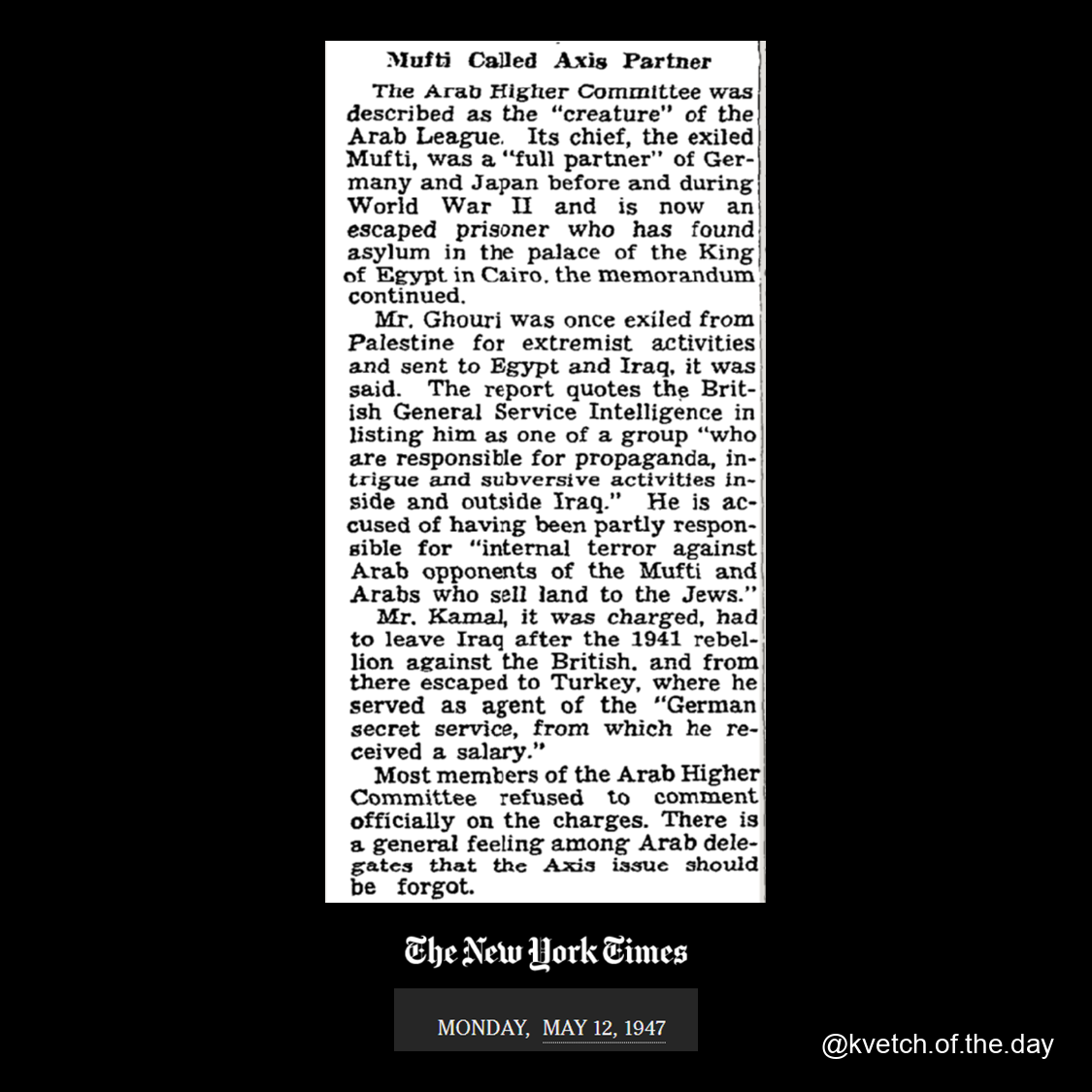
Scan from the kvetch-of-the-day news archive.
NYT 1947-05-12; vision-verified. Reports the charges of a memorandum (an advocacy source) against the Arab Higher Committee. Image re-read 2026-10-12: the Mufti called a 'full partner' of Germany and Japan, per the memorandum; of Mr. Ghouri: 'He is accused of having been partly responsible for "internal terror against Arab opponents of the Mufti and Arabs who sell land to the Jews."' Most Higher Committee members 'refused to comment officially on the charges'.
primary documentkvetch-of-the-day news-articles-backup: NYT clipping 'mufti called axis partner' (12 May 1947) ✓
Checked 2026-09-30 against the site's resolved clippings: the 1947-05-12 NYT clipping 'mufti called axis partner' is a verified scan. The earlier '67 clippings tagged Mufti' count came from the archive's tags and could not be checked locally, so the note no longer gives it; the other example (1946-08-19) is not among the resolved clippings.
historyUnited States Holocaust Memorial Museum, Holocaust Encyclopedia, 'Hajj Amin al-Husayni: Wartime Propagandist' and 'Key Dates' finding ✓
Read: spring 1943 protests to Germany, Italy, Hungary, Romania and Bulgaria against the transport of Jewish children to Palestine, suggesting Poland; 'the impact of the letters was nil'; the Germans had stopped the transports independently (March–April 1943). Re-read 2026-10-01: exiled leaders including al-Husayni 'escaped to Berlin, where they broadcast appeals to their home countries in order to foment unrest, sabotage, and insurrection against the Allies'; 'al-Husayni disseminated pro-Axis, anti-British, and anti-Jewish propaganda from Berlin'; April 1942 letters with al-Kailani asking for a blessing for 'the removal of the Jewish national homeland in Palestine'; 'The Germans, and Hitler in particular, repeatedly denied al-Husayni's request for legitimization'; spoke of a 'worldwide Jewish conspiracy'.
historyUS Holocaust Memorial Museum, Holocaust Encyclopedia, 'Hajj Amin al-Husayni: Key Dates' incident ✓
Read 2026-10-01. 18 Dec 1942: at the Central Islamic Institute in Berlin he 'denounces the Jews as the bitterest enemies of Islam'; speech broadcast to the Middle East 23 Dec. 13 Feb 1943: 'Hitler agrees to create the 13th Waffen-SS Mountain Division, later also known as "Handschar." SS chief Heinrich Himmler authorizes recruitment of Bosnian Muslims for the division. In March and April, the SS Main Office sends al-Husayni to assist in recruitment efforts.' July 1943: SS imam school; al-Husayni: Muslims would 'never have a better or more loyal ally than the Greater German Reich.' Feb 1944: the division deployed 'in western Croatia and northeastern Bosnia'. Re-read 2026-10-12: al-Husayni 'meets Hitler for the first time on November 28, 1941 in Berlin, Germany. During the meeting, held in the Reich chancellery, Hitler declined to grant al-Husayni's request for a public statement—or a secret but formal treaty—in which Germany would: 1) pledge not to occupy Arab land, 2) recognize Arab striving for …' (film caption).
What's left out
One leader is not a people — and the strongest version of the claim is false.
Other Palestinian Arabs opposed the Mufti: during the 1936–39 revolt the followers of Raghib al-Nashashibi, 'who supported compromise with the British', clashed with those of 'the more dominant Mufti, who opposed compromise, resulting in hundreds of assassinations of Palestinians by Palestinians' (Ori Yehudai, Origins, Ohio State University; who killed whom is not broken down there), and the 1947 report above relays a memorandum's charge that one of his committee members was partly responsible for 'internal terror against Arab opponents of the Mufti'. Some 12,000 Palestinian Arabs volunteered for the British army, by the count of the historian Mustafa Abbasi (Tel-Hai College), who found that many 'disregarded the mufti's pro-Axis policies' and that 'the economic motive played a central role' alongside others (Ynet; the Cathedra study as quoted by BESA). A BESA critique argues that pay was the prevailing motive and calls most of the study's conclusions 'dubious'. The claim that the Mufti gave Hitler the idea of exterminating the Jews, made publicly by Israel's prime minister in 2015, was criticised in Israel by opposition leader Isaac Herzog ('a dangerous distortion of history'), by German Chancellor Angela Merkel ('We don't see any reason to change our view of history') and by the PLO's Saeb Erakat (CNN); ten days later he wrote that he had not meant the Mufti convinced Hitler: 'The Nazis decided on that by themselves.' Treating Palestinian nationalism as Nazi at its root makes a whole people answerable for one leader, which is the same generalisation this site challenges when it's aimed at Jews. The modern examples show that such things exist, not how widespread admiration for Nazism is: a shop name or a bookstall copy is one instance. The book also sells where there was no Mufti: it is 'widely available in translations including Arabic, Russian and Japanese' and 'became a surprise best-seller' in Turkey in 2005 (AP via NBC News, April 2008); comparable sales figures by country are not sourced here ⚠. Antisemitic attitudes measured in polls are a serious finding; what produces them, the poll does not say (the ADL's own slides report correlates, such as less familiarity with Jews, not causes), and a poll result is a different claim from 'Nazi roots'. When Abbas made his 2023 remarks, more than 100 Palestinian academics, activists and artists signed an open letter calling them 'morally and politically reprehensible': 'We adamantly reject any attempt to diminish, misrepresent, or justify antisemitism, Nazi crimes against humanity or historical revisionism vis-à-vis the Holocaust'; Fatah called the letter 'a statement of shame' and its signatories 'mouthpieces for the occupation' (AP, 13 September 2023). And Palestinians who teach about the Holocaust exist; at least one paid a price: Professor Mohammed Dajani took students to Auschwitz in 2014, was called a 'traitor', and resigned his university posts after the backlash; the university accepted the resignation (Guernica interview, 2015) (see 'Who can afford to speak'). Palestinian Arabs also served on the Allied side: in August 1942 Britain formed a Palestine Regiment 'composed of Jewish and Arab infantry battalions', while dropping 'the policy of maintaining numerical parity between Jews and Arabs in recruiting' (JTA, 7 August 1942). How many of the Arab volunteers counted above served in that regiment is not sourced here ⚠. His 1943 letters against the children's rescue show intent, not effect: the museum notes that 'the impact of the letters was nil' — none of the governments sent children to Poland, and the Germans had already stopped the transports on their own.
Traps here:◆ "They all…"◆ Judging by origin◆ The exception as proof
pressReporting on Benjamin Netanyahu's October 2015 claim about the Mufti and the Final Solution, and historians' responses (2015) incident ✓
CNN, 31 Oct 2015 (read): quotes the 20 Oct speech from the transcript on Netanyahu's website ('If you expel them, they'll all come here' … 'Burn them') and his Facebook clarification: 'I did not mean to claim that in his conversation with Hitler in November 1941 the Mufti convinced him to adopt the Final Solution. The Nazis decided on that by themselves.' Re-read 2026-10-01: its 'Criticism' section quotes Isaac Herzog ('This is a dangerous distortion of history'), Angela Merkel ('We don't see any reason to change our view of history, particularly on this issue') and Saeb Erakat; it names no historians.
historyUnited States Holocaust Memorial Museum, Holocaust Encyclopedia, 'Hajj Amin al-Husayni: Wartime Propagandist' and 'Key Dates' finding ✓
Read: spring 1943 protests to Germany, Italy, Hungary, Romania and Bulgaria against the transport of Jewish children to Palestine, suggesting Poland; 'the impact of the letters was nil'; the Germans had stopped the transports independently (March–April 1943). Re-read 2026-10-01: exiled leaders including al-Husayni 'escaped to Berlin, where they broadcast appeals to their home countries in order to foment unrest, sabotage, and insurrection against the Allies'; 'al-Husayni disseminated pro-Axis, anti-British, and anti-Jewish propaganda from Berlin'; April 1942 letters with al-Kailani asking for a blessing for 'the removal of the Jewish national homeland in Palestine'; 'The Germans, and Hitler in particular, repeatedly denied al-Husayni's request for legitimization'; spoke of a 'worldwide Jewish conspiracy'.
pressYnet (The Media Line), 'When Palestinian Arabs and Jews fought the Nazis side by side' (2019) (2019) aggregate ✓
Read (2026-09-28): Prof. Mustafa Abbasi (Tel-Hai) 'has found that some 12,000 Arab Palestinians volunteered to serve in the British army during the Second World War'; 'the thousands of Palestinian Arabs who disregarded the mufti's pro-Axis policies'; study in Cathedra; about 30,000 Palestinian Jews served.
advocacy / viewRaphael G. Bouchnik-Chen, 'Palestinian Arab Volunteers in the British Army in WWII: A Reality Check', BESA Center (9 December 2019) (2019) finding ✓
Read (2026-09-28). Quotes Abbasi's abstract ('about 12,000 Palestinian Arabs volunteered') and his line that 'the economic motive played a central role'; argues 'Compensation as the prevailing motivation for Palestinian Arab enlistment is supported by the evidence' and that 'most of the study's conclusions are dubious'.
pressTiffanie Wen, 'Mohammed Dajani Daoudi: Journey to the Other' (interview), Guernica (15 April 2015) (2015) incident ✓
Read 1 Oct 2026. In March 2014 Dajani 'led the first ever group of students from the Palestinian territories to visit Holocaust sites at Krakow and Auschwitz'; afterwards 'Protests erupted on Al-Quds University's campus, he received death threats and was called a "traitor" and a "collaborator," and the school released a statement distancing itself'; in May he resigned his posts, which 'He has said … was intended as a kind of litmus test to see if the university would reject his resignation … Instead, the school accepted it'. 'A year after his contentious trip … just a week prior to our interview, his car was set ablaze in front of his home in the Beit Hanina neighborhood' (Molotov cocktails, per Dajani). The perpetrators are not identified there.
dataADL Global 100: A Survey of Attitudes Toward Jews in Over 100 Countries Around the World (2014), survey slides (2014) aggregate ✓
Read 2026-10-01. 53,100 interviews, July 2013 – February 2014, 'across 101 countries and the Palestinian Territories in the West Bank & Gaza'; funded by Leonard Stern. Index: share who say at least 6 of 11 negative stereotypes are 'probably true'. Ranked 1. West Bank and Gaza (93%), 2. Iraq (92%), 3. Yemen (88%); MENA average 74%; Greece (69%) highest outside MENA. The same slides report correlates, not causes: 'More familiarity = lower Index Scores', older respondents score higher, and 'In MENA, more educated people are more likely to hold anti-Semitic views'. Published by the ADL (see its org page; mission 'To stop the defamation of the Jewish people').
pressAP, 'Palestinian leader Abbas draws sharp rebuke for "reprehensible" Holocaust remarks, but colleagues back him' (13 September 2023), via CBS News (2023) incident ✓
Read 2026-10-01. Abbas, in a video of a speech to Fatah members, asserted European Jews were persecuted by Hitler because of 'social functions' and predatory lending, 'rather than their religion'; open letter by more than 100 Palestinian academics, activists and artists ('morally and politically reprehensible'; 'We adamantly reject any attempt to diminish, misrepresent, or justify antisemitism …'), mostly in the US and Europe, a few in East Jerusalem and the West Bank; Fatah: 'statement of shame', 'mouthpieces for the occupation'; Abbas earlier called the Holocaust 'the most heinous crime' of modern history, and in 2018 made a similar usury claim. Re-read 2026-10-12 (CBS/AP): the letter 'added': 'We adamantly reject any attempt to diminish, misrepresent, or justify antisemitism, Nazi crimes against humanity or historical revisionism vis-à-vis the Holocaust.'
advocacy / viewRafael Medoff, 'Mein Kampf in Gaza—and Beyond', Jewish Journal (26 November 2023), republished by JNS (2023) ✓
Read 2026-10-01 (opinion; the 1999 AFP report itself not read). 'In 1999, the French news agency AFP reported that it was a bestseller in the Palestinian Authority-controlled territories, according to sales figures compiled by the most popular bookstore in Ramallah'; Herzog revealed a copy found in a Gaza apartment used by Hamas, with margin notes (photo caption: 12 Nov 2023); 1982 copies in PLO strongholds in Lebanon; Golda Meir at the UN, 1956. Medoff is 'founding director of the David S. Wyman Institute for Holocaust Studies' (his byline). Re-read 2026-10-15 (JNS): 'Israeli President Isaac Herzog has revealed that an Arabic-language copy of Adolf Hitler's notorious manifesto of antisemitism and militarism was found in a Gaza apartment that Hamas was using as a base of operations. The terrorist who was studying it wrote notes in the margins.'
pressJTA, 'Abbas claims link between Nazis and Zionists' (22 January 2013) (2013) incident ✓
Read 2026-10-01. Abbas on Al-Mayadeen (21 Jan 2013): 'I challenge anyone to deny the relationship between Zionism and Nazism before World War II'; dissertation at Patrice Lumumba University; the 1984 book 'The Other Side'; per JTA, the book claimed the Zionist movement inflated the numbers and that the number of Jewish victims 'is in the tens of thousands'.
pressYnet, 'Abbas' book reveals: The "Nazi-Zionist plot" of the Holocaust' (26 November 2014) (2014) incident ✓
Read 2026-10-01. PhD completed May 1982, published as a book in Amman in 1984; earlier accusations 'based on a translation of excerpts of the introduction'; Abbas's answer that his words were taken out of context; Haaretz interview, May 2003: 'I did not want to discuss numbers … The Holocaust was a terrible, unforgivable crime against the Jewish nation'; his 2013 Al-Mayadeen defence of the thesis.
historyOri Yehudai, 'The 1936–1939 Arab Revolt in Palestine', Origins (Ohio State University) finding ✓
Read 2026-10-01. 'Bitter conflicts emerged between the followers of Raghib al-Nashashibi, former mayor of Jerusalem, who supported compromise with the British, and those of the more dominant Mufti, who opposed compromise, resulting in hundreds of assassinations of Palestinians by Palestinians.' Does not divide the killings by side. (Encyclopedia.com's Dictionary of the Israeli-Palestinian Conflict entry on Fakhri Nashashibi — 'peace gangs', his assassination in Baghdad — also read; not used on the page.)
pressAP via NBC News, 'Historians push for new "Mein Kampf" version' (29 April 2008) (2008) incident ✓
Read 2026-10-02. Banned from publication in Germany after the war; 'widely available in translations including Arabic, Russian and Japanese'; 'The book has sold well in translation in the Arab world and in Turkey, where it became a surprise best-seller in 2005'; wartime circulation 'around 10 million copies'.
newspaper'Mufti Called Axis Partner' (1947) incident ✓
Scan from the kvetch-of-the-day news archive.
NYT 1947-05-12; vision-verified. Reports the charges of a memorandum (an advocacy source) against the Arab Higher Committee. Image re-read 2026-10-12: the Mufti called a 'full partner' of Germany and Japan, per the memorandum; of Mr. Ghouri: 'He is accused of having been partly responsible for "internal terror against Arab opponents of the Mufti and Arabs who sell land to the Jews."' Most Higher Committee members 'refused to comment officially on the charges'.
pressJTA, 'Palestine Regiment of Jews, Arabs to Be Formed; War Secretary Rejects Jewish Army' (7 August 1942) (1942) incident ✓
Read 2026-09-29 (Jewish news agency, contemporaneous). 'Immediate formation of a Palestine Regiment composed of Jewish and Arab infantry battalions for general service in the Middle East was announced in the House of Commons'; 'the policy of maintaining numerical parity between Jews and Arabs in recruiting Palestinians for the British forces would be abandoned'; 'The Palestine Buffs, to which about 2,500 Jewish soldiers are now attached'. No Arab enlistment figure given.
More context
How to talk about this.
Acknowledge first: the Mufti of Jerusalem collaborated with Nazi Germany, broadcast for it and met Hitler; it's documented and it wasn't a footnote. Ask one question: 'what does one leader's collaboration say about a whole people?' Share one checkable thing: the US Holocaust Memorial Museum's finding on his 1943 letters against the children's rescue, that 'the impact of the letters was nil'. What not to say: 'Palestinian nationalism is Nazism', or the mirror denial that the Mufti's record matters. From the other side: grant the collaboration, then ask what a people should do with a leader in its past who did this, which Israelis and Palestinians both know something about.
Where it leads if pressed
Working it out: one leader, his reach, and what continued after him.
The claim moves from one man to a movement's 'roots'. The record lets the three steps be checked. The man: the Mufti's collaboration is documented by the US Holocaust Memorial Museum, from pro-Axis broadcasts from Berlin to SS recruitment of Bosnian Muslims for the 'Handschar' division in 1943; his 1943 letters against the transport of Jewish children were real too, though 'the impact of the letters was nil', and Hitler 'repeatedly denied' him the recognition he sought. Netanyahu's 2015 claim that the Mufti gave Hitler the idea of the Final Solution was withdrawn by Netanyahu himself: 'The Nazis decided on that by themselves.' His reach among Palestinians: the 1936–39 revolt brought 'hundreds of assassinations of Palestinians by Palestinians' between his camp and the Nashashibis'; about 12,000 Palestinian Arabs volunteered for the British army, by Mustafa Abbasi's count, against about 30,000 Palestinian Jews; a critic of the study at the BESA Center argues pay rather than politics drove most of the enlistment, which still means they did not follow the Mufti's line. What continued: in 2013 Mahmoud Abbas defended a 1982 thesis that put the Jewish dead 'in the tens of thousands', according to JTA; in 2023 he blamed Jews' 'social functions' for their persecution under Hitler, and more than 100 Palestinian academics and artists called that 'morally and politically reprehensible'; a professor, Mohammed Dajani, who took Palestinian students to Auschwitz in 2014 was called a 'traitor' and resigned. The worst case for each side. For 'Nazi roots': take everything at its worst, the Mufti's broadcasts and SS recruitment, Abbas's thesis, Mein Kampf's sales; one leader's alliance and later antisemitism are evidence of antisemitism, not of a movement founded on Nazism, and many Palestinians enlisted against the Axis or opposed the Mufti. For 'the Mufti is irrelevant': take every counter-example; he was the most powerful Palestinian Arab leader of his time, and his record is still defended or minimised at the top of Palestinian politics. Holds on the evidence here: the Mufti collaborated with Nazi Germany deliberately; Holocaust minimisation has continued at the top of Palestinian politics and has been opposed by Palestinians. Open, needs evidence of influence beyond the leadership: that his legacy shaped later attitudes more widely. The attitudes themselves are measured, their causes are not: in the ADL's 2014 survey, 93% of respondents in the West Bank and Gaza agreed with at least six of eleven negative stereotypes about Jews, the highest of 102 places surveyed, with Iraq at 92%; the ADL's own slides report correlates, not causes, among them that 'More familiarity = lower Index Scores'. A survey by an advocacy body against defamation of Jews, measuring stereotypes, cannot say where they came from, so it does not show the Mufti's influence either way. Not supported: that Palestinian nationalism as such has Nazi roots, or that the Mufti originated the Final Solution.
What the labels (Holds, Open, Arguable …) mean
historyUnited States Holocaust Memorial Museum, Holocaust Encyclopedia, 'Hajj Amin al-Husayni: Wartime Propagandist' and 'Key Dates' finding ✓
Read: spring 1943 protests to Germany, Italy, Hungary, Romania and Bulgaria against the transport of Jewish children to Palestine, suggesting Poland; 'the impact of the letters was nil'; the Germans had stopped the transports independently (March–April 1943). Re-read 2026-10-01: exiled leaders including al-Husayni 'escaped to Berlin, where they broadcast appeals to their home countries in order to foment unrest, sabotage, and insurrection against the Allies'; 'al-Husayni disseminated pro-Axis, anti-British, and anti-Jewish propaganda from Berlin'; April 1942 letters with al-Kailani asking for a blessing for 'the removal of the Jewish national homeland in Palestine'; 'The Germans, and Hitler in particular, repeatedly denied al-Husayni's request for legitimization'; spoke of a 'worldwide Jewish conspiracy'.
historyUS Holocaust Memorial Museum, Holocaust Encyclopedia, 'Hajj Amin al-Husayni: Key Dates' incident ✓
Read 2026-10-01. 18 Dec 1942: at the Central Islamic Institute in Berlin he 'denounces the Jews as the bitterest enemies of Islam'; speech broadcast to the Middle East 23 Dec. 13 Feb 1943: 'Hitler agrees to create the 13th Waffen-SS Mountain Division, later also known as "Handschar." SS chief Heinrich Himmler authorizes recruitment of Bosnian Muslims for the division. In March and April, the SS Main Office sends al-Husayni to assist in recruitment efforts.' July 1943: SS imam school; al-Husayni: Muslims would 'never have a better or more loyal ally than the Greater German Reich.' Feb 1944: the division deployed 'in western Croatia and northeastern Bosnia'. Re-read 2026-10-12: al-Husayni 'meets Hitler for the first time on November 28, 1941 in Berlin, Germany. During the meeting, held in the Reich chancellery, Hitler declined to grant al-Husayni's request for a public statement—or a secret but formal treaty—in which Germany would: 1) pledge not to occupy Arab land, 2) recognize Arab striving for …' (film caption).
pressReporting on Benjamin Netanyahu's October 2015 claim about the Mufti and the Final Solution, and historians' responses (2015) incident ✓
CNN, 31 Oct 2015 (read): quotes the 20 Oct speech from the transcript on Netanyahu's website ('If you expel them, they'll all come here' … 'Burn them') and his Facebook clarification: 'I did not mean to claim that in his conversation with Hitler in November 1941 the Mufti convinced him to adopt the Final Solution. The Nazis decided on that by themselves.' Re-read 2026-10-01: its 'Criticism' section quotes Isaac Herzog ('This is a dangerous distortion of history'), Angela Merkel ('We don't see any reason to change our view of history, particularly on this issue') and Saeb Erakat; it names no historians.
historyOri Yehudai, 'The 1936–1939 Arab Revolt in Palestine', Origins (Ohio State University) finding ✓
Read 2026-10-01. 'Bitter conflicts emerged between the followers of Raghib al-Nashashibi, former mayor of Jerusalem, who supported compromise with the British, and those of the more dominant Mufti, who opposed compromise, resulting in hundreds of assassinations of Palestinians by Palestinians.' Does not divide the killings by side. (Encyclopedia.com's Dictionary of the Israeli-Palestinian Conflict entry on Fakhri Nashashibi — 'peace gangs', his assassination in Baghdad — also read; not used on the page.)
pressYnet (The Media Line), 'When Palestinian Arabs and Jews fought the Nazis side by side' (2019) (2019) aggregate ✓
Read (2026-09-28): Prof. Mustafa Abbasi (Tel-Hai) 'has found that some 12,000 Arab Palestinians volunteered to serve in the British army during the Second World War'; 'the thousands of Palestinian Arabs who disregarded the mufti's pro-Axis policies'; study in Cathedra; about 30,000 Palestinian Jews served.
advocacy / viewRaphael G. Bouchnik-Chen, 'Palestinian Arab Volunteers in the British Army in WWII: A Reality Check', BESA Center (9 December 2019) (2019) finding ✓
Read (2026-09-28). Quotes Abbasi's abstract ('about 12,000 Palestinian Arabs volunteered') and his line that 'the economic motive played a central role'; argues 'Compensation as the prevailing motivation for Palestinian Arab enlistment is supported by the evidence' and that 'most of the study's conclusions are dubious'.
pressJTA, 'Abbas claims link between Nazis and Zionists' (22 January 2013) (2013) incident ✓
Read 2026-10-01. Abbas on Al-Mayadeen (21 Jan 2013): 'I challenge anyone to deny the relationship between Zionism and Nazism before World War II'; dissertation at Patrice Lumumba University; the 1984 book 'The Other Side'; per JTA, the book claimed the Zionist movement inflated the numbers and that the number of Jewish victims 'is in the tens of thousands'.
pressAP, 'Palestinian leader Abbas draws sharp rebuke for "reprehensible" Holocaust remarks, but colleagues back him' (13 September 2023), via CBS News (2023) incident ✓
Read 2026-10-01. Abbas, in a video of a speech to Fatah members, asserted European Jews were persecuted by Hitler because of 'social functions' and predatory lending, 'rather than their religion'; open letter by more than 100 Palestinian academics, activists and artists ('morally and politically reprehensible'; 'We adamantly reject any attempt to diminish, misrepresent, or justify antisemitism …'), mostly in the US and Europe, a few in East Jerusalem and the West Bank; Fatah: 'statement of shame', 'mouthpieces for the occupation'; Abbas earlier called the Holocaust 'the most heinous crime' of modern history, and in 2018 made a similar usury claim. Re-read 2026-10-12 (CBS/AP): the letter 'added': 'We adamantly reject any attempt to diminish, misrepresent, or justify antisemitism, Nazi crimes against humanity or historical revisionism vis-à-vis the Holocaust.'
pressTiffanie Wen, 'Mohammed Dajani Daoudi: Journey to the Other' (interview), Guernica (15 April 2015) (2015) incident ✓
Read 1 Oct 2026. In March 2014 Dajani 'led the first ever group of students from the Palestinian territories to visit Holocaust sites at Krakow and Auschwitz'; afterwards 'Protests erupted on Al-Quds University's campus, he received death threats and was called a "traitor" and a "collaborator," and the school released a statement distancing itself'; in May he resigned his posts, which 'He has said … was intended as a kind of litmus test to see if the university would reject his resignation … Instead, the school accepted it'. 'A year after his contentious trip … just a week prior to our interview, his car was set ablaze in front of his home in the Beit Hanina neighborhood' (Molotov cocktails, per Dajani). The perpetrators are not identified there.
advocacy / viewRafael Medoff, 'Mein Kampf in Gaza—and Beyond', Jewish Journal (26 November 2023), republished by JNS (2023) ✓
Read 2026-10-01 (opinion; the 1999 AFP report itself not read). 'In 1999, the French news agency AFP reported that it was a bestseller in the Palestinian Authority-controlled territories, according to sales figures compiled by the most popular bookstore in Ramallah'; Herzog revealed a copy found in a Gaza apartment used by Hamas, with margin notes (photo caption: 12 Nov 2023); 1982 copies in PLO strongholds in Lebanon; Golda Meir at the UN, 1956. Medoff is 'founding director of the David S. Wyman Institute for Holocaust Studies' (his byline). Re-read 2026-10-15 (JNS): 'Israeli President Isaac Herzog has revealed that an Arabic-language copy of Adolf Hitler's notorious manifesto of antisemitism and militarism was found in a Gaza apartment that Hamas was using as a base of operations. The terrorist who was studying it wrote notes in the margins.'
dataADL Global 100: A Survey of Attitudes Toward Jews in Over 100 Countries Around the World (2014), survey slides (2014) aggregate ✓
Read 2026-10-01. 53,100 interviews, July 2013 – February 2014, 'across 101 countries and the Palestinian Territories in the West Bank & Gaza'; funded by Leonard Stern. Index: share who say at least 6 of 11 negative stereotypes are 'probably true'. Ranked 1. West Bank and Gaza (93%), 2. Iraq (92%), 3. Yemen (88%); MENA average 74%; Greece (69%) highest outside MENA. The same slides report correlates, not causes: 'More familiarity = lower Index Scores', older respondents score higher, and 'In MENA, more educated people are more likely to hold anti-Semitic views'. Published by the ADL (see its org page; mission 'To stop the defamation of the Jewish people').
History to reckon with, not a verdict on a people.
The Mufti belongs in any honest history — including the Palestinian one — as a leader whose choices harmed both Jews and Palestinians. Used as a verdict on Palestinians today, it becomes the mirror of 'Zionists are the modern Nazis': a Nazi comparison used to delegitimise a whole people.
The usual reply — and its own traps
Arguments travel in pairs. Here is what the other side typically answers. Check whether both lean on the same trick.
heard from pro-Palestinian voices“Zionists are the modern Nazis.”On the timeline
Keep exploring
From the archive
How newspapers reported related events at the time — suggested by the archive's own tags, not yet reviewed for this argument. Open a scan and judge for yourself.
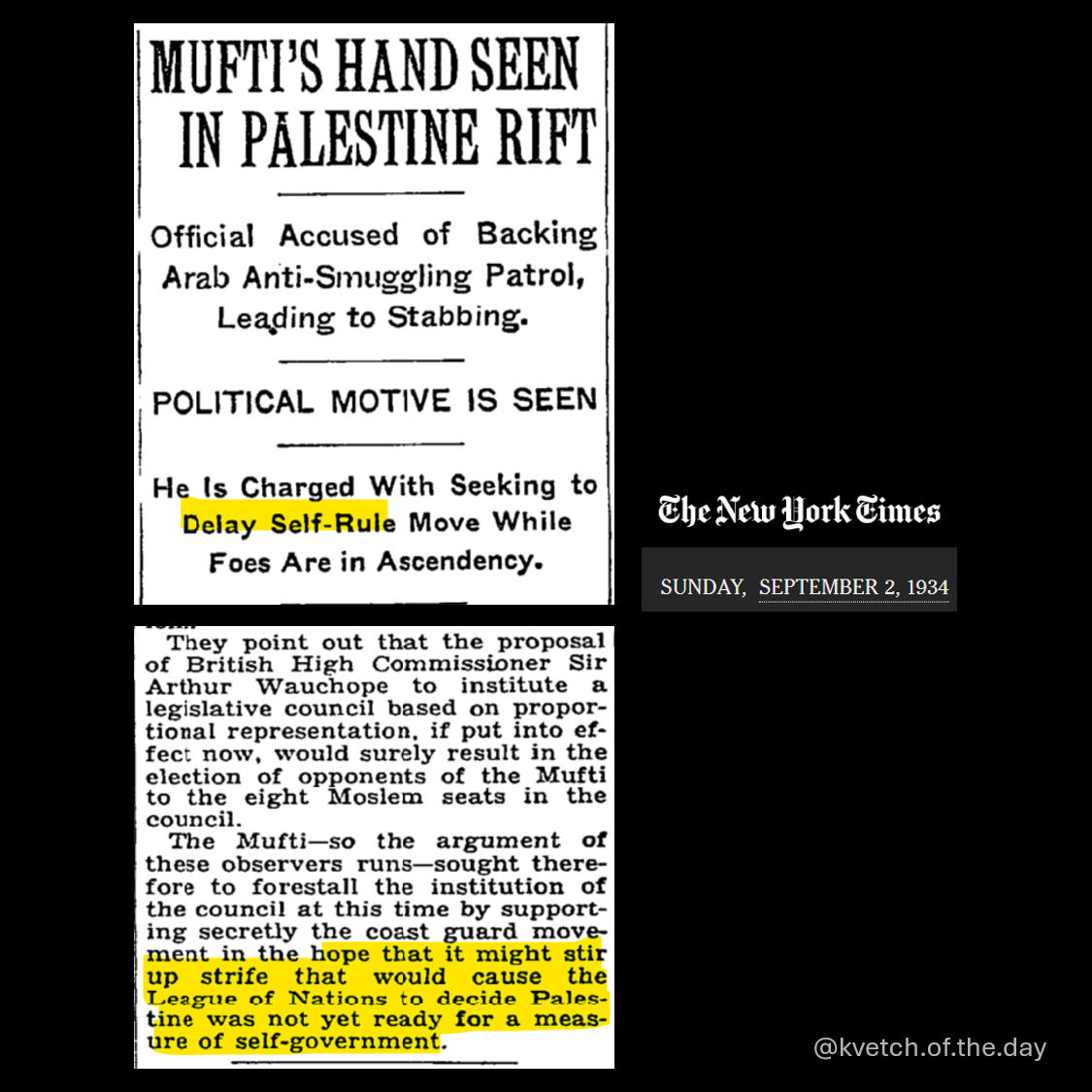 1934-09-02 · The New York TimesMufti’s Hand Seen in Palestine Rift
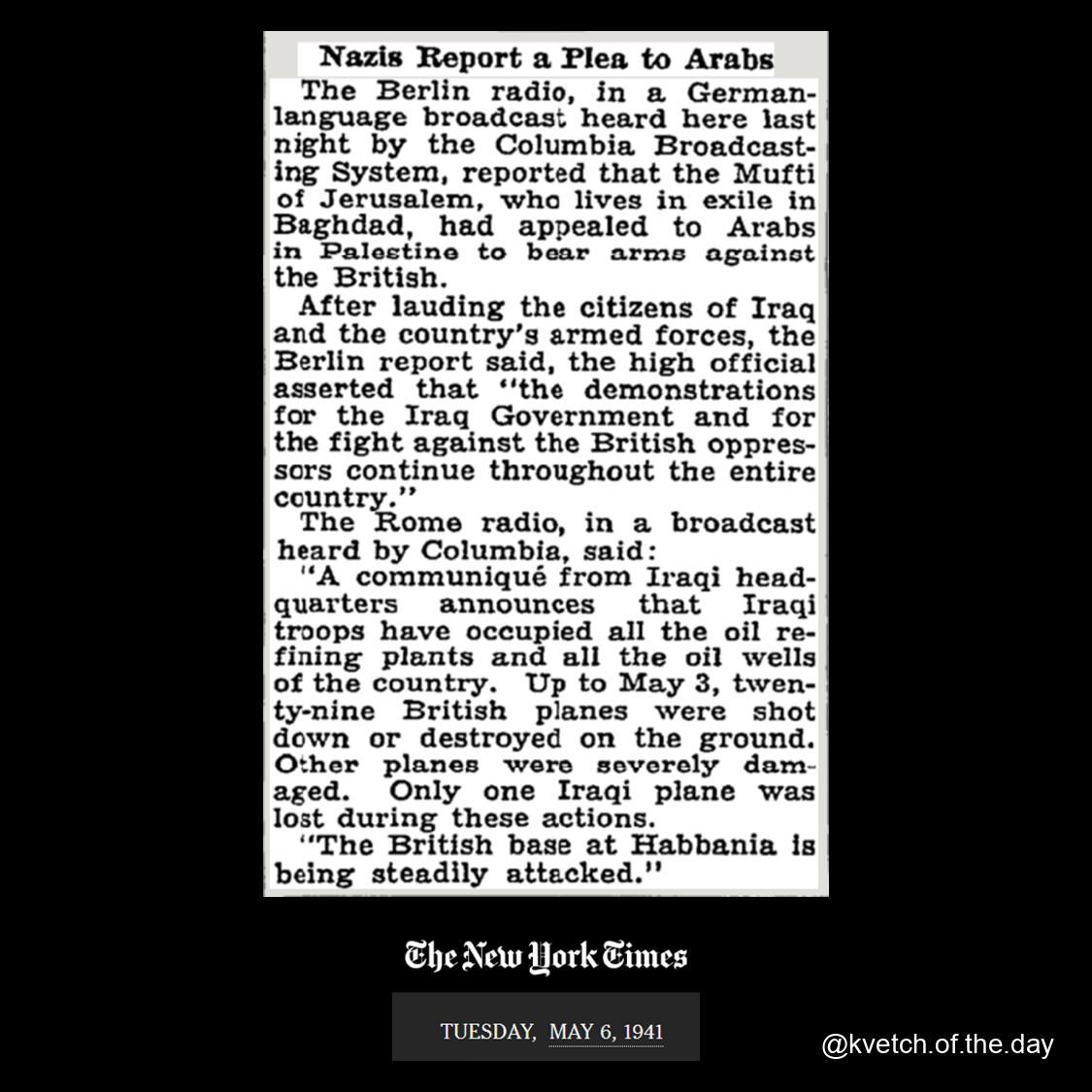 1941-05-06 · The New York Times · ✓nazis report a plea to Arabs
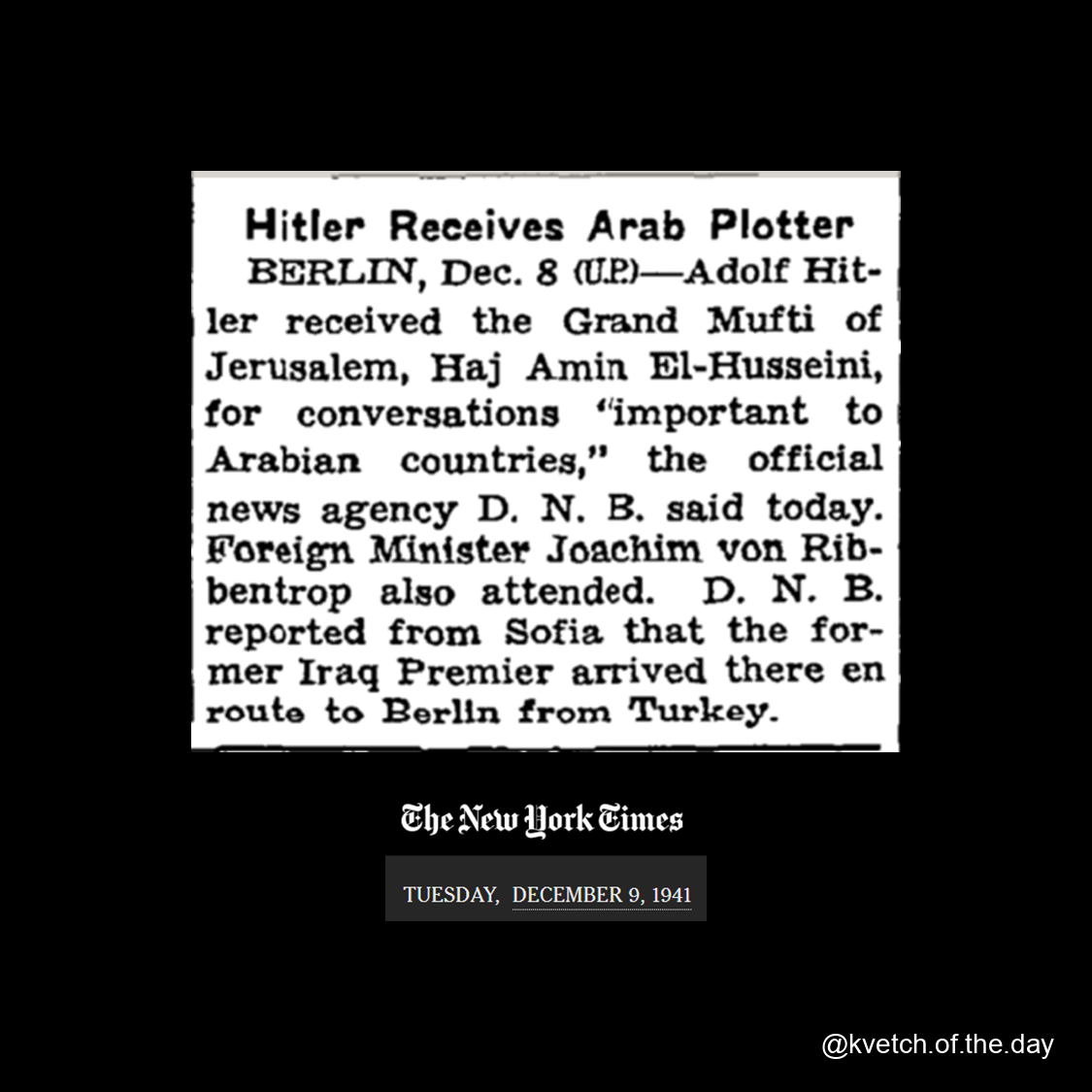 1941-12-09 · The New York Times · ✓Hitler receives arab plotter
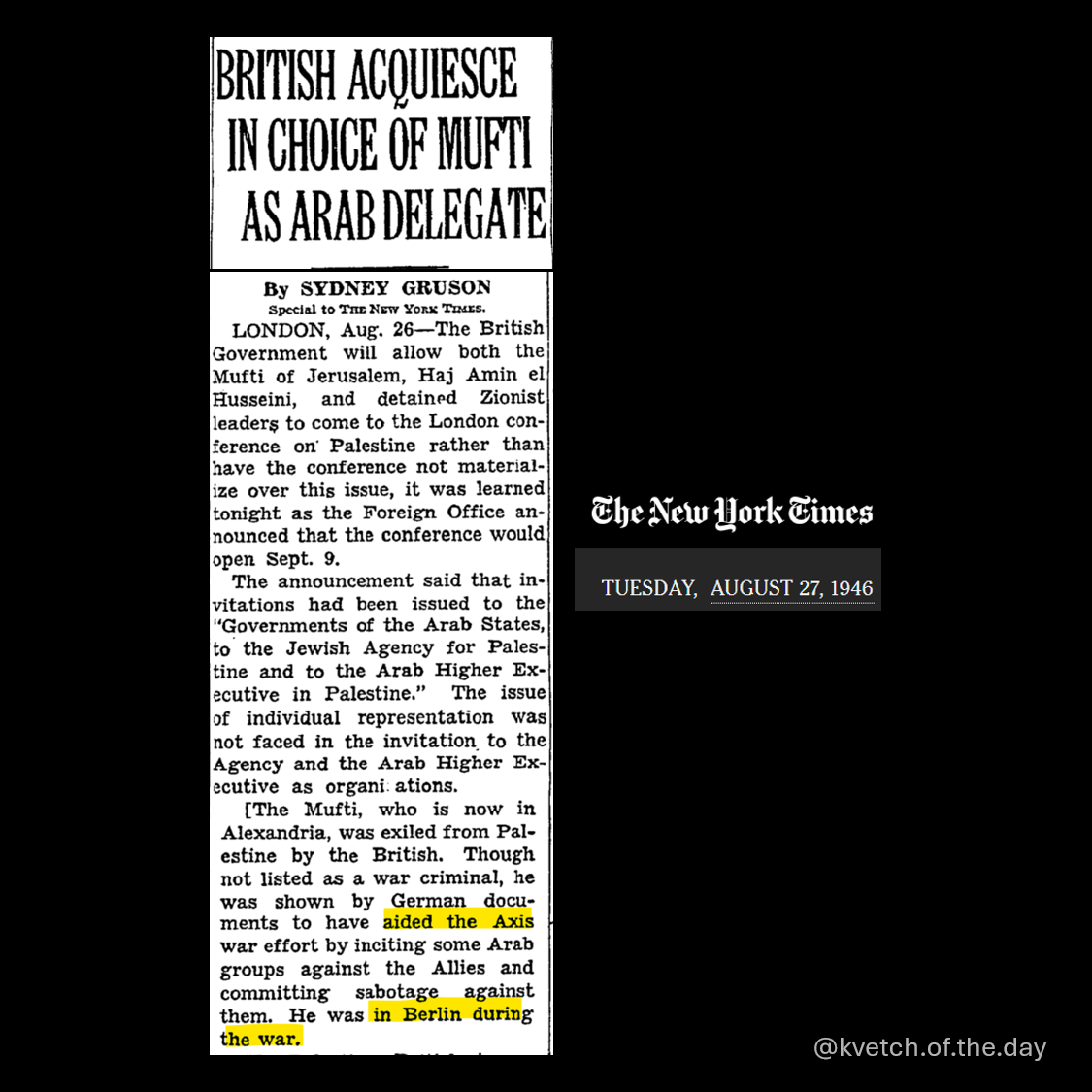 1946-08-27 · The New York Times · ✓British Acquiesce In Choice of Mufti as Arab Delegate1947-05-12 · The New York Times · ✓mufti called axis partner
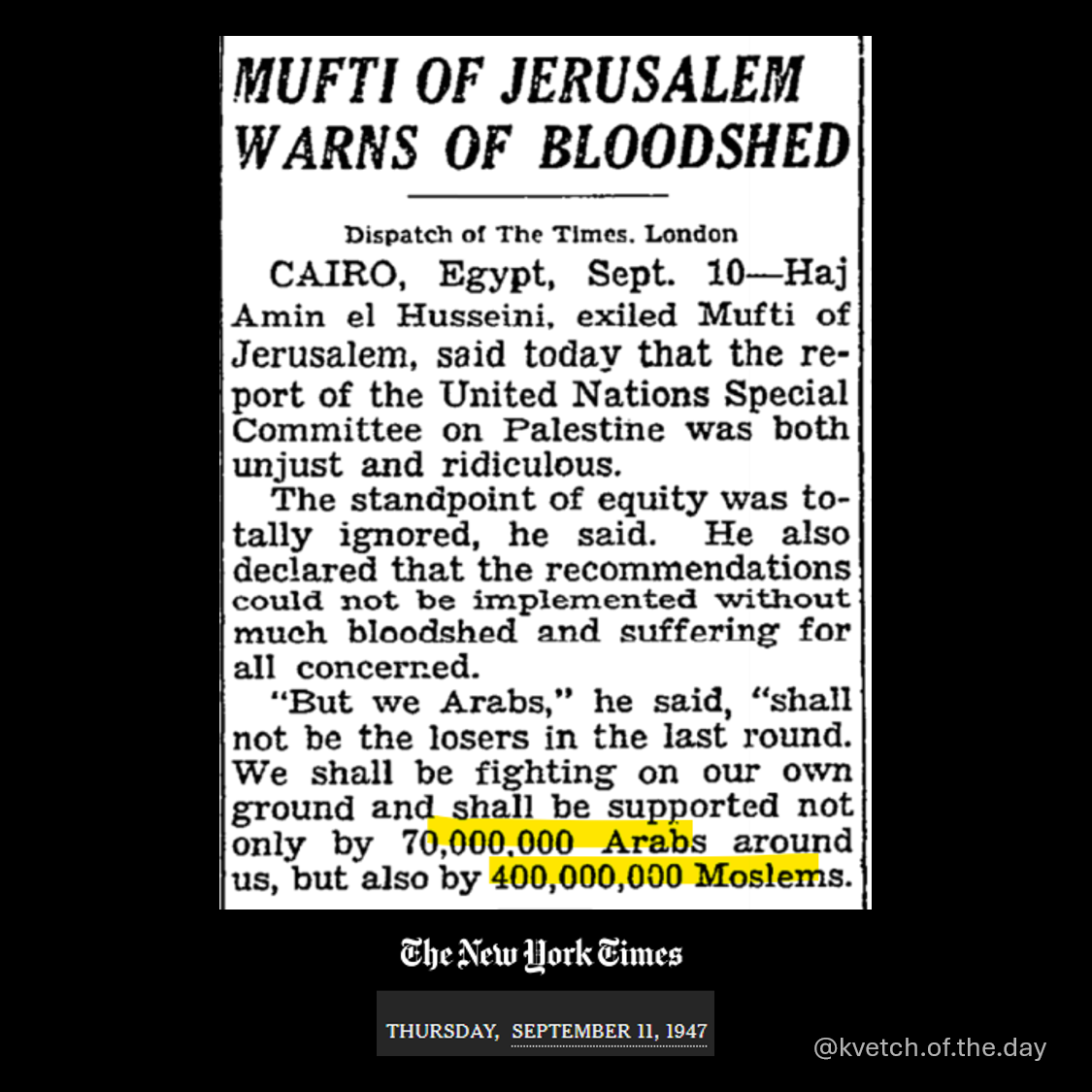 1947-09-11 · The New York TimesMufti Warns of Bloodshed
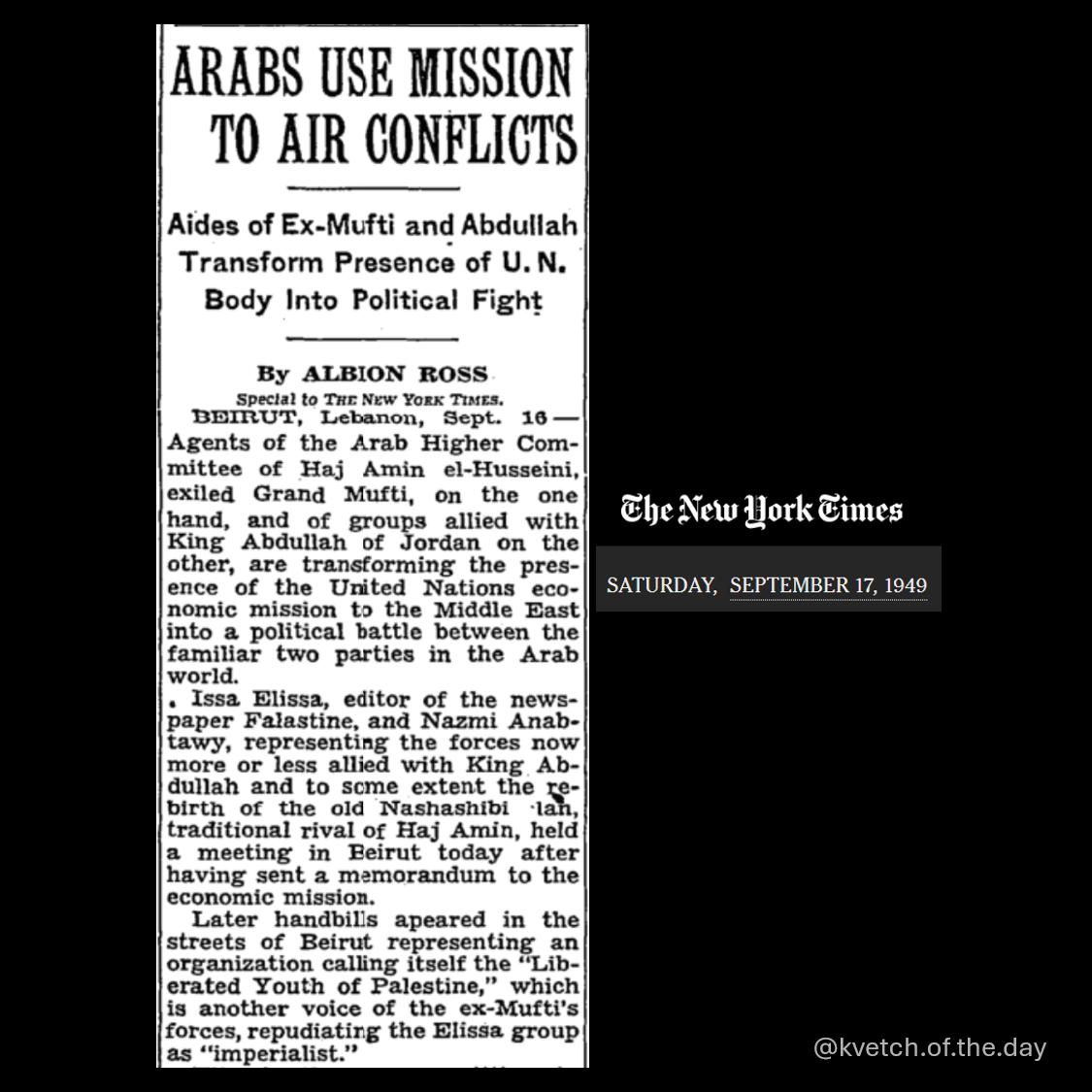 1949-09-17 · The New York TimesArabs Use Mission to Air Conflicts
Scans: kvetch-of-the-day news archive.