Argument
“Jews have been expelled from 109 countries — what do they have in common?”
Look at the list: England, France, Spain, Portugal, hundreds of cities and states. When one country expels you, maybe it's them; when 109 do, maybe it's you. Jews must be doing something to provoke it.
Is this an actual argument? We haven't yet found it in a public source
Traps in play:◆ The exception as proof◆ "They all…"◆ DARVO: deny, attack, reverse
Why people find it convincing
- Jews really were expelled from many places: England (1290), France (1306 and 1394), Spain (1492), Portugal (1496–97), many German cities and principalities, and after 1948 from much of the Arab world.
- A long list feels like a pattern, and a pattern feels like it must have a cause in the people it happens to.
- The list circulates as a neat meme with a precise-sounding number, which makes it look researched.
What's true
Expulsions were real, repeated and devastating.
The major countrywide expulsions of medieval and early modern Europe are well documented, and so are countless expulsions from individual cities, bishoprics and principalities, and the flight and expulsion of Jews from Arab countries after 1948. They are part of why Jewish history can read as a history of flight.
What's left out
How the number is made, why rulers expelled, and who else was expelled.
The '109' is not a count of countries. It comes from lists that add up cities, duchies, bishoprics and short-lived states, and count the same place several times for repeated expulsions, including local ones such as Vienna (1421) and Bavaria (1442). Aish traces the meme to 'a Holocaust-denying group in Australia'. The ADL's hate-symbol database agrees. Lists of alleged expulsions range 'from 100 to more than 1,000', and 109 'probably originates with a list of "109 locations" appearing on a longstanding Australian antisemitic website'. The number is now 'white supremacist numeric shorthand', and '110' is used to urge that some country be the next to expel Jews. So the '109' are 'locations', not countries, and the examples above include cities and duchies (Vienna, Bavaria) beside kingdoms (England 1290, France 1306, Spain 1492). Their causes, in Joshua Levy's summary for My Jewish Learning, were 'both economic and religious': in England Edward I 'forbade lending on interest', and when 'the economy did not improve' he expelled the Jews in 1290, their real estate 'turned over to the crown'; Philip IV ordered France's Jews out in 1306; in Spain Ferdinand and Isabel 'felt it was their duty to strengthen the standing of the Church' before the 1492 expulsion. The same history has places that took Jews in: 'Poland-Lithuania and the Ottoman Empire … provided refuge for the exiles'. Others were expelled the same way: 'Between 1609 and 1614, approximately 300,000 Moriscos — new Christians converted from Islam — were expelled from Spain' (Christian Berco, Europe, 1450 to 1789: Encyclopedia of the Early Modern World). In Cromwell's England there was 'no formal decision to allow readmission' after the Whitehall conference of December 1655, but Jews were soon 'more openly tolerated', and 'within months a synagogue and burial ground were allowed' (The Cromwell Association). France's Protestants lost their protections when Louis XIV revoked the Edict of Nantes in 1685, and a 'mass exodus, estimated at around 200,000 individuals' followed (John G. Gallaher and Raymond Pierre Hylton, EBSCO Research Starters, 2022). In the Dutch Republic, the Union of Utrecht's clause that no one was 'to be prosecuted for his religious beliefs', though 'intended to benefit the Protestants', 'provided the legal basis upon which Jews immediately began to take up residence' (Jane S. Gerber, My Jewish Learning). Roma were ordered out by decree too: in 1498 the Holy Roman Emperor Maximilian I 'ordered the expulsion of Roma, accusing them of supporting the Turks', though 'the order was not stringently enforced', and, citing Jennifer Illuzzi, 'between 1551 and 1774, rulers in the German lands passed more than 130 laws against Roma' (Jason Dawsey, The National WWII Museum, 2020).
Traps here:◆ The exception as proof◆ "They all…"
advocacy / viewAish, 'Debunking Antisemitism: The 109 Countries Myth' finding ✓
Read (2026-09-28). Origin: 'This antisemitic trope originated from a Holocaust-denying group in Australia'; causes: England 1290 ('a royal cash grab' via debts owed to Jewish lenders), France 1306 (Philip IV 'coveted the wealth of the Jews'), Spain 1492 (Alhambra Decree); local expulsions such as Vienna 1421 and Bavaria 1442. Does not itself spell out how the list of 109 was counted.
referenceADL, Hate Symbols Database, '109/110' ✓
Read (2026-09-28). 'The number 109 is white supremacist numeric shorthand for an antisemitic claim that Jews have been expelled from 109 different countries'; lists 'ranging from 100 to more than 1,000'; 109 'probably originates with a list of "109 locations" appearing on a longstanding Australian antisemitic website'; '110' used 'to urge that the United States or some other specific location be the next and 110th place to expel Jews'.
referenceJoshua Levy, 'Expulsion and Readmission', My Jewish Learning ✓
Read 2026-10-01. 'Medieval European Jewry repeatedly faced banishment for both economic and religious reasons'; 'Between 1290 and 1550, England, France, and most of southern and eastern Europe expelled their Jewish populations, at least once and sometimes several times'; England: Edward I 'forbade lending on interest', edict of 18 July 1290, real estate 'turned over to the crown'; France: Philip IV, 1306; Spain 1492 (Ferdinand and Isabel, the Inquisition); 'Poland-Lithuania and the Ottoman Empire– provided refuge for the exiles'. Re-read 2026-10-12 (article by Joshua Levy): Edward I 'forbade lending on interest in England, thereby depriving the Jews of their primary livelihood. When the economy did not improve, Edward was confronted with a choice'; 'Ferdinand and Isabel felt it was their duty to strengthen the standing of the Church in Spain, so they used the Inquisition'.
referenceChristian Berco, 'Moriscos, Expulsion of (Spain)', Europe, 1450 to 1789: Encyclopedia of the Early Modern World, via Encyclopedia.com ✓
Read 2026-10-01. 'Between 1609 and 1614, approximately 300,000 Moriscos — new Christians converted from Islam — were expelled from Spain'; first discussed in 1582, adopted after Philip III's accession (1598); the failure of assimilation among the factors.
referenceThe Cromwell Association, 'Cromwell and the Jews' ✓
Read 2026-10-01. Expelled 1290; Menasseh ben Israel's petition; the Whitehall conference (December 1655) 'was, in the end, inconclusive. There was no formal decision to allow readmission but it was soon evident that the presence of Jews would be more openly tolerated'; 'within months a synagogue and burial ground were allowed'; evidence of a London community before 1655; the reading of 1656 as proof of Cromwell's toleration 'is open to challenge'.
referenceJohn G. Gallaher and Raymond Pierre Hylton, 'Edict of Nantes is Revoked', EBSCO Research Starters (2022) (2022) ✓
Read 2026-10-01. The 1685 revocation 'effectively stripped the Huguenots, a Protestant minority, of their rights and freedom to practice their religion'; 'This mass exodus, estimated at around 200,000 individuals, included skilled professionals and artisans'. (Other estimates seen only in search summaries, e.g. 400,000, not used.)
referenceJane S. Gerber, 'Sephardic Jews in Amsterdam', My Jewish Learning ✓
Read 2026-10-01. 'Article XIII of the Treaty of Utrecht, which ratified the union of the northern provinces, declared that no one was to be prosecuted for his religious beliefs. Although this clause was intended to benefit the Protestants … it provided the legal basis upon which Jews immediately began to take up residence'; Manuel Rodrigues de Vega's 1604 petition. (The page's 'Wars of Spanish Succession' for the Dutch revolt looks like a slip in the source; not used.)
historyJason Dawsey, 'Fascination and Hatred: The Roma in European Culture', The National WWII Museum (10 October 2020) (2020) finding ✓
Read 2026-10-01. Dawsey is ASU WWII Studies Consultant at the museum's Jenny Craig Institute. 'Animus against Roma led to a wave of decrees and edicts. Religious conflict within Europe (the Protestant Reformation) and invasions of the continent by the Ottoman Turks certainly exacerbated the enmity. In 1498, the Holy Roman Emperor Maximilian I ordered the expulsion of Roma, accusing them of supporting the Turks (some Roma had converted to Islam in areas under Ottoman control). However, the order was not stringently enforced. Many more such acts followed. According to Jennifer Illuzzi, between 1551 and 1774, rulers in the German lands passed more than 130 laws against Roma.' Other half: Enlightenment ideas 'worked against the older hostility', though exclusion gave way to 'a still problematic notion of "improvement"'; the article argues anti-Roma racism is 'distinct from genocidal anti-Semitism' and not to be treated as an addendum to it.
More context
Reading the numbers: what '109' counts, and what the same counting gives for others.
A count is only as meaningful as its unit, and the '109' changes unit without saying so. The unit: the ADL traces it to a list of '109 locations', not countries; such lists range 'from 100 to more than 1,000' depending on what is counted. Cities (Vienna, 1421), duchies (Bavaria, 1442) and kingdoms (England, 1290; France, 1306; Spain, 1492) each count as one, and a place that expelled Jews twice counts twice. The period: the major countrywide expulsions fall mostly 'between 1290 and 1550', when 'England, France, and most of southern and eastern Europe expelled their Jewish populations, at least once and sometimes several times' (My Jewish Learning), in a Europe divided into hundreds of jurisdictions; a count of jurisdictions is therefore large by construction. The other side of the ledger: the same period's refuges are left out, 'Poland-Lithuania and the Ottoman Empire' took in exiles, and Amsterdam's Union of Utrecht gave Jews a legal basis to settle; and expulsions were not always final: England, which expelled its Jews in 1290, held a conference on readmission in December 1655 that was 'in the end, inconclusive', yet 'it was soon evident that the presence of Jews would be more openly tolerated', and 'within months a synagogue and burial ground were allowed' (Cromwell Association), so a single place can appear on such a list and later take Jews back. The comparison: by the same method, other minorities score high too. Spain expelled about 300,000 Moriscos between 1609 and 1614; about 200,000 Huguenots left France after 1685; and in the German lands alone 'rulers … passed more than 130 laws against Roma' between 1551 and 1774 (laws, not all of them expulsions; this page does not convert them into a count). The worst case for each side. For the meme: grant the highest list, over a thousand; it counts places and repeats, and the stated reasons were rulers' debts and religious policy, not anything the expelled shared beyond being a powerless minority. For 'the expulsions were minor': take the lowest reading; England, France and Spain still expelled their entire Jewish populations, and most of southern and eastern Europe did so at least once. Holds on the evidence here: Jews were expelled from many jurisdictions, repeatedly, over centuries. Open, needs a defined unit and period: a meaningful count. Not supported: that '109' is a count of countries, or that the number says anything about the expelled rather than the expellers.
What the labels (Holds, Open, Arguable …) mean
referenceADL, Hate Symbols Database, '109/110' ✓
Read (2026-09-28). 'The number 109 is white supremacist numeric shorthand for an antisemitic claim that Jews have been expelled from 109 different countries'; lists 'ranging from 100 to more than 1,000'; 109 'probably originates with a list of "109 locations" appearing on a longstanding Australian antisemitic website'; '110' used 'to urge that the United States or some other specific location be the next and 110th place to expel Jews'.
advocacy / viewAish, 'Debunking Antisemitism: The 109 Countries Myth' finding ✓
Read (2026-09-28). Origin: 'This antisemitic trope originated from a Holocaust-denying group in Australia'; causes: England 1290 ('a royal cash grab' via debts owed to Jewish lenders), France 1306 (Philip IV 'coveted the wealth of the Jews'), Spain 1492 (Alhambra Decree); local expulsions such as Vienna 1421 and Bavaria 1442. Does not itself spell out how the list of 109 was counted.
referenceJoshua Levy, 'Expulsion and Readmission', My Jewish Learning ✓
Read 2026-10-01. 'Medieval European Jewry repeatedly faced banishment for both economic and religious reasons'; 'Between 1290 and 1550, England, France, and most of southern and eastern Europe expelled their Jewish populations, at least once and sometimes several times'; England: Edward I 'forbade lending on interest', edict of 18 July 1290, real estate 'turned over to the crown'; France: Philip IV, 1306; Spain 1492 (Ferdinand and Isabel, the Inquisition); 'Poland-Lithuania and the Ottoman Empire– provided refuge for the exiles'. Re-read 2026-10-12 (article by Joshua Levy): Edward I 'forbade lending on interest in England, thereby depriving the Jews of their primary livelihood. When the economy did not improve, Edward was confronted with a choice'; 'Ferdinand and Isabel felt it was their duty to strengthen the standing of the Church in Spain, so they used the Inquisition'.
referenceJane S. Gerber, 'Sephardic Jews in Amsterdam', My Jewish Learning ✓
Read 2026-10-01. 'Article XIII of the Treaty of Utrecht, which ratified the union of the northern provinces, declared that no one was to be prosecuted for his religious beliefs. Although this clause was intended to benefit the Protestants … it provided the legal basis upon which Jews immediately began to take up residence'; Manuel Rodrigues de Vega's 1604 petition. (The page's 'Wars of Spanish Succession' for the Dutch revolt looks like a slip in the source; not used.)
referenceChristian Berco, 'Moriscos, Expulsion of (Spain)', Europe, 1450 to 1789: Encyclopedia of the Early Modern World, via Encyclopedia.com ✓
Read 2026-10-01. 'Between 1609 and 1614, approximately 300,000 Moriscos — new Christians converted from Islam — were expelled from Spain'; first discussed in 1582, adopted after Philip III's accession (1598); the failure of assimilation among the factors.
referenceJohn G. Gallaher and Raymond Pierre Hylton, 'Edict of Nantes is Revoked', EBSCO Research Starters (2022) (2022) ✓
Read 2026-10-01. The 1685 revocation 'effectively stripped the Huguenots, a Protestant minority, of their rights and freedom to practice their religion'; 'This mass exodus, estimated at around 200,000 individuals, included skilled professionals and artisans'. (Other estimates seen only in search summaries, e.g. 400,000, not used.)
historyJason Dawsey, 'Fascination and Hatred: The Roma in European Culture', The National WWII Museum (10 October 2020) (2020) finding ✓
Read 2026-10-01. Dawsey is ASU WWII Studies Consultant at the museum's Jenny Craig Institute. 'Animus against Roma led to a wave of decrees and edicts. Religious conflict within Europe (the Protestant Reformation) and invasions of the continent by the Ottoman Turks certainly exacerbated the enmity. In 1498, the Holy Roman Emperor Maximilian I ordered the expulsion of Roma, accusing them of supporting the Turks (some Roma had converted to Islam in areas under Ottoman control). However, the order was not stringently enforced. Many more such acts followed. According to Jennifer Illuzzi, between 1551 and 1774, rulers in the German lands passed more than 130 laws against Roma.' Other half: Enlightenment ideas 'worked against the older hostility', though exclusion gave way to 'a still problematic notion of "improvement"'; the article argues anti-Roma racism is 'distinct from genocidal anti-Semitism' and not to be treated as an addendum to it.
referenceThe Cromwell Association, 'Cromwell and the Jews' ✓
Read 2026-10-01. Expelled 1290; Menasseh ben Israel's petition; the Whitehall conference (December 1655) 'was, in the end, inconclusive. There was no formal decision to allow readmission but it was soon evident that the presence of Jews would be more openly tolerated'; 'within months a synagogue and burial ground were allowed'; evidence of a London community before 1655; the reading of 1656 as proof of Cromwell's toleration 'is open to challenge'.
How to talk about this.
Acknowledge first: Jews really were expelled from many places, which is a history of persecution worth knowing. Ask one question: 'what do the expellers have in common?'; the list turns victims into culprits by pretending the answer is 'the Jews'. Share one checkable thing: how the '109' is built, counting cities and repeated expulsions, and who circulates it. What not to say: nothing is needed beyond the facts; the meme is answered by the history it distorts. The same move against any people — 'expelled everywhere, so they must deserve it' — is the logic of pogroms.
Where it leads if pressed
Blaming the persecuted for their persecution.
'What do they have in common?' has only one intended answer: the Jews. The same reasoning would blame the Moriscos for Spain, the Huguenots for Louis XIV, and Roma for every town that drove them out. It's the logic of 'where there's smoke there's fire', applied to a minority at the mercy of those who expelled it, and it's the step from history to antisemitism. It also explains, in reverse, the Zionist conclusion that Jews needed one place from which they couldn't be expelled (see 'Jews can only be safe as a majority in their own state').
Traps here:◆ DARVO: deny, attack, reverse◆ The strict enemy frame
The usual reply — and its own traps
Arguments travel in pairs. Here is what the other side typically answers. Check whether both lean on the same trick.
heard from pro-Israel voices“Jews can only be safe as a majority in their own state.”On the timeline
Keep exploring
From the archive
How newspapers reported related events at the time — suggested by the archive's own tags, not yet reviewed for this argument. Open a scan and judge for yourself.
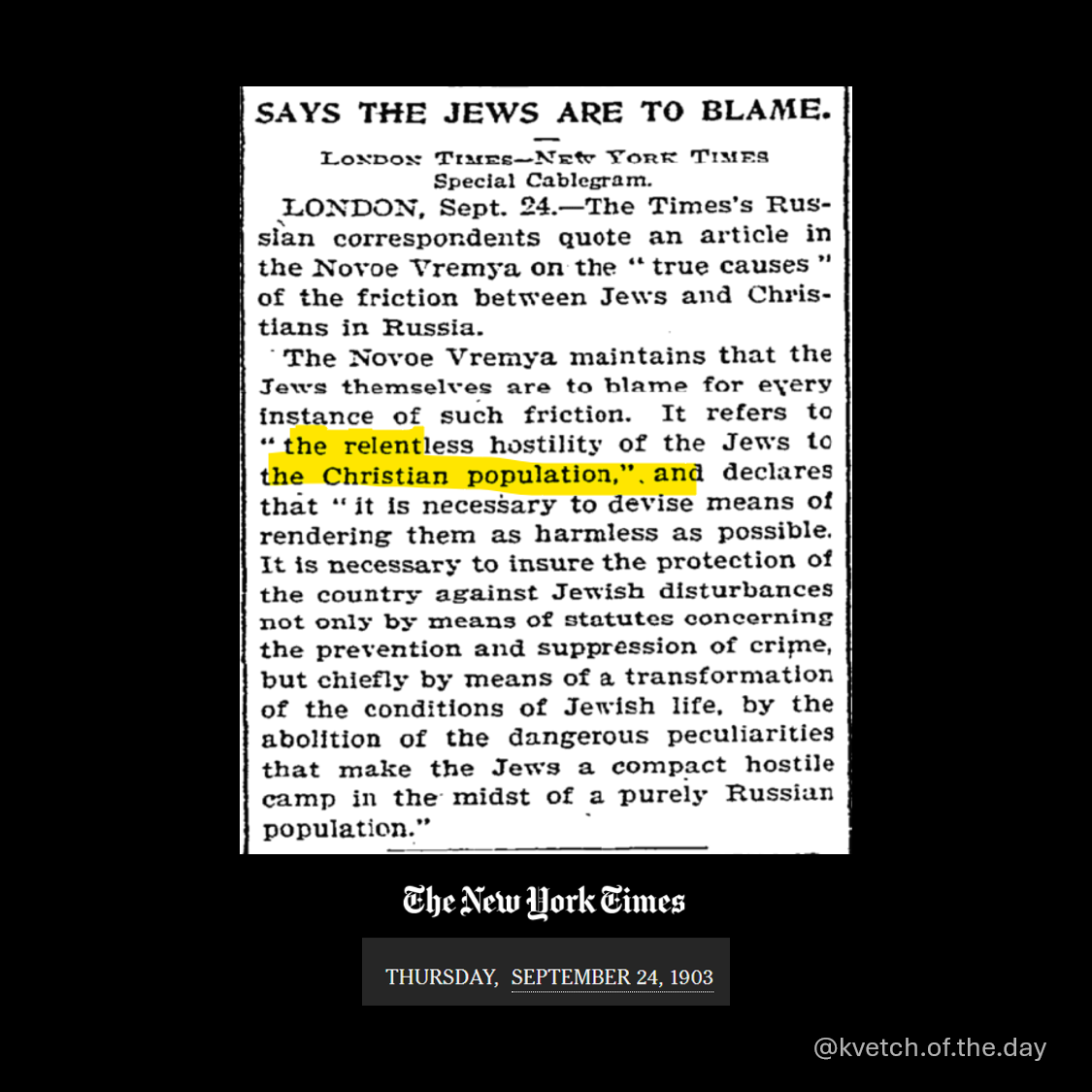 1903-09-24 · The New York TimesSays the Jews are to Blame
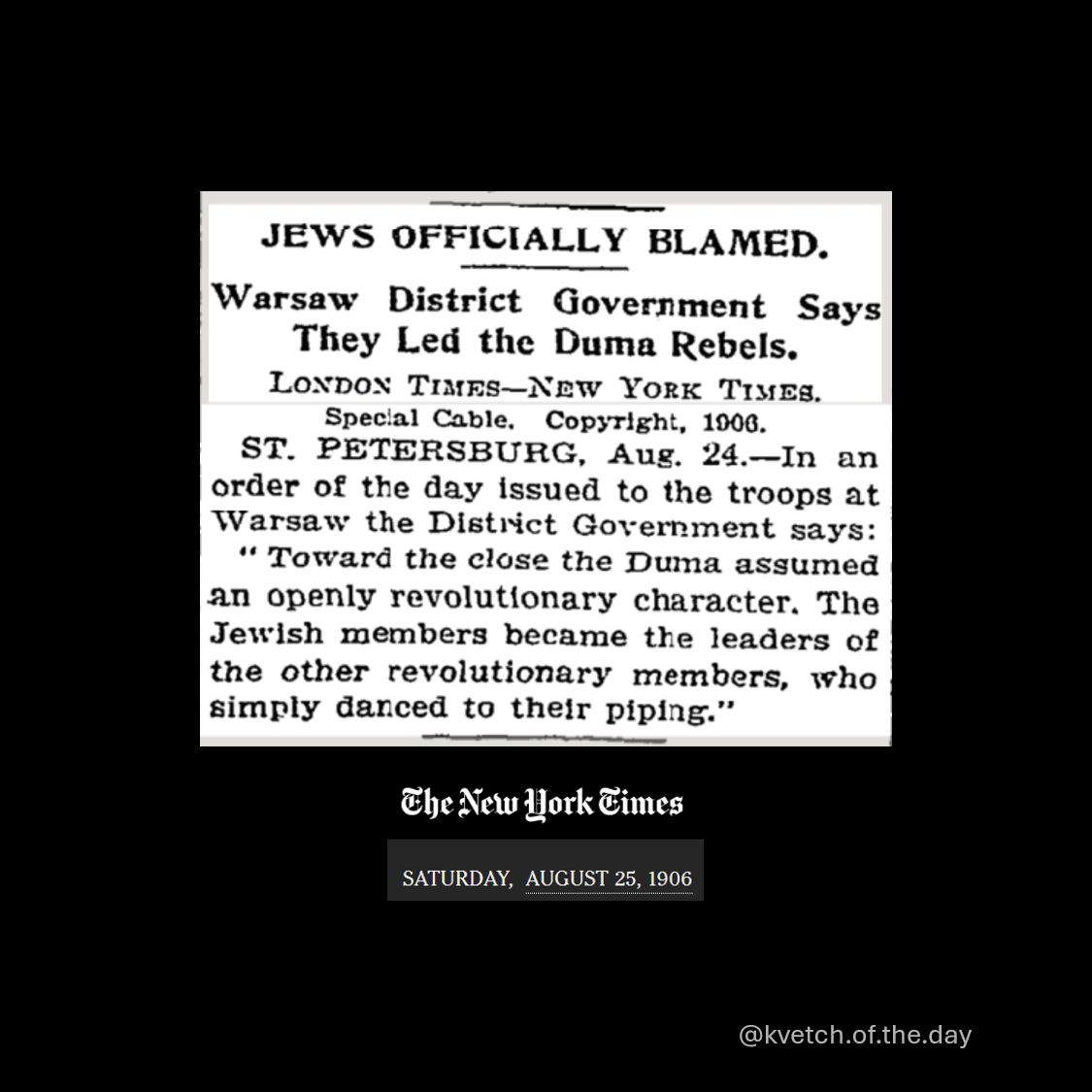 1906-08-25 · The New York TimesJews Officially Blamed
Scans: kvetch-of-the-day news archive.