Argument · heard from pro-Palestinian voices
“Victim card revoked.”
A reply to a Jew or Israeli raising antisemitism or past persecution: whatever Jews suffered, Israel's conduct has cancelled their claim to sympathy or protection.
Made publicly as a pro-Palestinian argument by Ibrahim Hewitt
Where it's been said
“By playing the victim card, Netanyahu hopes to convince people that it is the Palestinians who are trying to steal Israeli land and “annihilate” Israelis when, in fact, the opposite is true.”
“You don't get to act like a victim anymore. 'Poor little Israel' just sounds silly when you're the dominant power in the Middle East.”
Traps in play:◆ "They all…"◆ The purity loop◆ DARVO: deny, attack, reverse
Why people find it convincing
- Past suffering really doesn't justify present wrongs — for anyone.
- Some defenders of Israeli policy do invoke the Holocaust in political argument, which is frustrating to hear, and Israel's own Holocaust memorial has objected. In October 2023 Israel's UN ambassador Gilad Erdan pinned on a yellow star at the Security Council ('We will wear this star until you wake up and condemn the atrocities of Hamas'), and Yad Vashem's chairman Dani Dayan said 'This act disgraces the victims of the Holocaust as well as the state of Israel' (AFP, 30 October 2023).
- The argument has an intellectual form: Norman Finkelstein's 'The Holocaust Industry: Reflections on the Exploitation of Jewish Suffering' (2000) argues, as its subtitle says, that the memory of Jewish suffering has been exploited (its publisher describes it as moving from 'the place the Holocaust has come to occupy in global culture' to 'a disturbing examination of Holocaust compensation settlements') — and on that reading 'victim card' means exploitation of memory, not that Jews may now be hated.
- A version of it has come from inside Israel's establishment: Avraham Burg, a former Knesset speaker and head of the World Zionist Organization and the Jewish Agency, wrote in 'The Holocaust Is Over; We Must Rise From Its Ashes' (2008) that 'Everything is allowed because we suffered the Shoah and no-one is allowed to tell us what to do', criticising, in his reviewer's summary, that memories of the victims are 'abused in order to justify policies' including displacing Palestinians. The same review notes that his comparison of Israel with late-Weimar Germany brought him 'the accusation of twisting historical facts' (Qantara, 5 November 2009). His point is about how memory is used, not that past suffering forfeits sympathy.
- It feels like fairness: the same moral scrutiny for everyone, regardless of history.
What's true
Past victimhood is not a licence, and the Holocaust is not an argument for any particular policy.
No history of persecution justifies wrongdoing now, and invoking the Holocaust to shut down criticism of a specific Israeli policy is a bad argument.
What's left out
It makes protection from antisemitism conditional on approving of Israel.
'Card' implies victimhood is a privilege held on good behaviour. Aimed at a Jew outside Israel, for instance in reply to someone reporting an attack on a synagogue, it reaches a person who has no say over the Israeli government's conduct. Where the line runs is itself argued. In September 2026 the singer Pink shared posts from the @Stop_AntiSemitism account attacking Macklemore's 'Free Palestine' speech at an Ed Sheeran concert, and pressed for him to be dropped from the tour. A petition shared by the actor Javier Bardem then asked UNICEF to remove her as an ambassador, calling her comments 'incompatible with the role of a UNICEF Ambassador'. She said later that the post she shared 'said things in words I didn't write'. If protection from hatred belongs to persons, no government's conduct can earn or forfeit it for them; the phrase treats it as a card that can be taken back.
Traps here:◆ "They all…"◆ The purity loop◆ DARVO: deny, attack, reverse
pressLaura Molloy, 'Javier Bardem shares petition to remove Pink as UNICEF ambassador after Macklemore Palestine outrage', Paste (22 September 2026) (2026) incident ✓
Read (2026-09-28). Pink shared @Stop_AntiSemitism posts on Macklemore's 4 September MetLife speech ('accused Israel of a false ‘genocide’') and was 'among the most vocal critics' in the storm that got him dropped from Sheeran's tour (after Robert Kraft's threat). Change.org petition shared by Bardem on 21 September (per Reuters): 'Pink's recent comments are not just unfortunate but also incompatible with the role of a UNICEF Ambassador'; over 170,000 signatures. Pink: 'It said things in words I didn't write, and I wouldn't have chosen all of them.' The article does not mention Pink being Jewish or the phrase 'victim card'.
More context
The asymmetry test: would the same rule revoke Palestinian victimhood after October 7?
If victimhood can be revoked by the conduct of people who share your identity, the same rule would revoke Palestinian victimhood after October 7. Anyone who says that about Palestinians is making the same move. If it can't be revoked, the claim collapses. A rule applied to one people only is a device rather than a principle, whichever people it is applied to.
How to talk about this.
Acknowledge first: the Holocaust and centuries of persecution don't give any state a licence, and it's fair to say so. Ask one question: 'does past suffering stop counting when the victims' descendants do wrong, and would we say that of any other people?'. Share one checkable thing: that both peoples in this conflict are descendants of victims, and both have committed wrongs. What not to say: 'after the Holocaust, you can't criticise Israel'. From the other side: grant that suffering doesn't excuse conduct, then ask what 'revoked' is meant to allow.
Where it leads if pressed
Working it out: two claims in two words, and who pays for the second.
The phrase joins two claims. One is about how the Holocaust is used in politics; the other is about whether Jews' protection from hatred depends on Israel's conduct. They need different evidence. The first is documented, including by Israelis and Jews. When Israel's UN ambassador wore a yellow star in 2023, Yad Vashem's chairman said 'this act disgraces the victims of the Holocaust as well as the state of Israel'; a former Knesset speaker, Avraham Burg, wrote that memory is used to justify policy ('Everything is allowed because we suffered the Shoah'); Norman Finkelstein's book indicts those who 'exploit the tragedy'. A pro-Israel writer argues that Zionists 'don't need to play the victim card'. So the critique of using the Holocaust as an argument holds, and it is made from inside too. The second claim is tested by who is targeted. In England and Wales, police-recorded religious hate crimes against Jews rose from 1,543 to 3,282 in the year to March 2024, 121 per 10,000 Jewish people, 'the highest rate for any religious group', against 10 per 10,000 Muslims; in France antisemitic acts rose to 1,676 in 2023, concentrated 'très majoritairement après le 7 octobre', and anti-Muslim acts rose 29% to 242. The people targeted were Jews in Britain and France, who have no say over Israel's government. The worst case for each side. For 'victim card revoked': grant the critique at its strongest, the yellow star, Burg, Finkelstein; it shows the Holocaust misused as an argument, not that Jews elsewhere lose protection when Israel does wrong, and the attacks after 7 October fell on them; and the phrase is sometimes aimed at a threat that is on record: a 2025 Middle East Monitor column called Netanyahu's claim that Hamas wants to 'annihilate the Jewish people' playing 'the victim card', while Hamas's own 1988 charter quotes a hadith in which the stones and trees say 'there is a Jew behind me, come and kill him' (Art. 7). For 'any criticism is antisemitism': take the hate figures at their highest; criticism of Israel's use of Holocaust memory is made by Yad Vashem and Israelis themselves, and is not antisemitic. Holds on the evidence here: the Holocaust is sometimes used as a political argument, and Israelis criticise that; antisemitic hate crimes against diaspora Jews rose sharply after 7 October. Holds only case by case: that a particular use of the phrase targets the argument, not the people. Not supported: that past persecution licenses present conduct, or that Israel's conduct removes diaspora Jews' protection from hatred, a rule that applied to Palestinians after 7 October would be just as wrong.
What the labels (Holds, Open, Arguable …) mean
pressAFP, 'Israel envoy wears yellow star at UN, drawing Yad Vashem criticism' (France 24, 31 October 2023) (2023) incident ✓
Read (2026-09-29). Erdan: 'Just like my grandparents … from now on my team and I will wear yellow stars'; 'We will wear this star until you wake up and condemn the atrocities of Hamas.' Yad Vashem chairman Dani Dayan: 'This act disgraces the victims of the Holocaust as well as the state of Israel'; Yad Vashem urged him to wear the Israeli flag instead.
advocacy / viewUlrich von Schwerin, 'Avraham Burg: "The Holocaust Is Over": Caught in a National Trauma', Qantara.de (5 November 2009); book: Avraham Burg, The Holocaust Is Over; We Must Rise From Its Ashes (Palgrave Macmillan, 2008) (2009) ✓
Read 1 Oct 2026. Burg 'criticises the fact that the Holocaust determines the actions, the ideas, and ultimately the entire identity of Israel. Memories of the victims are abused in order to justify policies, not least the policy of displacing Palestinians'; Burg quoted: 'Everything is allowed because we suffered the Shoah and no-one is allowed to tell us what to do'; considered 'problematic – and even dangerous – by many both in Israel and in Germany'; his Weimar comparison brought 'the accusation of twisting historical facts'; Burg 'rose … to become the speaker of the Israeli parliament, the Knesset' and headed 'the World Zionist Organisation and the Jewish Agency'. Book record: Open Library OL11892613W.
advocacy / viewNorman G. Finkelstein, 'The Holocaust Industry: Reflections on the Exploitation of Jewish Suffering' (Verso, 2000; 2nd ed. 2003) (2000) finding ✓
Publisher's page read (2026-09-29): 'Controversial indictment of those who exploit the tragedy of the Holocaust for personal and political gain'; it 'moves from an interrogation of the place the Holocaust has come to occupy in global culture to a disturbing examination of Holocaust compensation settlements', 'scathing in his denunciation of the institutions and individuals who have cropped up around the issue of reparations'. The book itself is not read here; only its stated thesis is relied on.
advocacy / viewUri Pilichowski, 'Zionists don't need to play the victim card like Hamas does', The Jerusalem Post (9 June 2024) (2024) ✓
Read (2026-09-28). Quotes Philip Slater ('You don't get to act like a victim anymore. ‘Poor little Israel’ just sounds silly when you're the dominant power in the Middle East') without giving the original's date or place; the author argues from the pro-Israel side that 'Zionists don't need to play the victim card' but should explain 'they are exercising their right to defend themselves'.
dataHome Office, 'Hate crime, England and Wales, year ending March 2024' (official statistics, GOV.UK) (2024) aggregate ✓
Read, 2026-10-10. Police-recorded crime. 'The increase in offences was driven by a sharp rise in religious hate crimes targeted at Jewish people since the beginning of the Israel-Hamas conflict'; 'there were 3,282 religious hate crimes targeted at Jewish people in the year ending March 2024, more than double the number recorded the previous year (1,543)'; against Muslims '3,866 offences in the latest year, up 13% from 3,432'; '121 religious hate crimes per 10,000 population targeted at Jewish people, the highest rate for any religious group, and up from 57 per 10,000 the previous year'; Muslims '10 per 10,000 population, up from 9 per 10,000'; 'In October 2023, the police recorded 817 racially or religiously aggravated harassment offences, the highest ever monthly total for these crimes'; 'The most common hate crimes targeted against Jews and Muslims in the last year were public fear, alarm or distress offences.' Victims are classified by the perceived target, as flagged by the police.
dataCNCDH (French National Consultative Commission on Human Rights), 'Rapport 2023 sur la lutte contre le racisme, l'antisémitisme et la xénophobie — Les Essentiels' (June 2024) (2024) aggregate ✓
Read, 2026-10-10 (French; translations here are this site's). Figures of the interior ministry's territorial intelligence service (DNRT): '3 139 faits recensés en 2023 (contre 1 636 faits en 2022) : + 284 % pour les faits antisémites, soit 1 676 faits ; + 29 % pour les faits antimusulmans, soit 242 faits ; + 21 % pour tous les autres faits racistes, soit 1 121 faits'; antisemitic acts 'se concentrent très majoritairement après le 7 octobre'; 'L'augmentation exponentielle des actes racistes entre octobre et décembre 2023 (1 242 actes racistes recensés) alimente un fort sentiment d'insécurité tant parmi les Français juifs que musulmans'. Method: the DNRT's figures rest on reports from its local offices, local partners, the media 'ainsi que des associations représentant les communautés religieuses musulmane et juive, qui ont fait l'objet d'un dépôt de plainte'. The report stresses under-reporting ('chiffre noir'). Re-read 2026-10-12 (French original): the 1,242 racist acts of October–December 2023 'alimente un fort sentiment d'insécurité tant parmi les Français juifs que musulmans'.
advocacy / viewIbrahim Hewitt, 'Once again, Netanyahu plays the victim card', Middle East Monitor (25 May 2025) (2025) ✓
Read (2026-09-28). Opens: 'Once again, Israeli Prime Minister Benjamin Netanyahu has played the victim card, claiming that Hamas wants to “destroy the Jewish state” and “annihilate the Jewish people”.' Later: 'By playing the victim card, Netanyahu hopes to convince people that it is the Palestinians who are trying to steal Israeli land and “annihilate” Israelis when, in fact, the opposite is true.'
primary documentCovenant of the Islamic Resistance Movement (Hamas Charter) (1988) incident ✓
18 August 1988; Avalon Project translation checked: Art. 2 ('one of the wings of Moslem Brotherhood in Palestine'), Art. 7 (the hadith on Jews hiding 'behind stones and trees'), Art. 11 (Palestine 'an Islamic Waqf consecrated for future Moslem generations until Judgement Day'), Art. 13 ('so-called peaceful solutions and international conferences, are in contradiction to the principles' of the movement). Re-read 2026-09-28: Art. 28, 'The Zionist invasion … relies greatly in its infiltration and espionage operations on the secret organizations it gave rise to, such as the Freemasons, The Rotary and Lions clubs … It is behind the drug trade and alcoholism'; Art. 32, 'After Palestine, the Zionists aspire to expand from the Nile to the Euphrates', 'Their plan is embodied in the "Protocols of the Elders of Zion"', and the same article speaks of 'the fight with the warmongering Jews'. Re-read 2026-10-10: Art. 31, 'Under the wing of Islam, it is possible for the followers of the three religions - Islam, Christianity and Judaism - to coexist in peace and quiet with each other. Peace and quiet would not be possible except under the wing of Islam'; 'It is the duty of the followers of other religions to stop disputing the sovereignty of Islam in this region'. Superseded in part by the 2017 'Document of General Principles'. Art. 7 in full (re-read 2026-10-12): '"The Day of Judgement will not come about until Moslems fight the Jews (killing the Jews), when the Jew will hide behind stones and trees. The stones and trees will say O Moslems, O Abdulla, there is a Jew behind me, come and kill him."' (quoting al-Bukhari and Muslim). Art. 7's hadith in the Avalon text (re-read 2026-10-12): 'The stones and trees will say O Moslems, O Abdulla, there is a Jew behind me, come and kill him. Only the Gharkad tree, (evidently a certain kind of tree) would not do that because it is one of the trees of the Jews.'
Protection from antisemitism made conditional on Israel's conduct.
Followed through, the phrase makes protection from antisemitism conditional: it can be read as saying hostility to Jews is acceptable as long as Israel exists in a form the speaker disapproves of. It belongs to a cluster: 'Zionists are the modern Nazis' turns the Holocaust against Jews, 'Holocaust inversion was only coined in the 2000s' dismisses the name for that move, and 'victim card revoked' declares the protection void.
Keep exploring
From the archive
How newspapers reported related events at the time — suggested by the archive's own tags, not yet reviewed for this argument. Open a scan and judge for yourself.
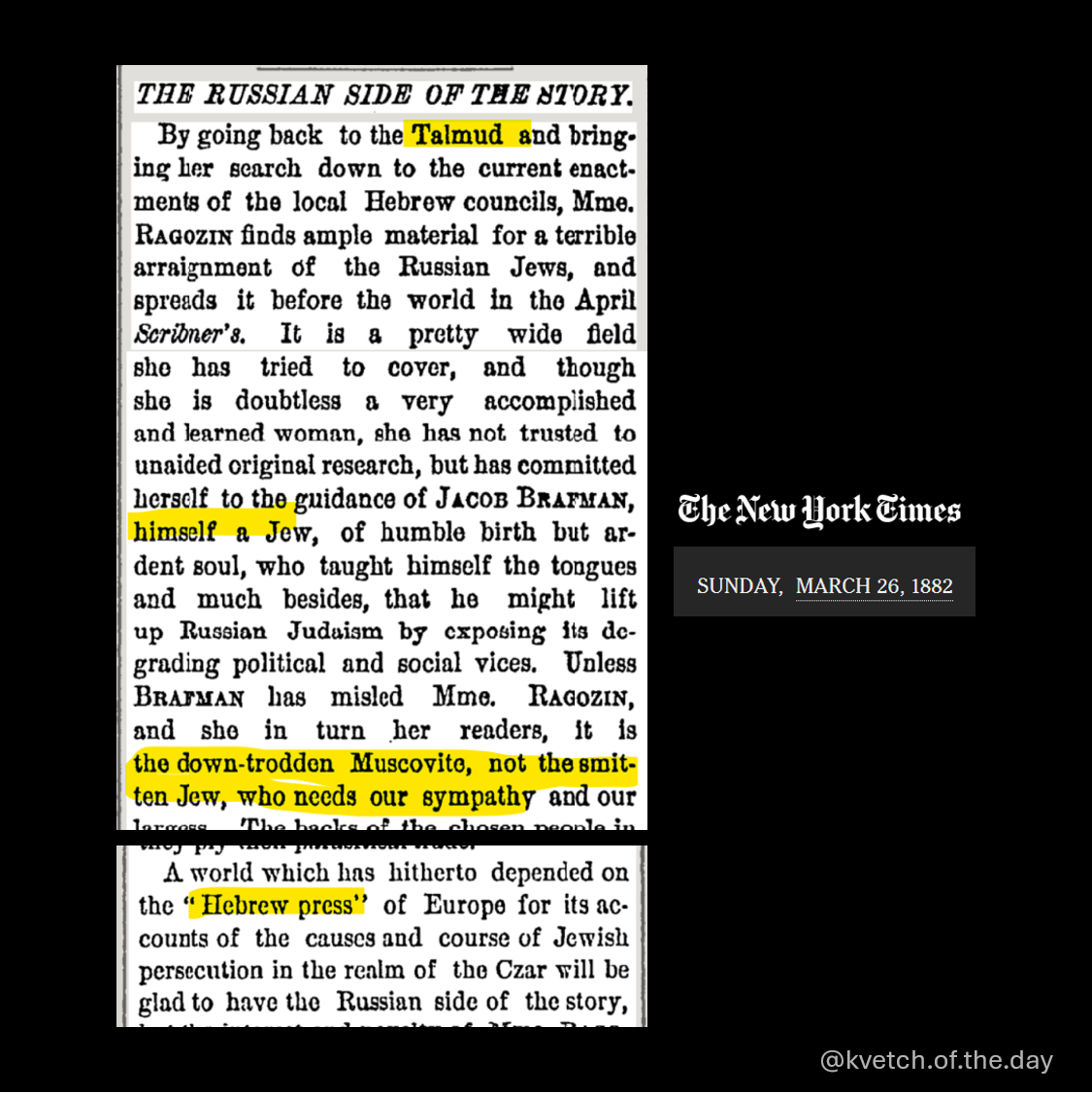 1882-03-26 · The New York TimesThe Russian Side of the Story
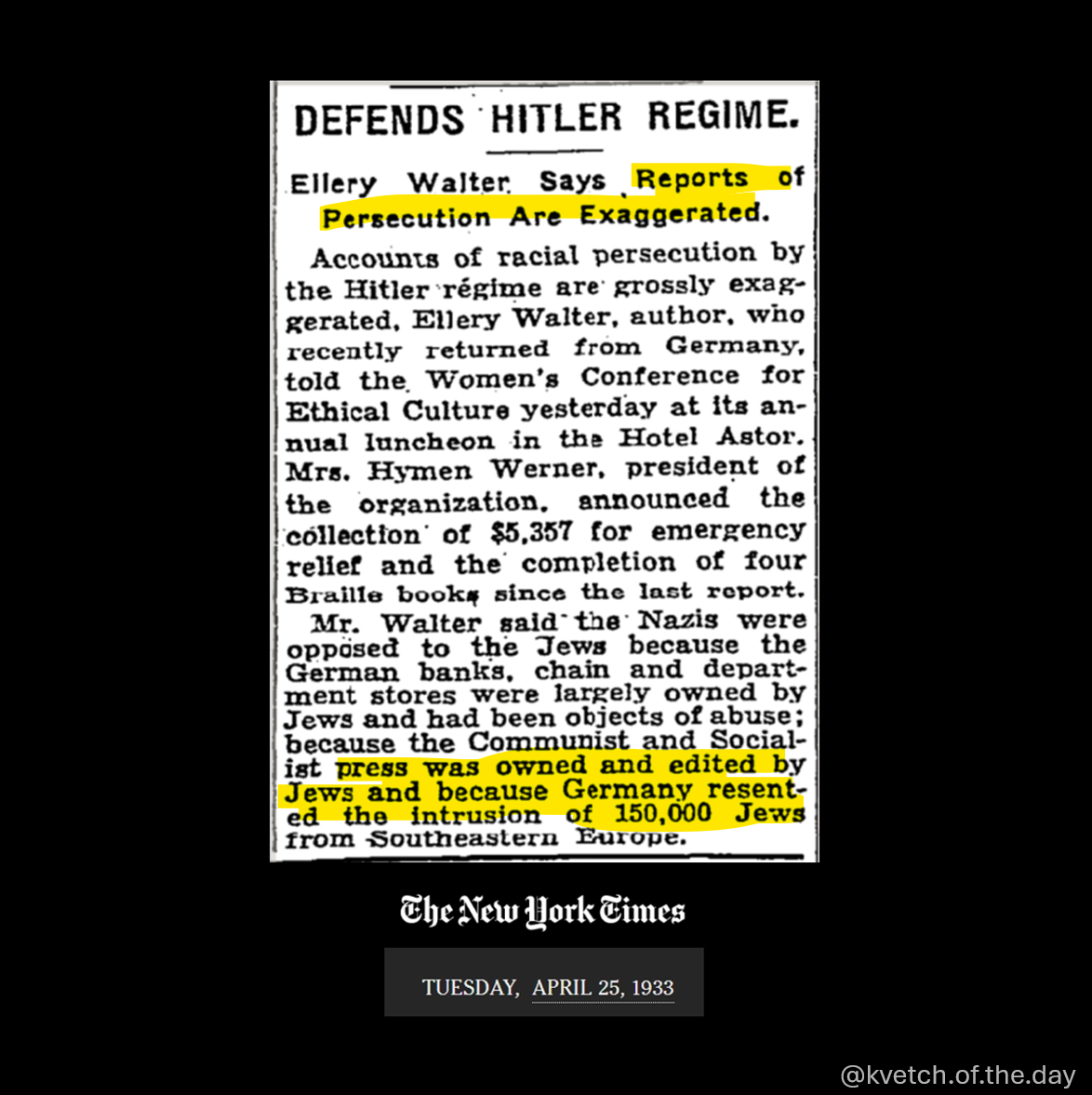 1933-04-25 · The New York Times · ✓Defends Hitler Regime
Scans: kvetch-of-the-day news archive.